
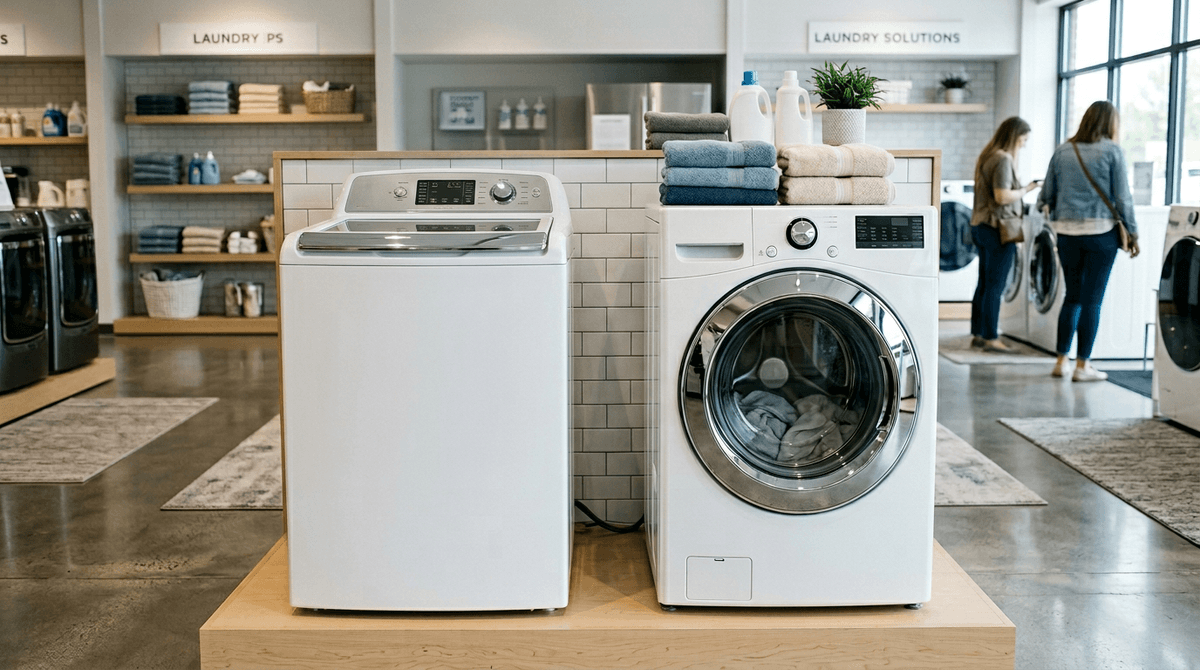
Front-load washers often use less total energy per load than top-load models, mainly because they use less water and can spin out more moisture before drying.
For your own wash frequency and tariff, use the WattSizing Calculator.
Quick Comparison
| Topic | Top Load Washer | Front Load Washer |
|---|---|---|
| Typical machine power during cycle | 400 - 1,000 W | 300 - 900 W |
| Water use tendency | Higher | Lower |
| Spin extraction efficiency | Moderate | Usually higher |
| Typical total energy per load | 0.5 - 1.2 kWh (cold wash lower) | 0.3 - 0.8 kWh (cold wash lower) |
| Best fit | Faster loading convenience | Better efficiency and fabric care |
Comparison Table: Example Laundry Loads
Assume electricity rate of $0.16/kWh.
| Laundry Case | Top Load Example | Front Load Example | Cost Comparison |
|---|---|---|---|
| Cold wash mixed clothes | 0.60 kWh/load | 0.40 kWh/load | $0.10 vs $0.06 |
| Warm wash family load | 0.95 kWh/load | 0.65 kWh/load | $0.15 vs $0.10 |
| Heavy bedding load | 1.20 kWh/load | 0.85 kWh/load | $0.19 vs $0.14 |
Worked Scenarios
1) Moderate Household Laundry
Assume 20 loads/month, mostly cold to warm:
- Top load average: 0.8 kWh/load
- Front load average: 0.55 kWh/load
Monthly energy:
- Top load: 16 kWh
- Front load: 11 kWh
Monthly electricity cost at $0.16/kWh:
- Top load: $2.56
- Front load: $1.76
Difference: $0.80/month at washer level alone.
2) Including Dryer Impact
Front-loaders often remove more water in spin. If dryer runtime drops by 10 minutes/load for 20 loads/month and dryer draw averages 3.0 kW:
- Dryer savings:
3.0 x (10/60) x 20 = 10 kWh/month - Extra cost avoided:
10 x 0.16 = $1.60/month
Combined washer + dryer savings can be more meaningful than washer-only savings.
Practical Decision Guidance
- If energy and water efficiency are priorities, front-load models usually lead.
- Use cold water where fabric care allows; hot water dominates laundry energy.
- Match washer capacity to household size to avoid partial-load waste.
- Maintenance and proper detergent use matter for both types.
Related reading:
FAQs
Do top-load washers always use more electricity?
Not always for machine watts alone, but they often use more water, which can increase total energy.
Is front-load efficiency only from the motor?
No. Lower water use and better spin extraction are major contributors.
How much does water temperature matter?
A lot. Warm/hot cycles can significantly increase total load energy compared with cold cycles.
Are high-efficiency top-loaders competitive?
Some are much better than older top-load models, but front-loaders often still lead on total per-load efficiency.
CTA
Want a laundry-specific estimate with your load count, water temperature, and dryer use? Use the WattSizing Calculator to compare annual cost by washer type.


