
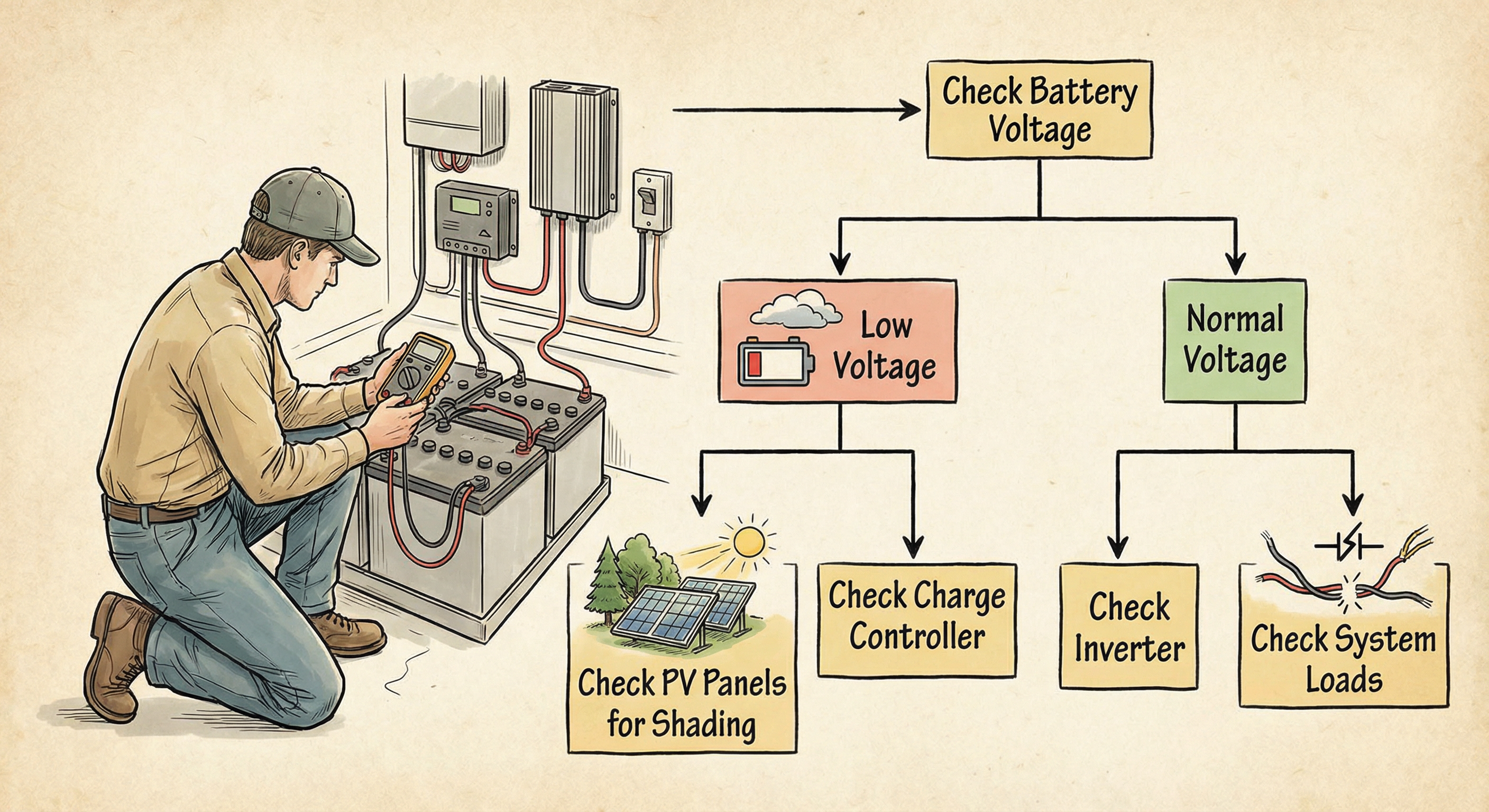
Even the best systems have bad days. Here is a flowchart-style guide to fixing the most common gremlins in off-grid solar.
Problem 1: "My Batteries Won't Charge"
Symptoms: Sun is out, but battery voltage is low (e.g., 12.2V) and not rising.
-
Check the Controller: Is the "Charging" LED on?
- NO: Check the connection from Panels -> Controller. Is the breaker tripped? Is a wire loose? Measure voltage at the controller input terminals with a multimeter.
- YES: Check the connection from Controller -> Battery. Is the fuse blown?
-
Check Panel Voltage: Disconnect the panels. Measure Voc (Open Circuit Voltage).
- Zero Volts: Broken wire, bad connector (MC4), or blown fuse in combiner box.
- Low Volts: Shading? Dirt? One bad panel in a series string?
-
Check Battery Voltage: Is the battery too low? Some controllers won't start if the battery is below 9V (for a 12V system). You might need to "jump start" the battery with an AC charger to wake up the controller.
Problem 2: "My Inverter Keeps Beeping/Shutting Down"
Symptoms: You turn on the microwave, and the inverter screams and dies.
-
Low Voltage Disconnect (LVD): This is the #1 cause.
- When a heavy load starts, battery voltage sags. If it touches the cutoff (e.g., 10.5V), the inverter protects the battery and shuts off.
- Fix: Check your wire gauge. Undersized wires cause massive voltage drop. Tighten all connections. Charge batteries fully.
-
Overload: Are you trying to pull 2500W from a 2000W inverter?
- Fix: Check the surge rating. A microwave might be rated 1000W cooking power but pull 1800W electrical power.
-
Overheating: Is the fan running? Is the inverter in a hot closet?
- Fix: Improve ventilation.
Problem 3: "My Batteries Die Too Fast at Night"
Symptoms: Full at sunset, empty by midnight.
-
Old Batteries: Capacity fade. A 100Ah battery might only hold 20Ah now.
- Test: Load test the battery.
-
Phantom Loads: Something is eating power.
- Culprits: Inverter standby power (can be 50W+!), wall warts, TV standby lights, propane detectors.
- Fix: Turn off the inverter when not in use. Install switches for phantom loads.
-
Not Actually Full: Your controller says "Float" (Full), but maybe it transitioned too early.
- Fix: Check absorption time settings. Lead acid needs 2-4 hours of absorption charging to truly reach 100%.
Problem 4: "I Smell Rotten Eggs"
Symptoms: Sulfur smell near batteries.
- DANGER: This is hydrogen sulfide gas from a boiling lead-acid battery.
- Cause: Overcharging (voltage too high) or a shorted cell.
- Action: Turn off everything immediately. Ventilate the room. Do not create sparks. Check charge controller settings (Voltage setpoint too high?). Replace the bad battery.
Tools You Need
- Multimeter: Essential for measuring Voltage and Continuity.
- Clamp Meter: Measures Amps (Current) without cutting wires.
- Hydrometer: (For flooded lead acid) Measures specific gravity of electrolyte.
Conclusion
90% of solar problems are loose connections or bad settings. Check your wires first, then your manual.
For preventative care, use our Off-Grid Solar Maintenance Checklist.


