
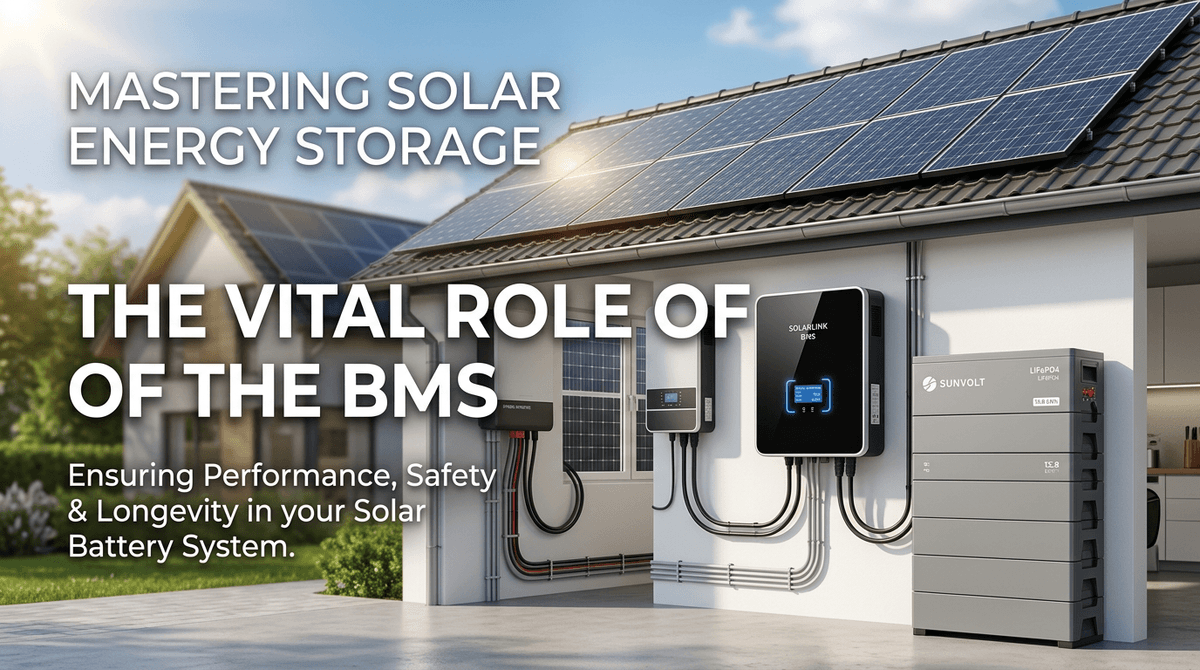
If you are building a modern off-grid solar system, chances are you are using Lithium Iron Phosphate (LiFePO4) batteries. They are lighter, last longer, and perform significantly better than traditional lead-acid batteries. However, unlike old-school lead-acid batteries, lithium batteries require a "brain" to operate safely.
This brain is called a Battery Management System (BMS).
A BMS is an electronic circuit board built inside (or attached to) a lithium battery pack. Its primary job is to monitor the health of the battery cells and protect them from operating outside their safe parameters. Without a BMS, a lithium battery can quickly destroy itself—or worse, become a severe fire hazard.
In this comprehensive guide, we will explore exactly what a BMS does, why it is an absolute necessity, and what features you should look for when buying a solar battery.
If you are currently designing your solar system, don't forget to use our WattSizing Solar Calculator to ensure your battery bank is perfectly sized for your needs!
The 5 Core Functions of a Battery Management System (BMS)
A high-quality BMS acts as a bodyguard for your battery. It constantly monitors voltage, current, and temperature, and will physically disconnect the battery from your solar system if it detects a dangerous condition.
Here are the five primary ways a BMS protects your investment:
1. Over-Voltage Protection (Overcharge Protection)
Lithium cells are incredibly sensitive to high voltages. If a solar charge controller malfunctions and pumps too much voltage into a lithium battery, the cells can swell, vent toxic gas, or catch fire.
The BMS constantly monitors the voltage of every individual cell inside the battery. If any cell exceeds its maximum safe voltage (typically around 3.65V for LiFePO4), the BMS will open its internal solid-state switches (MOSFETs) and stop the charging process immediately.
2. Under-Voltage Protection (Over-Discharge Protection)
Just as overcharging is dangerous, draining a lithium battery too far will cause permanent, irreversible chemical damage to the cells. If a LiFePO4 cell drops below 2.5V, it may never hold a charge again.
If you accidentally leave a heavy load running (like an inverter or a fridge) for too long, the BMS will detect the dropping voltage. Before the cells reach a critical state, the BMS will cut off the power output, shutting down your system to save the battery.
3. Over-Current Protection (Short Circuit Protection)
If a wire chafes and creates a short circuit, or if you try to pull 300 amps out of a battery only rated for 100 amps, the internal components of the battery will overheat and melt.
The BMS monitors the exact amount of current (amps) flowing in and out of the battery. If it detects a massive surge of current—such as a short circuit—it will shut down the battery in a fraction of a second, preventing a catastrophic fire.
4. Temperature Protection (High and Low)
Lithium batteries are sensitive to extreme temperatures, particularly when charging.
- High Temp: If the battery gets too hot (usually above 140°F / 60°C), the BMS will shut it down to prevent thermal runaway.
- Low Temp: This is critical for off-grid users. You cannot charge a lithium battery below freezing (32°F / 0°C). Doing so will cause lithium plating inside the cells, destroying the battery instantly. A good BMS includes a low-temperature cutoff sensor that will prevent the battery from accepting a charge if the ambient temperature is too cold, while still allowing it to discharge (provide power).
5. Cell Balancing
A 12V LiFePO4 battery is actually made up of four 3.2V cells wired in series. Over time, as the battery charges and discharges, these cells can become unbalanced. For example, Cell 1 might be at 3.4V while Cell 2 is only at 3.2V.
If the cells are unbalanced, the battery cannot reach its full capacity. The BMS performs "cell balancing" by bleeding off a tiny amount of power from the highest-voltage cells, allowing the lower-voltage cells to catch up during the charging cycle. This ensures the battery pack remains healthy and provides its full rated capacity for years.
Do Lead-Acid Batteries Need a BMS?
Generally, no. Traditional Flooded Lead-Acid, AGM, and Gel batteries do not have an internal BMS.
Lead-acid chemistry is much more forgiving. If you slightly overcharge a lead-acid battery, it will simply boil off some of its electrolyte (which can be refilled in flooded types). If you over-discharge it, it will lose some lifespan, but it won't instantly destroy itself.
Because lithium chemistry is so volatile and sensitive, a BMS is strictly required.
Smart BMS vs. Dumb BMS
When shopping for lithium solar batteries, you will encounter two types of Battery Management Systems:
"Dumb" (Standard) BMS
This is the standard BMS found in most budget-friendly drop-in replacement batteries (like cheaper brands on Amazon). It performs all the essential safety functions—over/under voltage, over-current, and temperature protection—but it operates silently in the background. You cannot see what it is doing, and you cannot adjust its parameters.
"Smart" BMS with Bluetooth/Comms
Premium batteries (like Victron, EG4, or high-end SOK batteries) feature a "Smart BMS." These systems include Bluetooth modules or communication ports (RS485/CAN bus) that allow the battery to talk to your smartphone or your solar inverter.
Advantages of a Smart BMS:
- Real-Time Data: You can open an app on your phone and see the exact state of charge (SoC), the voltage of every individual cell, and the current temperature.
- Closed-Loop Communication: The BMS can talk directly to your solar charge controller. If the battery is getting full, the BMS can tell the charger to slow down. This creates a perfectly synchronized, highly efficient system.
- Customizable Parameters: Advanced users can adjust the cutoff voltages and balancing parameters to suit their specific needs.
What to Look for When Buying a Battery with a BMS
Not all Battery Management Systems are created equal. If you are buying a drop-in lithium battery for your RV or cabin, make sure the internal BMS meets these criteria:
- Continuous Discharge Rating: The BMS dictates how much power you can pull from the battery at once. If you have a 100Ah battery with a 50A BMS, you can only pull 600 watts continuously. If you want to run a microwave or AC, look for a battery with at least a 100A or 200A continuous discharge BMS.
- Low-Temperature Charging Cutoff: This is non-negotiable if your batteries will be stored outside or in an unheated space. Cheaper batteries often omit this sensor to save money. Always verify the BMS has low-temp protection.
- Self-Heating Function (Optional): Some advanced BMS units not only stop charging in freezing weather but will actually divert incoming solar power to internal heating pads, warming the battery up to a safe temperature before allowing a charge.
Conclusion
A Battery Management System is the unsung hero of the modern off-grid solar revolution. It takes the volatile, highly sensitive chemistry of lithium batteries and turns them into incredibly safe, reliable, and long-lasting power storage solutions.
Never buy a lithium battery without a built-in BMS, and always ensure the BMS is rated to handle the power demands of your specific system.
Ready to build your system? Head over to the WattSizing Solar Calculator to perfectly size your solar array, battery bank, and inverter!
Frequently Asked Questions (FAQ)
Can I bypass a tripped BMS?
If your BMS has shut down the battery due to low voltage, it will usually "wake up" automatically once a charge voltage is applied. Some solar charge controllers require a 12V jump-start (using a portable jump pack or another battery) to "wake up" a sleeping BMS. You should never physically bypass or remove the BMS to access the raw cells.
Does a BMS balance cells automatically?
Yes, a quality BMS will automatically balance the internal cells, usually at the very top of the charge cycle (when the battery is nearly 100% full). This is why it is recommended to occasionally charge your lithium batteries to 100% and let them sit for an hour, allowing the BMS time to perform its balancing act.
Can a BMS break or fail?
Yes. Because a BMS is an electronic circuit board, it can fail due to manufacturing defects, extreme heat, or massive electrical surges (like a lightning strike). If the BMS fails, the battery will usually read 0 volts at the terminals, even if the internal cells are perfectly healthy. In premium batteries, the BMS can be unscrewed and replaced without throwing away the entire battery.


