
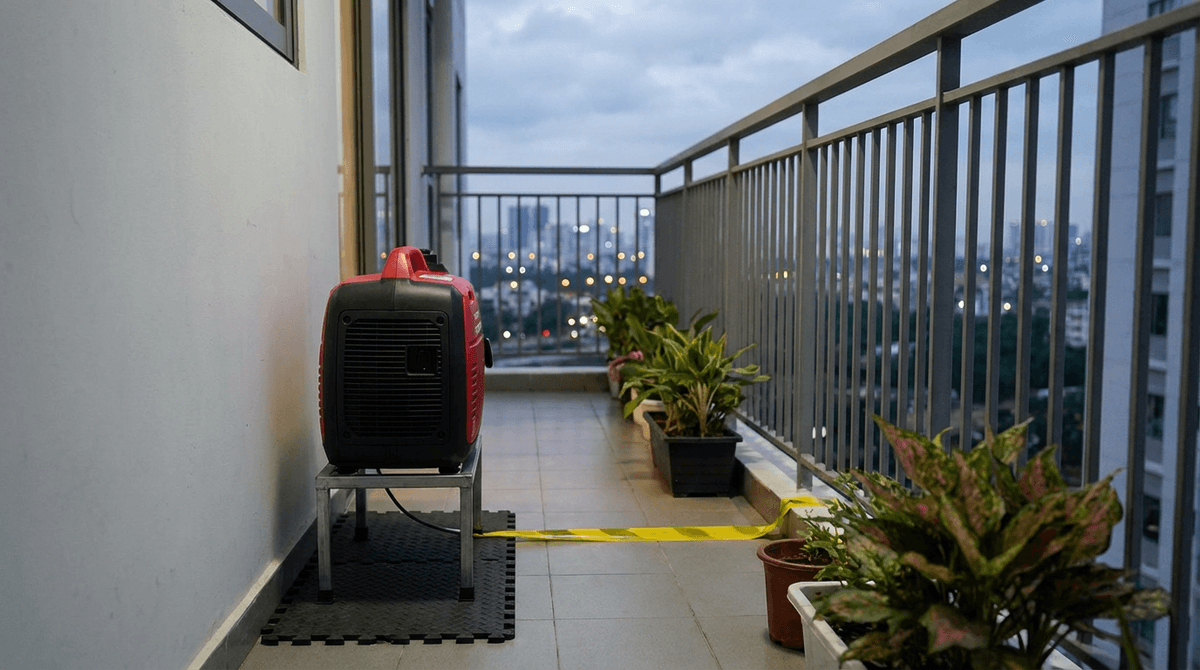
For most apartments, backup planning is about essentials like refrigeration, internet, lights, fans, and device charging. A practical generator range is usually 2,000 to 4,500 watts, with higher capacity needed only for larger appliances.
Use the WattSizing Calculator to size from your actual appliance list.
Quick Answer
- Basic essentials: 2,000-2,500 W
- Essentials + larger fridge + occasional microwave: 3,000-4,000 W
- Heavier backup loads: 4,500+ W
Apartment-Specific Constraints
Generator sizing in apartments is not just electrical math. You must also consider:
- Building rules about fuel storage and outdoor operation
- Noise limits and quiet-hour policies
- Safe placement and ventilation requirements
- Extension cord routing and transfer options
In many apartment situations, a battery-based power station may be easier to operate than a fuel generator.
Typical Essential Loads
| Apartment Load | Typical Running Watts | Typical Starting Watts |
|---|---|---|
| Refrigerator | 120 - 250 W | 600 - 1,200 W |
| Router + modem | 15 - 40 W | 15 - 40 W |
| LED lighting (several rooms) | 40 - 150 W | 40 - 150 W |
| Laptop + phone charging | 40 - 150 W | 40 - 150 W |
| Box/pedestal fan | 40 - 100 W | 80 - 200 W |
| Microwave (small-medium) | 800 - 1,500 W | 1,000 - 1,800 W |
Most essential-only setups stay under 1,000 W continuous, but surge plus occasional cooking loads drive recommended generator size higher.
Clear Size Recommendations
- 2,000-2,500 W: Router, lights, charging, small fan, careful fridge cycling
- 3,000-4,000 W: More comfortable essentials with fridge and occasional microwave
- 4,500 W+: Multiple kitchen loads or larger surge-heavy appliances
If your apartment prohibits fuel generators, use this same load math to size a battery inverter system.
Worked Examples
Example 1: Essential Communications + Cooling
- Router/modem: 30 W
- Two fans: 120 W
- LED lights: 80 W
- Laptop + phones: 100 W
- Fridge average while cycling: 180 W
- Total running: 510 W
A 2,000 to 2,500 W unit is usually enough with surge headroom.
Example 2: Essentials + Light Kitchen Use
Same as above plus periodic 1,100 W microwave use. A 3,000 to 3,500 W generator is typically more practical.
Safety and Compliance Notes
- Never run fuel generators indoors, on balconies, or near windows.
- Follow building policy and local code first.
- Use CO alarms and weather-protected outdoor placement.
- Keep extension runs short and properly rated.
For apartment-friendly alternatives, see Solar Panels for Apartments and Balconies and Solar Generator vs DIY Solar Cost.
FAQs
Can I run a portable generator on an apartment balcony?
In most cases, no. It is often restricted for fire, fumes, and CO safety reasons. Always follow building rules and local regulations.
Is 2,000 watts enough for apartment backup?
Often yes for communications, lights, charging, and some refrigeration support. It is usually not enough for multiple high-watt kitchen appliances at once.
Should I choose a battery power station instead?
For many apartment residents, yes. Battery systems are quieter, fume-free, and easier to operate where fuel generators are restricted.
CTA
Build a realistic outage load list and size your backup system in minutes with the WattSizing Calculator.


