
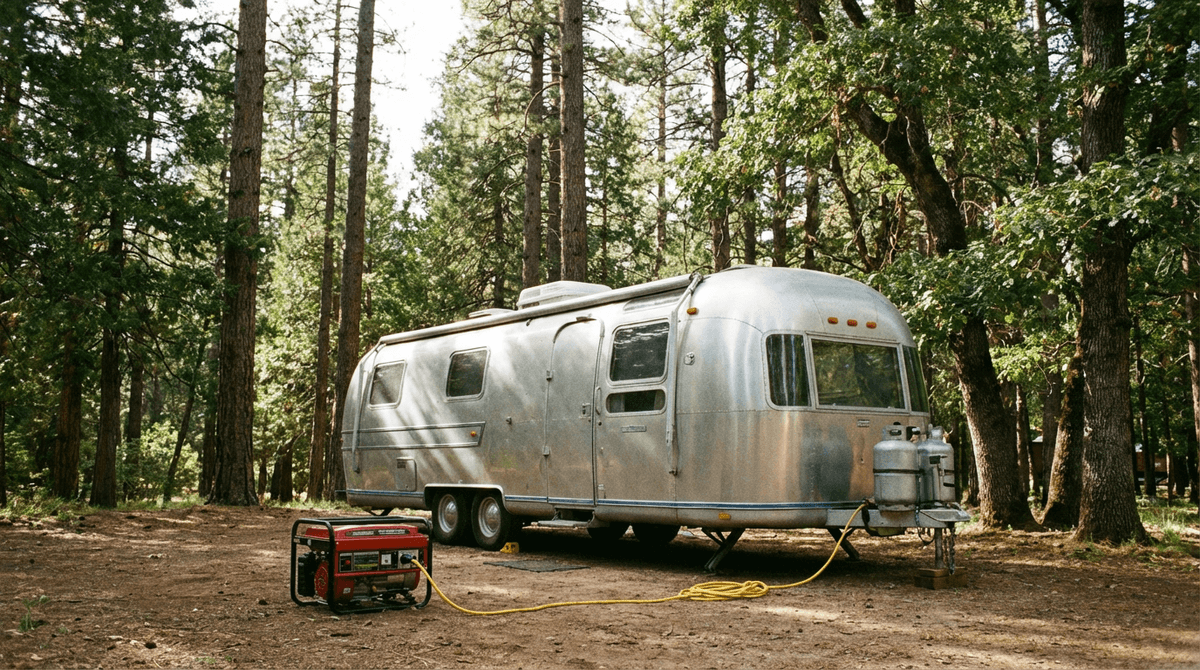
Most camping trailers run comfortably on a 2,000 to 4,000 watt generator, while trailers with roof AC typically need 3,000 to 4,500 watts (or soft-start support) for reliable startup.
For exact load matching, use the WattSizing Calculator.
Quick Answer
If you are running lights, outlets, and battery charging only, a 2,000 to 2,500 watt inverter generator is often enough.
If you need to run a 13.5k BTU roof AC, plan around 3,000 to 4,000 watts minimum, and more if you also run microwave or water heater at the same time.
What Drives Generator Size in a Trailer
The main factor is whether you run the air conditioner:
- No AC use: generator size stays small and quiet.
- AC use: startup surge becomes the critical limit.
Other meaningful loads:
- Converter/charger charging depleted batteries
- Microwave
- Coffee maker or electric kettle
- Electric water heater element (if enabled on electric mode)
For deeper trailer solar + battery strategy, see Off-Grid Solar RV Campervan Sizing.
Trailer Generator Sizing Table
| Trailer Use Case | Typical Running Watts | Practical Starting Requirement |
|---|---|---|
| Lights, outlets, battery charging only | 400 - 1200 W | 700 - 1700 W |
| Basic trailer + microwave occasionally | 900 - 2200 W | 1400 - 3000 W |
| 13.5k BTU roof AC + basics | 1600 - 3000 W | 2800 - 4500 W |
| 15k BTU roof AC + basics | 2000 - 3500 W | 3500 - 5500 W |
| AC + microwave overlap (not ideal) | 2500 - 4200 W | 4200 - 6500 W |
Soft-start devices can reduce AC startup spikes significantly in many trailers.
Calculation Example
Example trailer loads:
- 13.5k BTU roof AC: 1,600 W running / 3,200 W start
- Converter/charger: 500 W
- Lights + outlets + router: 200 W
- Fridge controls (on propane mode): 120 W
Step 1: Running total
1,600 + 500 + 200 + 120 = 2,420 W
Step 2: Surge gap from AC
3,200 - 1,600 = 1,600 W
Step 3: Startup-capable minimum
2,420 + 1,600 = 4,020 W
Step 4: Add 15% margin
4,020 x 1.15 = 4,623 W
Practical choice: a 4,500 to 5,000 watt class unit, or two paralleled inverter generators in that combined range.
Campground-Friendly Tips
- Choose inverter generators for quieter operation and cleaner power.
- Avoid AC + microwave overlap unless your generator margin is strong.
- Run heavy charging in daytime so evening loads stay stable and quiet.
- Check campground rules for permitted generator hours and decibel limits.
FAQs
Is a 2,000 watt generator enough for a camping trailer?
Often yes for battery charging and light loads, but usually not enough for roof AC startup.
Can I run a trailer AC with two small generators in parallel?
Yes, many campers do this. Combined output can meet AC startup while keeping each unit portable.
Do I need a 30A or 50A generator for my trailer?
Match your trailer service and expected loads. A trailer with 50A service does not always need a full 50A-capable generator if you are only running selected loads.
CTA
Want to avoid overbuying or undersizing? Use the WattSizing Calculator to map your trailer loads and choose a generator size that works in real camping conditions.


