
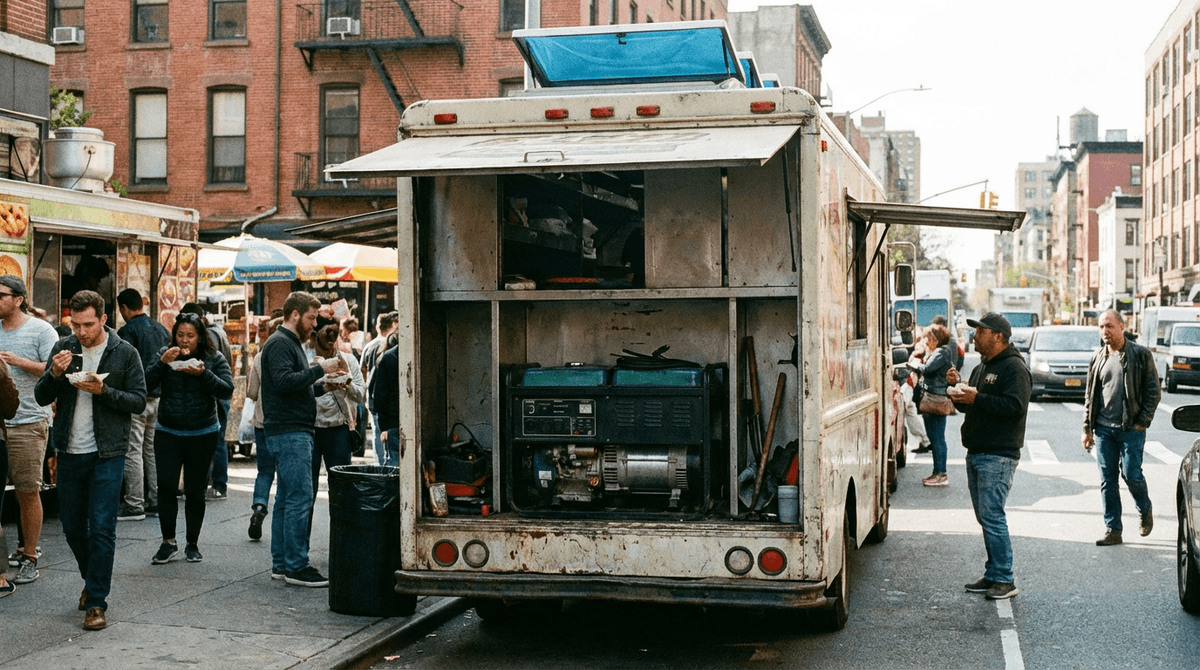
Food truck generator sizing is business-critical: undersize it and service slows down; oversize it and fuel costs climb all season. The right target is enough capacity for rush-hour loads with stable voltage for refrigeration and POS equipment.
Run your menu and equipment mix in the WattSizing Calculator.
Quick Answer
Most food trucks need a 7,500 to 15,000 watt generator, with exact size driven by whether cooking is mostly electric or propane-assisted.
Sizing Explanation
Start with what runs during your busiest hour:
- Continuous cold chain loads (fridge, freezer, prep cooler)
- Cooking appliances in active use
- Ventilation, hood fans, and lights
- POS, chargers, and small electronics
- Startup and cycling spikes, plus 20% margin
If your truck uses electric griddles, fryers, or high-watt warmers, generator requirements rise quickly.
Related reads:
Food Truck Generator Sizing Table
| Food Truck Profile | Typical Running Watts | Typical Peak Watts | Recommended Generator Size |
|---|---|---|---|
| Light prep + refrigeration + POS | 2,000 - 4,000 W | 4,000 - 6,500 W | 5,000 - 8,000 W |
| Mixed menu with one electric cooking unit | 4,000 - 7,000 W | 7,000 - 10,500 W | 8,000 - 12,000 W |
| Heavy electric cooking + multiple cold units | 7,000 - 11,000 W | 11,000 - 16,000 W | 12,000 - 18,000 W |
| Large trailer-style kitchen service | 10,000 - 16,000 W | 16,000 - 24,000 W | 18,000 - 28,000 W |
Worked Example
Your truck load during lunch rush:
- Refrigerator + freezer: 1,100 W run / 2,000 W start
- Prep cooler: 450 W run / 800 W start
- Electric griddle: 2,200 W
- Hood fan + vent: 700 W
- Warmers + POS + lighting: 900 W
Calculation:
- Continuous load:
1,100 + 450 + 2,200 + 700 + 900 = 5,350 W - Peak moment (cold equipment cycling + active cooking): about 6,700 W
- Add 20% service margin:
6,700 x 1.2 = 8,040 W
Practical pick: 9,000 to 10,000 W generator.
Practical Service Tips
- Prioritize propane for high-heat cooking when possible to reduce electrical demand.
- Keep cold-chain loads on dedicated circuits to protect food safety.
- Schedule battery charging and nonessential loads outside peak service windows.
- Log fuel burn per shift so you can plan runtime with confidence.
FAQs
Can a 5,000W generator run a food truck?
Only for lighter setups with limited electric cooking. Most revenue-focused trucks need more overhead.
Should I choose inverter or conventional generator?
Inverter systems are quieter and cleaner for electronics, but many larger trucks use robust commercial units for higher capacity.
Do I need separate startup calculations for fridges and freezers?
Yes. Compressor cycling can overlap with cooking demand and cause nuisance trips if unaccounted for.
Is 120V enough for food truck equipment?
Some setups are 120V-only, but many need 120/240V split-phase service. Confirm appliance and panel requirements before purchase.
CTA
Planning power for smooth service and safe food handling? Use the WattSizing Calculator to size your generator around real menu-time loads and operating hours.


