
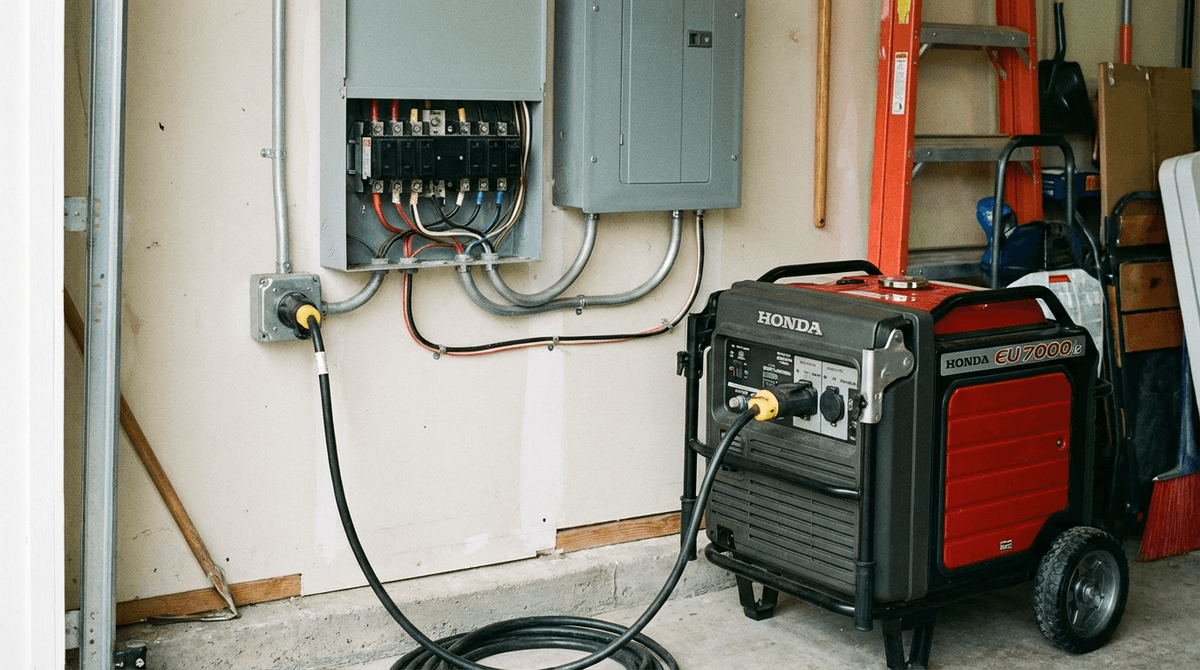
Most homes need a generator in the 5,000 to 9,000 running watt range to power essential circuits comfortably, depending on whether you include major motor loads like a sump pump or well pump.
Build your load list quickly with the WattSizing Calculator.
Quick Answer
For a typical essential-circuits panel (refrigerator, lights, internet, outlets, and furnace blower), a 6,000 to 7,500 watt generator is a practical starting point.
If you add larger motor loads (well pump, sump pump, larger freezer), expect to size up into the 7,500 to 10,000+ watt range.
What Counts as "Essential Circuits"?
Most homeowners include:
- Refrigerator and/or freezer
- Kitchen and hallway lights
- Internet modem + router
- A few general-use outlets
- Furnace blower or boiler controls
- Sump pump or well pump (if applicable)
The biggest sizing mistake is treating this as only running watts. Motor-based loads can start at much higher wattage for a short time.
Essential Circuits Sizing Table
| Essential Circuit Group | Typical Running Watts | Typical Starting Watts |
|---|---|---|
| Core essentials (fridge, lights, internet, outlets) | 700 - 1800 W | 1200 - 2600 W |
| Core + furnace blower | 1200 - 2600 W | 2200 - 4200 W |
| Core + sump pump | 1300 - 3000 W | 3000 - 5500 W |
| Core + freezer + furnace blower | 1500 - 3200 W | 2600 - 5000 W |
| Core + well pump + freezer | 1800 - 3800 W | 4200 - 7500 W |
If your plan includes electric water heating, check What Size Generator for Electric Water Heater, since that load can dominate your total.
Calculation Example
Example essential panel:
- Refrigerator: 250 W running / 800 W start
- Freezer: 400 W running / 1,100 W start
- Furnace blower: 700 W running / 1,400 W start
- Lighting + internet + outlets: 500 W running / 600 W start
- Sump pump: 900 W running / 2,200 W start
Step 1: Running total
250 + 400 + 700 + 500 + 900 = 2,750 W
Step 2: Largest surge gap
Sump pump surge gap = 2,200 - 900 = 1,300 W
Step 3: Startup-capable requirement
2,750 + 1,300 = 4,050 W
Step 4: Add 25% headroom
4,050 x 1.25 = 5,060 W
Practical selection: 5,500 to 6,500 running watts, with enough surge rating for motor starts.
Practical Selection Rules
- Prioritize clean 120V output and sufficient surge handling.
- Choose a model that can run at 50 to 80% load during normal backup.
- If you need both 120V and 240V loads, confirm split-phase capability.
- Use a transfer switch/interlock and have a licensed electrician verify layout.
FAQs
Is a 7,500 watt generator enough for most homes' essentials?
For many homes, yes. It often covers refrigeration, lighting, internet, and one or two motor loads if managed well.
Can I run central AC on an essential-circuits generator?
Usually not on smaller essential-only setups. Central AC often pushes you into a much larger standby class.
Should I include every outlet in the house?
No. Start with true essentials and only add circuits with clear outage value.
CTA
Ready to size your backup system with less guesswork? Use the WattSizing Calculator to model your exact circuit list and choose the right generator size.


