
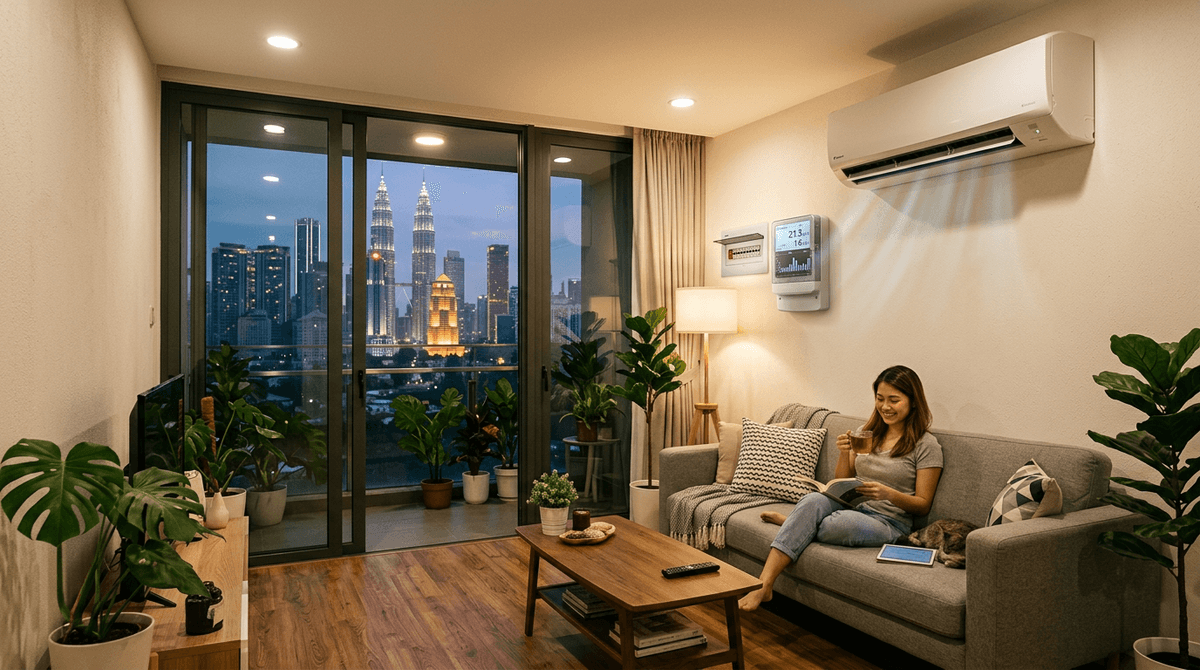
Malaysia is not a dry-climate textbook. When outdoor dew points stay high, your air conditioner spends a long time stripping moisture before the room feels cold—so compressor hours (and kWh) climb faster than a wattage label suggests. Most international “average home electricity” pages ignore that and paste one kWh band for all of Southeast Asia.
Bottom line (illustrative): Many urban condos and apartments fall roughly 200–550 kWh/month depending on AC habits and efficiency; large landed homes with multiple splits and poor shading can exceed 600–1,500+ kWh/month in the hottest months. Your PDF bill beats any blog table.
Tools: How to Calculate Electricity Bill from kWh · How to Calculate kWh from Watts and Hours · WattSizing Calculator
Peninsular Malaysia (TNB) versus Sarawak and Sabah
Tenaga Nasional Berhad (TNB) covers most of Peninsular Malaysia. Sarawak is typically served by Sarawak Energy; Sabah has a different distribution landscape. Tariff names, fuel-adjustment lines, and bill layouts are not identical—so a forum thread from KL may not match a Kuching bill line-for-line.
For pricing oversight context in Peninsular Malaysia, Suruhanjaya Tenaga (ST) publishes materials at st.gov.my. Always confirm sen/kWh on TNB or Sarawak Energy portals for your account month.
Illustrative monthly kWh bands (not official statistics)
| Home profile | Typical kWh/month (illustrative) |
|---|---|
| Small flat, fans-first, limited AC | 120–280 |
| Mid condo, regular inverter AC use | 280–520 |
| Large condo / terraced, heavy cooling | 520–900 |
| Large landed, multiple ACs, pool pump | 900–1,500+ in peak heat |
What moves you up or down: setpoints, filter maintenance, western sun on glass, occupancy, electric water heating (if used), second fridge/freezer, and always-on entertainment or work-from-home gear.
How to read your bill like a benchmark, not a lottery ticket
- Note billing days and total kWh—compute kWh per day before you compare months.
- Scan for fixed or semi-fixed lines versus kWh-scaled lines; cutting kWh does not shrink fixed portions.
- If your bill shows fuel adjustment or regulatory components, treat blog “one price per kWh” posts as incomplete.
Domestic tariff structures have been updated in regulatory periods—use your utility’s tariff notice for the month, not a screenshot from last year.
What thin “average kWh” articles usually skip
- Latent load: humidity forces longer AC runs at the same thermostat number.
- Monsoon seasons: cloudier days can change comfort behaviour (more indoor time, dehumidify modes).
- East vs West Malaysia: comparing ringgit totals without comparing kWh and utility is meaningless.
Worked example (illustration only)
If your bill shows 420 kWh over 30 days and an illustrative blended rate of MYR 0.45/kWh on the variable slice only:
420 × 0.45 ≈ MYR 189 before other monthly lines.
Cut 10% usage → 378 kWh → 378 × 0.45 ≈ MYR 170 at the same illustrative rate. Your real statement may include additional charges—use this only to practise arithmetic.
FAQs
Is there one official “national average kWh” for every Malaysian home?
No single number fits humid flats, landed pools, and East Malaysia together. Use official utility statistics where published, but prioritise your own rolling kWh per day.
Why is my bill high when I “only” run AC at night?
Night-only cooling can still mean many compressor hours if the building holds heat or outdoor units sit in poor airflow. kWh per day tells the truth.
Does solar net metering change how I interpret averages?
PV can lower grid import kWh while your total electrical demand stays high. Read import, export, and self-consumption context on your bill or inverter app if available.
Are inverter ACs always cheaper to run?
Usually yes versus old fixed-speed units if maintained—but oversized heads, dirty coils, and leaky doors erase the benefit.
How do I compare my usage fairly year to year?
Compare kWh per day for similar calendar months and note guests, new appliances, and work-from-home changes.
Where should I verify tariffs and consumer notices?
Start with TNB for Peninsular accounts and Sarawak Energy where applicable; use ST for regulatory pricing context.
Sources
CTA
Model appliance hours and monthly kWh in the WattSizing Calculator, then reconcile with your next TNB or SEB bill.


