
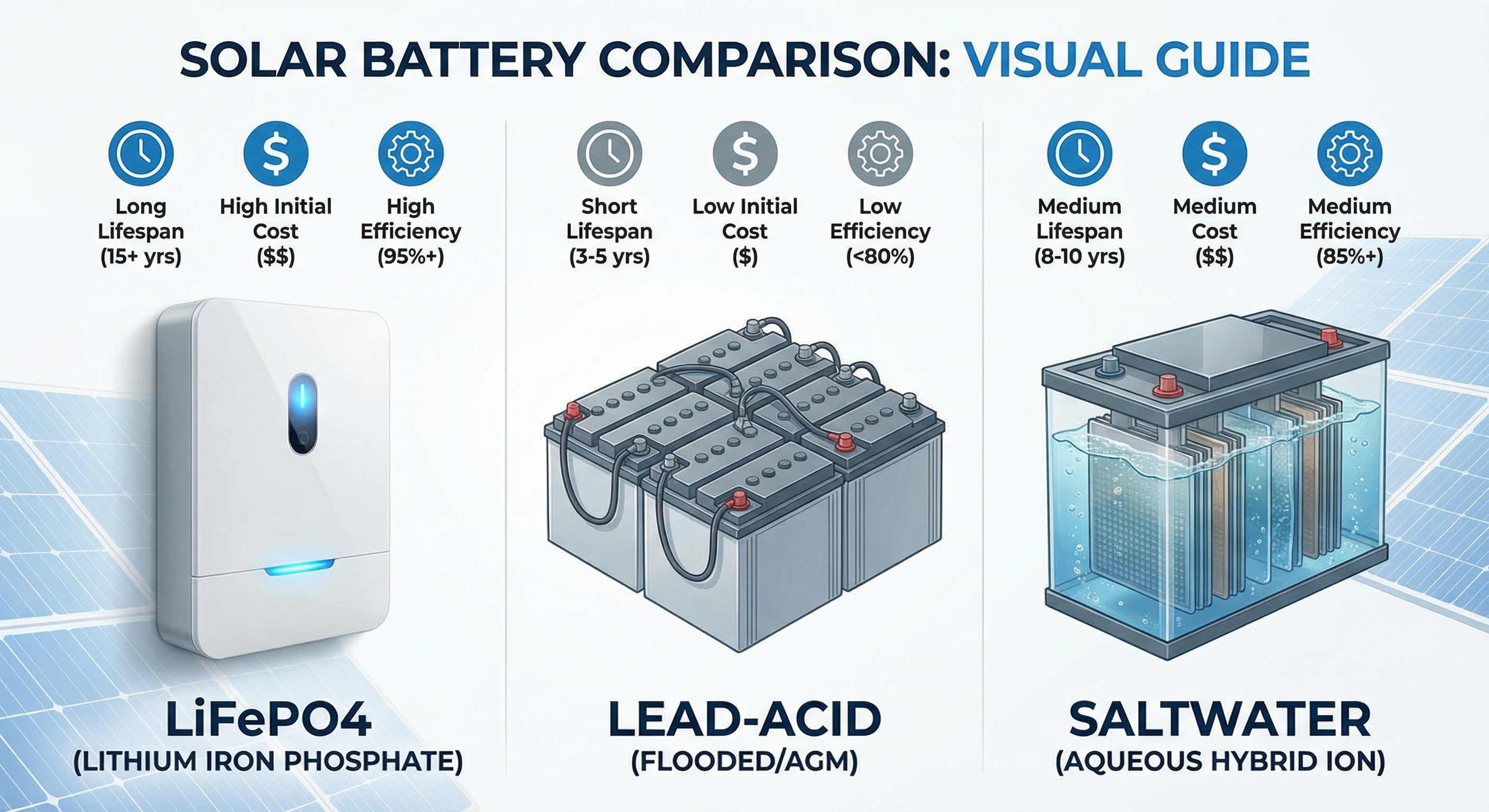
The battery bank is the heart of any off-grid solar system. While solar panels generate the power, the batteries determine whether you keep the lights on at night or during a storm. In 2026, the landscape of energy storage has shifted dramatically, with lithium technologies becoming the dominant force.
However, "best" is subjective. The right battery for a full-time off-grid home isn't necessarily the right one for a weekend hunting cabin. In this guide, we compare the three main contenders: Lithium Iron Phosphate (LiFePO4), Lead Acid (AGM/Gel/Flooded), and Saltwater batteries.
1. Lithium Iron Phosphate (LiFePO4)
In 2026, LiFePO4 (LFP) is widely considered the best overall choice for 90% of off-grid applications.
Pros
- Long Cycle Life: LFP batteries typically offer 3,000 to 6,000+ cycles at 80% Depth of Discharge (DoD). This translates to 10-15 years of daily use.
- High Depth of Discharge: You can safely use 80-100% of the battery's capacity without significant damage. A 100Ah LFP battery gives you nearly 100Ah of usable power.
- Efficiency: They have high round-trip efficiency (charging and discharging), meaning less energy is lost as heat.
- Weight: They are about 1/3 the weight of lead-acid batteries for the same usable capacity.
- Safety: Unlike other lithium chemistries (like NMC used in phones/EVs), LFP is extremely stable and not prone to thermal runaway (fire).
Cons
- Upfront Cost: Still more expensive initially than lead-acid, though the price has dropped significantly.
- Cold Weather Charging: You cannot charge LiFePO4 batteries below freezing (32°F / 0°C) without damaging them. Many modern batteries come with built-in heaters to solve this.
Best For: Full-time off-grid living, RVs, vans, and anyone who wants a "buy once, cry once" solution.
2. Lead Acid (Flooded, AGM, Gel)
The old guard. Lead-acid technology has been around for over 150 years.
Types
- Flooded (FLA): Cheapest, requires maintenance (adding distilled water), vents gases (needs ventilation).
- Sealed (AGM/Gel): Maintenance-free, safer, but more expensive than flooded.
Pros
- Low Upfront Cost: The cheapest way to get storage capacity today.
- Temperature Tolerance: Can be charged in sub-freezing temperatures (though efficiency drops).
- Recyclability: Highly recyclable infrastructure exists everywhere.
Cons
- Short Lifespan: Typically 300-500 cycles at 50% DoD. Expect to replace them every 3-5 years.
- Low Depth of Discharge: You should generally not discharge them below 50%. A 100Ah lead-acid battery only gives you 50Ah of usable power.
- Heavy: Extremely heavy and bulky.
- Voltage Sag: Voltage drops significantly under heavy load.
Best For: Backup power systems that are rarely used, budget builds, or extremely cold climates where heating lithium batteries isn't feasible.
3. Saltwater Batteries (Aqueous Hybrid Ion)
Saltwater batteries emerged as an eco-friendly alternative but have had a rocky commercial history. In 2026, they remain a niche but interesting option.
Pros
- Eco-Friendly: Made from non-toxic, abundant materials (saltwater electrolyte, manganese oxide). No heavy metals.
- Safety: Non-flammable and non-explosive.
- 100% Depth of Discharge: Can be fully discharged without damage.
Cons
- Low Power Density: They are physically huge and heavy for the amount of energy they store.
- Low C-Rate: They cannot charge or discharge quickly. You can't run high-surge appliances (like power tools or A/C) directly off them easily without a massive bank.
- Availability: Harder to find and fewer manufacturers compared to Lithium or Lead Acid.
Best For: Stationary, eco-conscious homes with low peak power demands and plenty of space for the battery bank.
Comparison: Cost of Ownership
Let's look at the real cost over 10 years for a system needing 5kWh of usable storage daily.
Option A: Lead Acid (AGM)
- Need 10kWh total capacity (50% DoD).
- Cost: ~$1,500.
- Lifespan: 3 years.
- Replacements in 10 years: 3 sets.
- Total 10-Year Cost: ~$4,500 + hassle of replacing.
Option B: LiFePO4
- Need ~6kWh total capacity (80% DoD).
- Cost: ~$2,000.
- Lifespan: 10+ years.
- Replacements: 0.
- Total 10-Year Cost: ~$2,000.
Note: Prices are estimates for 2026 context.
Conclusion
For almost every off-grid scenario in 2026, LiFePO4 is the winner. The higher upfront cost is quickly recovered by the longevity, efficiency, and lack of maintenance.
- Choose Lead Acid only if you are on a strict shoestring budget or need a system for a cabin you visit twice a year.
- Choose Saltwater only if environmental impact is your absolute #1 priority and you have low power needs.
Once you've chosen your battery, you need to know how to keep it healthy. Read The Truth About Solar Battery Lifespan and Degradation.
Also, ensure your system is wired correctly. Check out AC Coupling vs DC Coupling for Battery Storage to decide how to integrate your batteries.


