
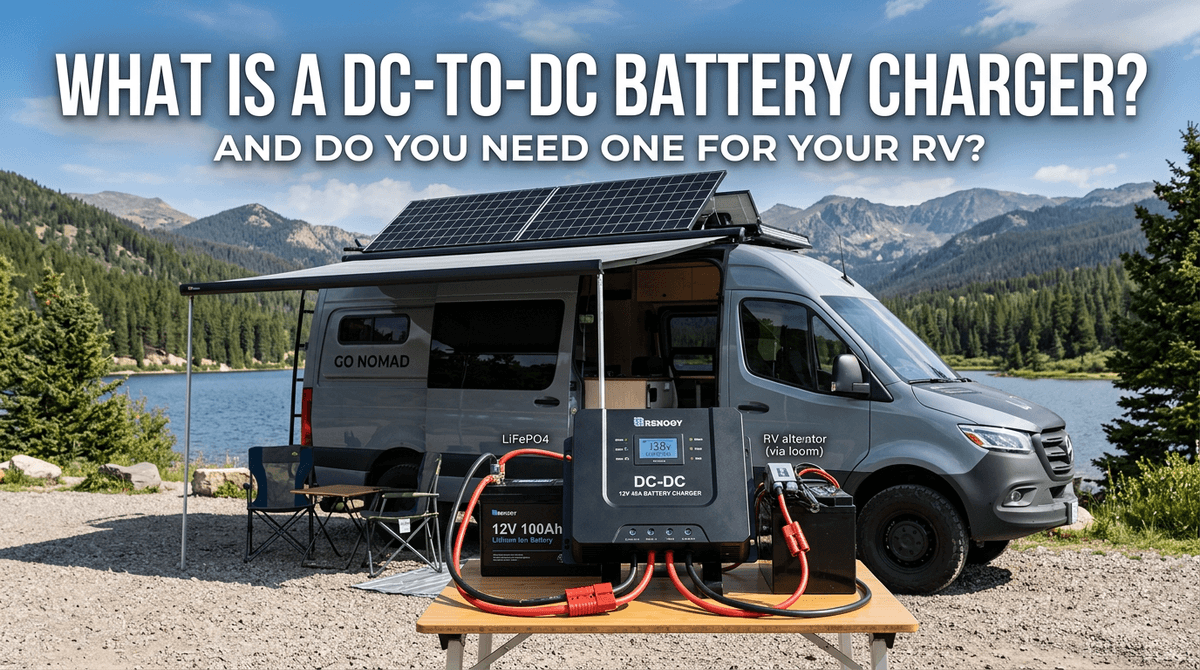
When building an off-grid electrical system for an RV, camper van, or overland vehicle, solar panels are usually the first thing that comes to mind. But what happens when it rains for three days straight? Or when you're parked in a heavily shaded forest?
This is where alternator charging comes in. Your vehicle's engine is essentially a massive generator. Tapping into that power while you drive is one of the most reliable ways to keep your "house" batteries topped up. However, directly connecting your house batteries to your starter battery is a recipe for disaster—especially if you use modern lithium batteries.
To do it safely and efficiently, you need a DC-to-DC battery charger.
In this comprehensive guide, we’ll explain exactly what a DC-to-DC charger is, why it is an absolute necessity for modern RV electrical systems, and how to choose the right size for your setup. If you are planning a full system build, don't forget to use our solar calculator to ensure all your components are perfectly matched.
What is a DC-to-DC Battery Charger?
A DC-to-DC battery charger (often called a battery-to-battery or B2B charger) is a smart electrical device installed between your vehicle's starter battery (alternator) and your auxiliary "house" battery bank.
Its primary job is to take the Direct Current (DC) voltage produced by your alternator, adjust it to the precise voltage profile required by your house batteries, and deliver a controlled, safe amount of current (Amps) to charge them while the engine is running.
Think of it as a smart middleman. It protects both the alternator from burning out and the house batteries from being undercharged or overcharged.
The Old Way: Battery Isolators vs. DC-to-DC Chargers
For decades, RV manufacturers used a simple device called a Smart Battery Isolator (Voltage Sensitive Relay or VSR).
A VSR is essentially a dumb switch. When you turn on your engine, the alternator charges the starter battery. Once the starter battery hits a certain voltage (usually around 13.3V), the VSR "clicks" closed, directly connecting the starter battery to the house batteries. The alternator then charges both simultaneously. When you turn the engine off, the VSR opens, separating the batteries so you don't accidentally drain your starter battery while camping.
Why VSRs No Longer Work (The Lithium Problem)
VSRs worked perfectly fine when house batteries were traditional Lead-Acid (AGM or Gel) and alternators were "dumb" (outputting a constant 14.4V).
However, modern electrical systems have changed drastically:
- Lithium Iron Phosphate (LiFePO4) Batteries: Lithium batteries have an incredibly low internal resistance. They will accept as much current as you throw at them. If you connect a depleted 200Ah lithium battery directly to your alternator via a simple VSR, the lithium battery will attempt to pull 100+ Amps immediately.
- Alternator Burnout: Most stock vehicle alternators are designed to provide short bursts of high current (to start the engine) and then run at a low, continuous output (to power the radio and headlights). If a lithium battery forces an alternator to run at maximum capacity for an hour straight, the alternator will overheat and literally burn up.
- Smart Alternators (Euro 5/6 Engines): Modern vehicles (post-2015) use "smart" alternators to improve fuel efficiency. Once the starter battery is full, the vehicle's computer drops the alternator voltage down to 12.5V or lower. This is too low to charge a house battery (especially lithium, which requires 14.2V - 14.6V).
How the DC-to-DC Charger Solves These Problems
A DC-to-DC charger completely replaces the old VSR system and solves all three problems:
- Current Limiting: A 30A DC-to-DC charger will only pull 30 Amps from the alternator, regardless of how hungry the lithium battery is. This protects your alternator from overheating.
- Voltage Boosting: Even if your smart alternator drops its output to 12.5V, the DC-to-DC charger will take that 12.5V and boost it up to the 14.4V required to properly charge a lithium battery.
- Multi-Stage Charging: Like a high-quality solar charge controller, a DC-to-DC charger uses a smart, multi-stage charging profile (Bulk, Absorption, Float) tailored specifically to your battery chemistry (Lithium, AGM, Gel).
Do You Actually Need One?
If you are building an electrical system in an RV, van, or truck camper, the answer is almost certainly yes.
You NEED a DC-to-DC Charger If:
- You are using Lithium (LiFePO4) house batteries. (This is non-negotiable to protect your alternator).
- Your vehicle has a "Smart Alternator" (variable voltage).
- Your house batteries are located far away from the engine bay (e.g., in a travel trailer). The long wire run causes a voltage drop, which the DC-to-DC charger will boost back up to the correct charging voltage.
- You want to charge your batteries significantly faster while driving.
You Might NOT Need One If:
- You have an older vehicle (pre-2010) with a standard alternator AND you are using Lead-Acid (AGM/Gel) house batteries. In this specific, older scenario, a cheap VSR isolator will still work fine.
- You rely 100% on a massive solar array or shore power and never plan to charge while driving. (Though having alternator charging as a backup is highly recommended).
How to Size a DC-to-DC Charger
Choosing the right size (Amperage) charger is a balancing act between how fast you want your batteries to charge and how much extra capacity your alternator has.
DC-to-DC chargers typically come in sizes ranging from 20A to 60A.
Step 1: Check Your Alternator Capacity
You cannot pull more power than your alternator can safely provide. A general rule of thumb is that you should not draw more than 50% of your alternator's total rated output for continuous house battery charging.
- If you have a standard 120A alternator: 120A × 0.50 = 60A available. However, the vehicle needs power to run the engine, AC, and lights (roughly 40A-50A). Therefore, a 20A or 30A DC-to-DC charger is the safest choice.
- If you have a heavy-duty 220A alternator (common in diesel trucks and transit vans): 220A × 0.50 = 110A available. You can safely run a 40A or 60A DC-to-DC charger.
Step 2: Check Your Battery's Charge Acceptance Rate
Lithium batteries can charge fast, but they still have limits. Check the manufacturer's spec sheet for the "Maximum Continuous Charge Current."
- A single 100Ah LiFePO4 battery typically has a max charge rate of 50A. A 60A charger would damage it. A 30A charger is perfect.
- If you have two 100Ah batteries wired in parallel (200Ah total), the max charge rate doubles to 100A. You can safely use a 60A charger.
Sizing Examples:
- Small Setup (100Ah Battery, Standard Alternator): Choose a 20A or 30A charger (e.g., Renogy 20A, Victron Orion-Tr Smart 12/12-30).
- Medium Setup (200Ah Battery, Upgraded Alternator): Choose a 40A charger (e.g., Renogy 40A).
- Large Setup (400Ah+ Battery Bank, Heavy Duty Alternator): Choose a 60A charger, or run two 30A chargers in parallel.
Installation Best Practices
Installing a DC-to-DC charger is straightforward, but because it deals with high continuous current, safety is paramount.
- Use the Correct Wire Gauge: A 40A charger pulling power over a 15-foot run from the engine bay to the back of a van requires thick wire (usually 4 AWG or 2 AWG) to prevent dangerous voltage drop and overheating.
- Fuse Both Sides: You must install a fuse on the wire near the starter battery, AND a fuse on the wire near the house battery. If the wire shorts out in the middle of the vehicle, power can flow backward from the house battery and cause a fire.
- The Ignition / D+ Wire: Most DC-to-DC chargers require a small trigger wire connected to the vehicle's ignition circuit. This tells the charger to only turn on when the engine is actually running, preventing it from draining the starter battery while parked.
- Ventilation: DC-to-DC chargers (especially the Victron Orion series) get very hot during operation. Mount them vertically in a well-ventilated area, not stuffed inside a sealed wooden cabinet.
Combining Solar and Alternator Charging
One of the most common questions is: Can I run my solar panels and my DC-to-DC charger at the same time?
Yes, absolutely.
Your solar charge controller and your DC-to-DC charger will work together seamlessly. They both monitor the voltage of the house battery. If the battery is low, they will both pump in current simultaneously. (e.g., 30A from the alternator + 10A from solar = 40A total charge rate).
As the battery gets full and the voltage rises, both chargers will naturally taper off their current output and eventually drop into "Float" mode.
All-in-One Units (DC-DC + MPPT)
If you are building a system from scratch, you might consider an all-in-one unit, such as the Renogy DCC50S 50A DC-DC MPPT. This single device acts as both a 50A alternator charger AND a solar charge controller.
- Pros: Saves space, requires less wiring, and is often cheaper than buying two separate Victron units.
- Cons: If the unit fails, you lose both solar and alternator charging simultaneously. It also limits your total solar input (usually capped at 600W-800W).
Frequently Asked Questions (FAQ)
Will a DC-to-DC charger drain my starter battery?
No. Properly installed DC-to-DC chargers are triggered by the vehicle's ignition (D+ wire) or by sensing a voltage spike when the alternator turns on. When you turn the engine off, the charger shuts down, completely isolating the house battery from the starter battery.
Can I use a DC-to-DC charger to charge a portable power station (like a Jackery)?
Most portable power stations have built-in charge controllers that limit 12V input to 8A or 10A (via a cigarette lighter plug). You cannot connect a 30A DC-to-DC charger directly to a Jackery. However, you can use a small inverter connected to the vehicle battery to power the Jackery's AC charging brick while driving.
Why is my DC-to-DC charger getting so hot?
It is normal for these units to get hot. They are converting voltages at high amperages, which generates heat. The Victron Orion-Tr Smart, for example, uses its entire metal casing as a heatsink and can reach 140°F (60°C). Ensure it is mounted vertically with plenty of airflow.
Do I need a DC-to-DC charger if I have a travel trailer?
Yes, even more so than a van. The wire run from your truck's alternator all the way back to the trailer's battery bank is very long. This causes a massive voltage drop. By the time the power reaches the trailer, it might only be 11.5V—far too low to charge a battery. A DC-to-DC charger mounted inside the trailer will take that 11.5V and boost it up to the 14.4V needed to charge the batteries.
Conclusion
If you are upgrading to lithium batteries or building a modern off-grid electrical system in a vehicle, a DC-to-DC battery charger is not an optional luxury—it is a mandatory component.
It protects your expensive vehicle alternator from burning out, ensures your expensive lithium batteries receive the exact charging profile they need, and provides a massive, reliable source of power when the sun isn't shining.
By correctly sizing the charger to your alternator and battery bank, and using proper wiring and fuses, you'll have a robust system that charges effortlessly every time you turn the key.
Ready to design your complete system? Use our Off-Grid Solar Calculator to perfectly match your solar array, battery bank, and DC-to-DC charger today!


