
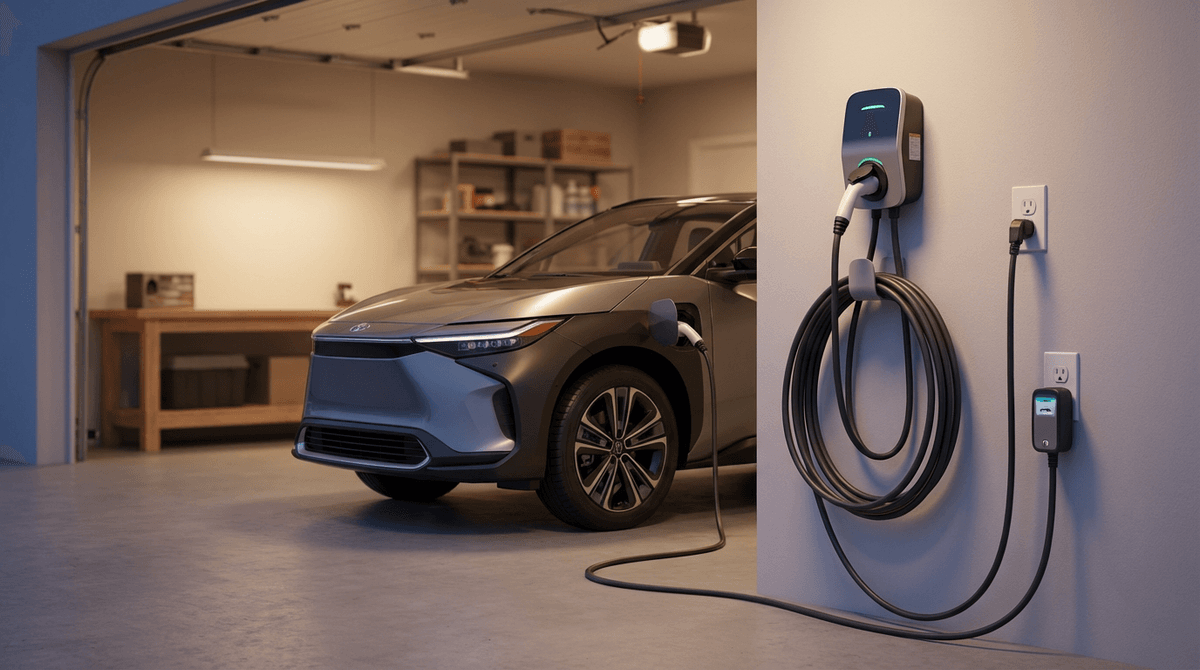
In most home setups, 240V EV charging is more efficient than 120V charging because fixed charging overheads are spread over less time and cable/current losses are reduced per delivered kWh.
For your vehicle and commute profile, use the WattSizing Calculator.
Quick Comparison
| Topic | 120V Charging (Level 1) | 240V Charging (Level 2) |
|---|---|---|
| Typical charging power | 1.2 - 1.9 kW | 3.3 - 11.5 kW |
| Typical wall-to-battery efficiency | 80% - 90% | 88% - 95% |
| Charge speed | Slow | Much faster |
| Best fit | Low daily mileage, overnight trickle | Regular driving, faster recovery |
| Main trade-off | Lower setup cost, higher relative losses | Higher install cost, lower losses/time |
Comparison Table: Energy Delivery Example
Assume electricity rate of $0.18/kWh and a need to deliver 300 kWh/month into the battery.
| Metric | 120V Example (85% efficient) | 240V Example (92% efficient) |
|---|---|---|
| Wall energy needed | 300 / 0.85 = 352.9 kWh | 300 / 0.92 = 326.1 kWh |
| Monthly charging cost | 352.9 x 0.18 = $63.52 | 326.1 x 0.18 = $58.70 |
| Difference | $4.82/month lower on 240V |
Worked Scenarios
1) Daily Commuter (12,000 miles/year class)
Assume EV consumption equivalent to 300 kWh/month delivered to battery.
- 120V wall energy: 352.9 kWh/month
- 240V wall energy: 326.1 kWh/month
Annual cost at $0.18/kWh:
- 120V: $762.24
- 240V: $704.40
Annual difference: $57.84 plus major convenience gains from faster charging.
2) Higher-Mileage Driver
Assume battery energy need of 500 kWh/month:
- 120V wall energy:
500 / 0.85 = 588.2 kWh - 240V wall energy:
500 / 0.92 = 543.5 kWh
Monthly cost:
- 120V: $105.88
- 240V: $97.83
Difference: $8.05/month.
Practical Decision Guidance
- If daily charging demand is low, 120V may be sufficient despite lower efficiency.
- For regular commuting, 240V usually improves both efficiency and schedule flexibility.
- Time-of-use tariffs can amplify savings if 240V charging helps you stay fully in off-peak windows.
- Always evaluate installation cost, panel capacity, and circuit availability.
Related reading:
FAQs
Is 240V always more efficient than 120V?
Usually yes in practice, but efficiency depends on vehicle charger design, current level, and ambient conditions.
Why does charging overhead matter?
Vehicle electronics and thermal systems consume power while charging; longer sessions can increase overhead share.
Does faster charging harm battery life?
Typical home Level 2 rates are generally considered moderate and are usually not a major battery-life concern.
Can I keep 120V and still reduce costs?
Yes. Charge during off-peak periods and keep cables/connections in good condition.
CTA
Want to compare 120V and 240V using your mileage and utility plan? Use the WattSizing Calculator to estimate monthly charging cost and efficiency impact.


