
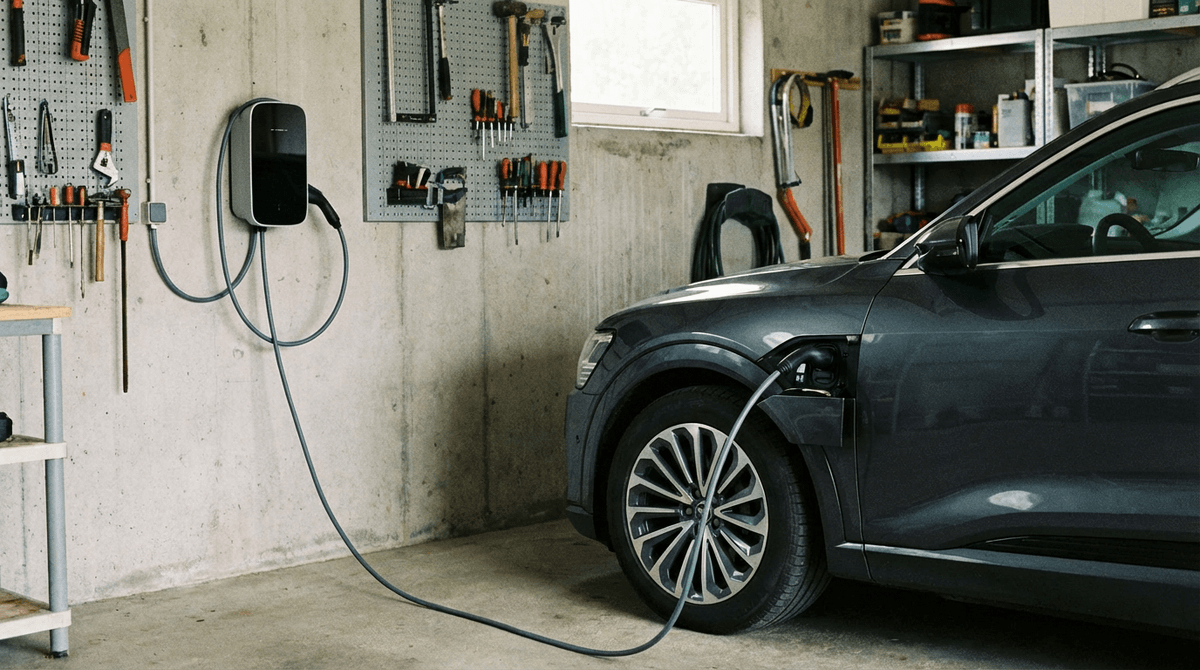
EV charging is one of the biggest controllable home loads. Typical wall draw is around 1,200-1,900 W for common Level 1 (120 V) charging and about 3,300-11,500 W for many Level 2 (240 V) home setups. The real number is usually the lowest limit among the EVSE, branch circuit, and the car's onboard charger.
Use How to calculate kWh from watts and hours and Daily off-grid use in Wh to map charging windows to energy. For home overlap, compare with other heavy rows like water heater, electric stove, and heat pump. Build the combined plan in the WattSizing calculator.
1) Typical EV charging watts by setup
| Charging setup | Typical running watts | Common ceiling logic |
|---|---|---|
| Level 1 (120 V, 12 A) | ~1,200-1,500 W | Portable EVSE + standard receptacle |
| Level 1 (120 V, 16 A-capable) | ~1,500-1,900 W | Vehicle and EVSE must both permit it |
| Level 2 (240 V, 16 A) | ~3,300-4,000 W | Entry home L2 row |
| Level 2 (240 V, 32 A) | ~6,500-7,700 W | Very common residential wallbox class |
| Level 2 (240 V, 40-48 A) | ~8,000-11,500 W | Higher-power home charging where panel/circuit allow |
Nameplate does not guarantee full draw on every car. Vehicle acceptance limits and charge-state taper can pull the average down.
2) Why your car may not pull the charger max
Power is constrained by the lowest active limit at that moment:
- EVSE current setting
- Branch circuit / breaker configuration
- Vehicle onboard charger limit
- Battery state of charge and temperature (taper behavior)
Near high state of charge, many EVs taper charging current, so session-average watts are lower than early-session peak.
3) kWh per charging block (simple example)
Example: a Level 2 session averages 7,200 W for 2 hours.
- kWh = (7,200 x 2) / 1000 = 14.4 kWh
- At $0.16/kWh, energy cost is about $2.30
If your utility has time-of-use pricing, session timing can matter as much as watts. EIA context: Electricity explained.
4) Panel and home overlap: the real planning issue
EV charging is rarely dangerous by itself when installed correctly on a dedicated circuit. The planning problem is overlap with other major loads in the same hour: water heater, electric stove, clothes dryer, or heat pump.
Smart charging schedules, EVSE current limits, or utility demand-response programs can reduce peak stacking without changing your vehicle.
5) Generator and off-grid framing
Most home EV charging is too heavy for small backup systems if you expect normal charging speed during outages. For generator planning, use running vs starting watts with your full concurrent list, not the EV row alone.
For off-grid or hybrid systems, verify inverter continuous rating and battery discharge limits before enabling EV charging windows. Start with inverter sizing for off-grid solar, then account for waveform and mixed-load behavior with pure sine vs modified sine.
6) Practical ways to reduce charging impact
- Schedule charging in lower-rate utility windows.
- Set realistic daily charge targets instead of frequent top-off behavior.
- Lower EVSE current when peak household loads are active.
- Stagger EV charging against electric cooking, hot water recovery, and HVAC peaks.
FAQs
Does an EV charger always pull its rated maximum watts?
No. Actual draw can be lower due to car limits, EVSE settings, circuit constraints, and battery taper near higher state of charge.
Is Level 2 always better than Level 1?
Level 2 is much faster and often more practical for daily driving, but it increases peak household load and may require panel/circuit upgrades.
Can EV charging overload a home electrical system?
It can if installed or configured incorrectly. Dedicated circuits, proper breaker sizing, and load management are important.
Why does charging speed slow near full battery?
Most EVs taper current as battery state of charge rises to protect battery health and thermal limits.
Should I charge overnight every day?
Not always. It depends on commute needs, utility pricing, and battery strategy. Many drivers do well with scheduled windows and moderate targets.
Can I run EV charging and electric cooking at the same time?
You can if the service and circuits support it, but overlap may increase demand spikes. Smart scheduling often reduces stress and cost.
Is EV charging realistic on small generators or off-grid systems?
Usually limited. Standard home Level 2 charging is a large sustained load; many small systems need reduced current or dedicated charging windows.
Recap: EV charging commonly ranges from about 1.2-1.9 kW on Level 1 to 3.3-11.5 kW on home Level 2. Real draw is capped by EVSE, circuit, and vehicle limits, then reduced by taper near high charge. Size from the full household overlap and model sessions in the WattSizing calculator.


