
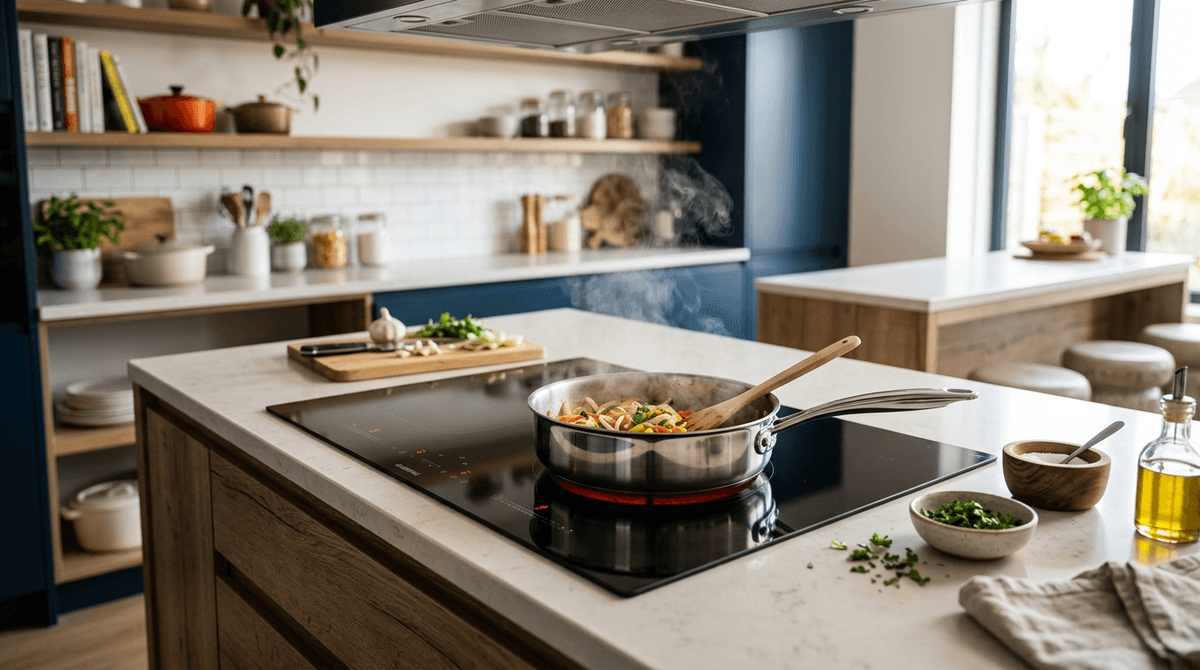
Induction cooktops typically use about 1,200 to 3,700 watts per active burner zone, and whole-unit peak draw can range from around 3,000 to 7,600 watts depending on model size.
For full system planning, use the WattSizing Calculator.
1) Load shape and what changes draw
Induction transfers energy directly into compatible cookware, which is one reason it can heat quickly and efficiently. Power draw depends on:
- Number of active cooking zones
- Power level setting
- Pan size and base material
- Whether boost mode is enabled
At low simmer settings, draw can be much lower than nameplate maximum. At boost, one zone may briefly run near its top rating, so simultaneous high-power cooking across multiple zones can push total demand up fast.
2) Typical watt ranges (label first)
| Induction Setup | Typical Running Watts | Typical Peak Watts |
|---|---|---|
| Single portable induction burner | 700 - 1,800 W | 1,800 - 2,000 W |
| 2-burner induction cooktop | 1,200 - 3,000 W | 3,000 - 3,600 W |
| 4-zone 30-inch induction cooktop | 1,800 - 4,500 W | 5,000 - 7,200 W |
| 36-inch induction cooktop | 2,500 - 5,500 W | 6,000 - 7,600 W |
3) Session or daily kWh example
Example: One induction zone averages 1,900 W for 40 minutes of cooking.
- Run time: 40 / 60 = 0.67 h
- Energy use: (1,900 x 0.67) / 1000 = 1.27 kWh
If you often cook with multiple zones, total demand can approach electric oven levels. For comparison, read How Many Watts Does a Electric Oven Use and How Many Watts Does a Microwave Use.
Generator and Off-Grid Sizing for Induction Cooktops
Induction cooking is efficient, but instantaneous draw can still be large. A generator or off-grid inverter must cover the zones you actually use, boost modes, and overlap with other essential appliances.
Generator Sizing Guidelines
- Single portable burner (120 V): Often 700–1,800 W running. Practical generators often start around 2,000–3,000 W once margin and extras (like a fridge) are included.
- Two portable burners or light built-in use: Commonly 3,500–5,000 W class.
- Heavy multi-zone or large built-in cooking: Plan 5,500 W+ and verify nameplates. Your limiter is simultaneous high zones, not average dinner watts.
Why "Max Nameplate" is the Wrong First Step
Induction power depends on how many zones are active, power level, pan fit, and whether boost is engaged. Low simmer can be modest; three zones near high can approach whole-unit peaks. Generators care about worst-case overlap during a 20-minute boil—not your average stir-fry.
Illustrative Outage Menu (Hypothetical)
You cook with a two-zone pattern totaling 2,600 W during the busiest minute, plus:
-
Refrigerator: ~180 W average while cycling
-
Kitchen + hall LEDs: ~120 W
-
Modem + router: ~35 W
-
Sum:
2,600 + 180 + 120 + 35 = 2,935 W -
With 25% margin:
2,935 × 1.25 ≈ 3,669 W
Illustrative pick: 4,000–4,500 W continuous class generator.
Off-Grid Solar Considerations
Off-grid, the limiting factor is rarely the sticker alone—it is whether your inverter’s continuous rating can carry the zone you plan to use, and whether your battery bank can supply that many watt-hours for the minutes you actually cook.
- Sequence zones: Boil water first, then turn that zone down before starting another high draw—keeps total W inside a smaller inverter.
- Avoid “boost everywhere”: Treat boost like a sprint your battery may not repeat all evening.
- Inverter vs Surge: Inverters are rated for continuous output; short “surge” ratings help motor starts, not a 10-minute boil. Plan from the watts you will hold.
Apartments, tiny kitchens, and RVs (portable one‑burner vs full cooktop)
- In an apartment — Built‑in 240 V cooktops can max most of a 40 A or 50 A kitchen feeder when multiple zones and boost align; a portable 120 V single burner is often the largest plug on a 15 A office circuit. The W in the table does not know your lease—your breaker and cord do.
- RV / small cabin — A 700–1,800 W portable burner is common; the pain is the inverter and battery for boil times, not the average stir‑fry. Treat kWh = W × h ÷ 1,000 for each meal.
- Tiny house, off‑grid, backup — Stagger boil → simmer → second zone to stay inside a small inverter (already noted above). “Winter vs summer / rainy season / peak hours” mostly changes how often you cook comfort food, not a hidden second nameplate; time‑of‑use is $, not a higher W for the same setting.
4) Practical ways to reduce energy impact
- Use flat, induction-compatible pans for better energy transfer.
- Match pan size to burner zone to avoid wasted heat.
- Start with boost only when needed, then lower to maintain temperature.
- Cook with lids to shorten time to boil and simmer.
5) Backup sizing context
Use Generator running watts vs starting watts to model overlap with other home loads, not this row in isolation. For small systems, validate Inverter sizing for off-grid solar and waveform trade-offs in Pure sine vs modified sine.
FAQs
Does induction always use less electricity than electric coil or radiant?
Often yes for the same cooking task, mainly because heat transfer is more direct. Actual savings depend on cookware, habits, and duration.
Is there a startup surge like a compressor appliance?
Not usually in the same way. Induction is mostly an electronics-driven load, but instantaneous draw can still be high at boost settings.
Can a 2,000 W generator run an induction cooktop?
It can run many single portable burners at moderate settings, but two zones or boost plus a fridge often pushes you higher.
Do I size the inverter from one burner or from "worst case I might forget"?
Size for the maximum simultaneous zones you will actually run, with a little headroom for boost if you use it. Undersizing trips overload; oversizing costs money and idle losses.
Why do guides disagree on portable vs built-in sizing?
Built-in units have more zones and higher simultaneous potential. Portable units cap your worst case—often easier on a mid-size generator or off-grid inverter.
Is pure sine wave mandatory for induction?
Many units tolerate standard inverter output, but clean, stable power reduces nuisance trips—prefer documented specs from the cooktop maker when available.
How many kWh is one induction cooking session?
Use (average watts for the pattern you actually ran) × (hours) ÷ 1,000. A hard boil and boost window can look nothing like a simmer hour—measure if bills surprise you.
Is induction in an RV the same as at home in watts?
The burner’s electrical behavior is the same; the supply (inverter, shore, generator) and concurrent loads are not.
Why does my apartment trip when I use two induction zones and the oven?
Stacked high‑W on shared kitchen wiring, not a secret “winter mode.”
Sources
- U.S. Energy Information Administration (EIA) - Electricity explained
- U.S. Department of Energy - Energy Saver
- ENERGY STAR - Save Energy at Home
CTA
Ready to size your setup accurately? Use the WattSizing Calculator to estimate panel, battery, and inverter requirements from your real appliance loads.


