
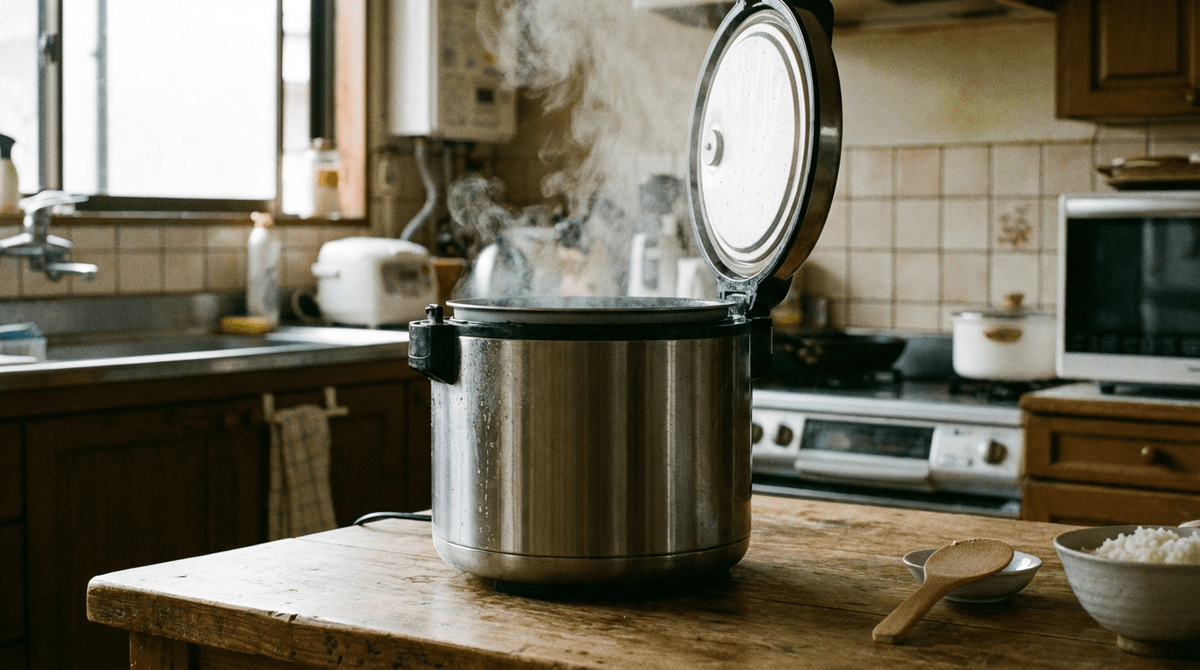
Most rice cookers use about 300 to 700 watts while cooking, and roughly 20 to 80 watts on keep-warm. For inverter/generator planning, many setups should allow around 600 to 1,000 watts of headroom depending on size and features.
For full system planning, use the WattSizing Calculator.
1) Load shape and what changes draw
Rice cookers are mostly resistive-heating appliances. Power draw is usually steady during the cook cycle, then drops significantly once it switches to keep-warm. That means the instantaneous watts can be moderate, while daily energy depends heavily on how long you leave keep-warm enabled.
If you’re sizing backup power, the key is to plan for the cooking draw (plus margin for other kitchen loads). For daily energy planning, focus on total cook minutes + keep-warm hours and convert to kWh.
2) Typical watt ranges (label first)
| Rice Cooker Type / Size | Typical Cooking Watts | Typical Keep-Warm Watts | Typical “Headroom” Target |
|---|---|---|---|
| Small (3-cup) basic | 250 - 450 W | 20 - 50 W | 500 - 700 W |
| Medium (5-6 cup) basic | 300 - 600 W | 25 - 60 W | 600 - 900 W |
| Large (8-10 cup) basic | 450 - 800 W | 30 - 80 W | 800 - 1200 W |
| “Fuzzy logic” / induction models | 600 - 1200 W | 30 - 90 W | 1000 - 1500 W |
3) Session or daily kWh example
Example: A rice cooker draws 550 W for 35 minutes to cook, then 40 W on keep-warm for 2 hours.
- Cook energy: ( (550 \times (35/60)) / 1000 = 0.32 ) kWh
- Keep-warm energy: ( (40 \times 2) / 1000 = 0.08 ) kWh
- Total per use day: 0.40 kWh
At $0.16/kWh, that’s about $0.06/day, or roughly $1.92/month if done daily.
If you want to translate this into a full daily load list, start with How to Calculate Daily Energy Use and then check inverter sizing guidance in Inverter Sizing for Off-Grid Solar.
Generator and Backup Sizing
Rice cookers are mostly steady resistive watts while cooking; keep-warm is lower but can run a long time (important for energy, less for surge). Cooking sets the peak for most models.
| Rice cooker profile | Typical practical generator / inverter class (illustrative) |
|---|---|
| Small (3–5 cup) + essentials | 1,200–2,000 W—can be tight if a fridge starts during cooking |
| Medium / large basic + essentials | 2,000–3,000 W |
| Induction or high-feature (higher cook watts) | 2,500–4,000 W |
Stacked example (illustrative): medium rice cooker 550 W cooking; fridge 180 W run (watch ~1,100 W start); misc. 110 W. Running: 550 + 180 + 110 = 840 W. If the fridge starts during cooking, a simplified peak can reach 550 + 1,100 + 110 = 1,760 W; add ~20% margin ≈2,100 W—a ~2,500–3,000 W class is a common comfortable pick.
Safety: use listed transfer gear; run portables outdoors; size extension cords for continuous resistive current. See the U.S. DOE on portable generators.
Dorms, quick meals, and “per day if I eat rice every day”
- Dorm or shared kitchen — A ~500–800 W cook cycle is not a whole‑house problem unless you also run a kettle, microwave, and hot plate on one 15 A string.
- Apartment and backup — The fridge start can overlap cook on a 2,000 W generator; that is why the stacked example exists.
- kWh per day — Cook kWh + keep‑warm kWh. Leaving keep‑warm 10 h is often 0.2–0.8 kWh by itself, even though cooking was the large instant spike.
- “Peak hours” and TOU — Affects your bill, not the rice cooker’s physics; schedule the cook to save money, not W.
4) Practical ways to reduce energy impact
- Turn off keep-warm when you won’t eat soon (it can quietly add hours of extra energy).
- Batch-cook rice and refrigerate portions instead of running multiple small cycles.
- Use a lid that seals well; steam leaks increase cook time and energy.
- Avoid stacking high-watt kitchen loads at the same time on small inverters.
5) Backup sizing context
Use Generator running watts vs starting watts to model overlap with other home loads, not this row in isolation. For small systems, validate Inverter sizing for off-grid solar and waveform trade-offs in Pure sine vs modified sine.
FAQs
Does a rice cooker have a big startup surge?
Usually no. Most rice cookers are resistive-heating loads, so they don’t have compressor-style surge, but some models can briefly draw above average when heating up.
Why does my rice cooker wattage look higher than expected?
Bigger capacity, induction heating, and “quick cook” modes can raise cooking watts. Nameplate ratings are often worst-case.
Is keep-warm expensive?
Per hour it’s typically modest (often 20–80 W), but leaving it on all day can add noticeable kWh over time.
Is keep-warm the right number to “max size” a generator?
Usually no—cooking watts dominate the instantaneous load; keep-warm matters more for total energy over long hours.
Why can a fuzzy-logic or induction-style cooker change the generator pick?
High-power cook modes can raise cooking watts into a new bracket—use the nameplate cook setting, not the brochure “eco” story alone.
Can I run a rice cooker and microwave together on backup?
Staggering helps; simultaneous kitchen peaks add fast. Model both in the WattSizing Calculator.
How many kWh per day is a rice cooker if I use it every day for dinner?
Daily kWh ≈ (kWh per cook from the table above) + (keep-warm kWh you actually leave on). Two short cooks can beat one long keep‑warm if you’re sloppy about turning it off.
Is a rice cooker OK for an off-grid solar kitchen?
Often yes—steady resistive cook is easier to reason about than a compressor; still watch cook + fridge overlap on the same inverter.
Sources
- U.S. Energy Information Administration (EIA) - Electricity explained
- U.S. Department of Energy - Energy Saver
- ENERGY STAR - Save Energy at Home
CTA
Ready to size your setup accurately? Use the WattSizing Calculator to estimate panel, battery, and inverter requirements from your real appliance loads.


