
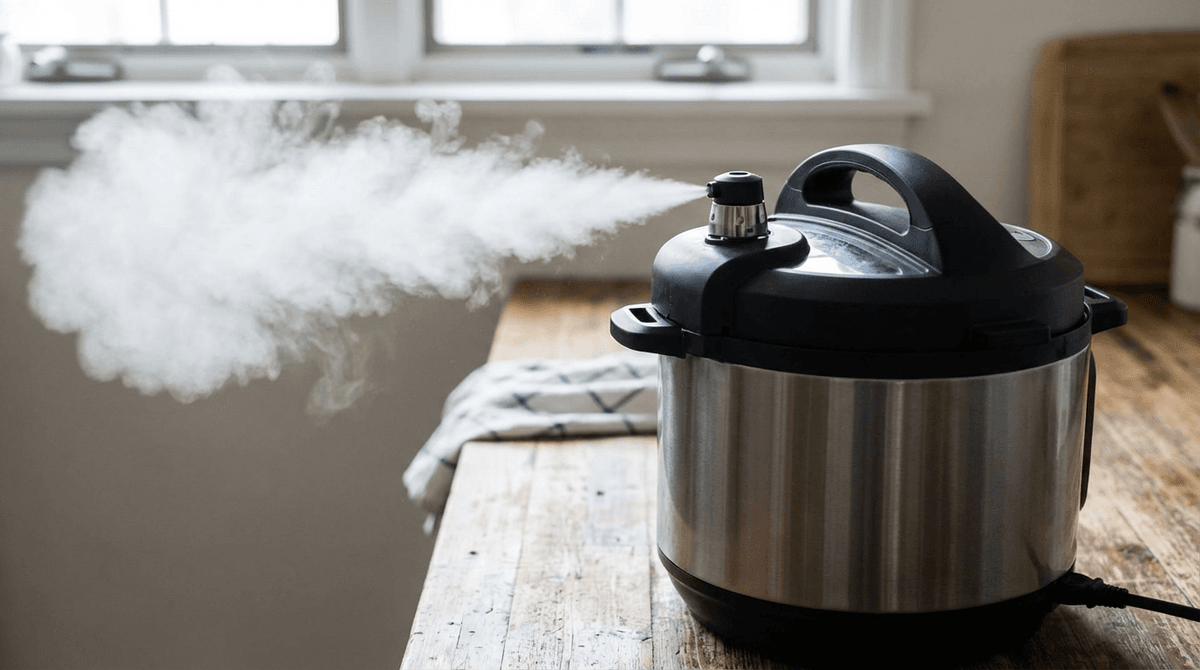
Most Instant Pot models are rated around 700 to 1,200 watts, but average draw during pressure cooking is often lower because the heater cycles after it reaches pressure. For inverter/generator planning, many setups should allow about 1,000 to 1,800 watts of headroom depending on size and what else is running.
For full system planning, use the WattSizing Calculator.
1) Load shape and what changes draw
An Instant Pot (and similar electric multi-cookers) uses a heating element controlled by a thermostat and pressure sensor. Power draw typically looks like this:
- Preheat/come-to-pressure: higher watts for a short period
- Pressure cook/maintain: cycling on/off, lower average watts
- Keep warm: low watts, but can run for hours if left on
For backup planning, the safest approach is sizing for the rated watts (plus margin). For energy planning, estimate kWh using an average over the recipe duration.
2) Typical watt ranges (label first)
| Instant Pot Size / Mode | Typical Running Watts (Peak) | Typical Average Watts | Notes |
|---|---|---|---|
| 3 qt (pressure cook) | 600 - 800 W | 200 - 500 W | Lower peak, shorter heat-up |
| 6 qt (pressure cook) | 900 - 1200 W | 300 - 700 W | Common household size |
| 8 qt (pressure cook) | 1000 - 1400 W | 400 - 900 W | More mass to heat |
| Sauté / sear | 800 - 1400 W | 700 - 1200 W | Often near-continuous heat |
| Keep warm | 20 - 90 W | 20 - 90 W | Low watts, long duration |
3) Session or daily kWh example
Example: A 6-qt Instant Pot averages 550 W across a recipe day (preheat + 25 minutes pressure + natural release), for a total active time of 55 minutes, then keep warm averages 50 W for 1 hour.
- Active time in hours: 55 / 60 = 0.92 h
- Active energy: ( (550 \times 0.92) / 1000 = 0.51 ) kWh
- Keep-warm energy: ( (50 \times 1) / 1000 = 0.05 ) kWh
- Total: 0.56 kWh
At $0.16/kWh, that’s about $0.09 per use, or roughly $2.69/month if used daily.
For complete home load planning, use How to Calculate Daily Energy Use and check inverter guidance in Inverter Sizing for Off-Grid Solar.
Generator and Backup Sizing
Instant Pots are rated roughly 700–1,200 W on many models, but average draw during pressure cooking is lower because the heater cycles. Generator and inverter planning should still respect preheat, sauté, and worst-minute overlap with a fridge or lights—not a comfortable long-run average alone.
| Setup | Typical practical generator / inverter class (illustrative) |
|---|---|
| 3 qt mini + margin | 1,000–1,600 W |
| 6 qt standard | 1,500–2,500 W common |
| 8 qt / high-power + refusal to sequence other kitchen peaks | 2,000–3,500 W |
Illustrative outage cook: 6 qt preheat/come-to-pressure window 1,000 W; fridge 180 W average while cycling; kitchen lighting + USB 100 W. Hardest minute: 1,000 + 180 + 100 = 1,280 W; with ~20% margin ≈1,540 W—a ~2,000 W inverter class is often comfortable. Add a microwave on the same stack and size that load or sequence heavy modes.
Habits: run sauté → pressure → other high loads in order; avoid Instant Pot + kettle + toaster overlap on a ~2,000 W source. Rehearse on generator power before you need it. Keep the cooker on a stable surface; run generators outdoors only—see CPSC generator safety for CO risk.
Dorms, apartments, RVs, and “watts per day” (older long‑tail angles)
- Dorm / first apartment — One 15 A kitchenette circuit: preheat can be the whole budget. Microwave + Instant Pot needs sequencing, not hope.
- RV or van — Inverter W must cover preheat; battery kWh must cover minutes to hours of cook + keep‑warm if you refuse to use gas.
- Off‑grid — Treat sauté as a near‑continuous high‑W mode; pressure is cyclic but can still spike demand on a small bank.
- “Per day” — Sum each use’s kWh (see the example), then multiply by uses per day for a daily line item; keep‑warm all day can dominate if you leave it on.
- Night vs day — Only matters for your schedule and TOU rates; the element does not care what the clock says.
4) Practical ways to reduce energy impact
- Use keep-warm intentionally; turn it off if you won’t eat soon.
- For sauté-heavy recipes, consider reducing sauté time (it can be one of the higher-average-watt modes).
- Don’t stack high-watt kitchen loads at the same time on backup power.
- If you’re comparing appliances, note that shorter cook times don’t always mean less energy—high watts can offset the time savings.
5) Backup sizing context
Use Generator running watts vs starting watts to model overlap with other home loads, not this row in isolation. For small systems, validate Inverter sizing for off-grid solar and waveform trade-offs in Pure sine vs modified sine.
FAQs
Does an Instant Pot have startup surge?
Not like a compressor motor. It can draw near its rated watts during warm-up, but it’s primarily a controlled heating load.
Is the rated wattage what it uses the whole time?
Usually no. During pressure cooking, the heater cycles, so average watts are often lower than the rating.
What’s a good internal comparison for kitchen planning?
See How Many Watts Does a Microwave Use and How Many Watts Does a Slow Cooker Use since they represent different “high-watt short time” vs “lower-watt long time” patterns.
Can a 1,000 W generator run a 6 qt Instant Pot?
Often risky during preheat—many units sit near nameplate watts for that window. Check your model and stack with fridge and lights, or size up / sequence loads.
Should I size a generator to average pressure-cook watts?
No for headroom—size to the peak modes you will use during an outage, especially preheat and sauté.
Does keep-warm matter for generator sizing?
Almost never for peak—keep-warm is small compared to preheat. It still matters for total kWh if left on for hours.
Is Instant Pot surge like a fridge compressor?
No large motor surge, but preheat can sit near rated watts for minutes—treat that as the design minute.
How many kWh per day if I use my Instant Pot once a day?
Uses/day × kWh per use from the recipe math above. A 0.5 kWh dinner every day is about 15 kWh/month from that device alone, before keep‑warm mistakes.
Can I use an Instant Pot in an RV on a 1,000 W inverter?
Often no for 6 qt preheat—check preheat/ sauté and inverter peak minutes, or step down to a 3 qt or sequence with everything else off.
Sources
- U.S. Energy Information Administration (EIA) - Electricity explained
- U.S. Department of Energy - Energy Saver
- ENERGY STAR - Save Energy at Home
CTA
Ready to size your setup accurately? Use the WattSizing Calculator to estimate panel, battery, and inverter requirements from your real appliance loads.


