
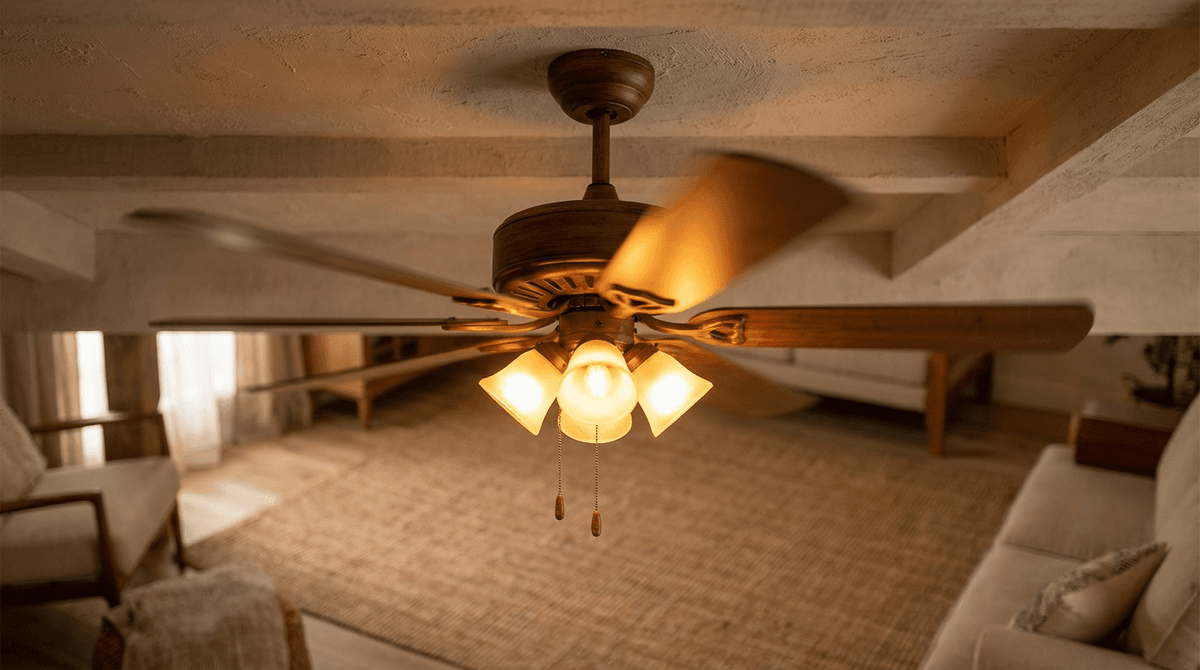
A ceiling fan moves air in a column; it does not remove heat like a window AC or central air. Comfort comes from airflow over skin, so “felt” cool and watts at the cord are two different things. The bill is driven by motor type (typical AC induction vs EC/“DC” designs), speed, and whether a light kit still runs hot filaments or efficient LEDs.
Use How to calculate kWh from watts and hours and Daily off-grid use in Wh for overnight rows. Generator running watts vs starting watts applies, but inrush is usually small next to a refrigerator. Inverter sizing for off-grid solar and Pure sine vs modified sine matter for motor noise and life. Compare portable shapes in box and pedestal fans. Add every load in the WattSizing calculator.
1) AC-motor fans: what “three speeds” usually costs
| Speed (typical AC fan) | Running W (ballpark) |
|---|---|
| Low | ~15–30 |
| Medium | ~30–55 |
| High | ~50–95 |
Older, larger, or out-of-balance units can land high in the band; nameplate and a meter beat memory.
2) DC-motor (EC) fans: more steps, often lower W
Most “DC ceiling fans” sold for North American 120 V homes still wire to AC; the motor drive rectifies and controls current inside the canopy. The practical win is efficiency and finer speed steps, not a 12 V battery-native install—unless you bought a product explicitly designed for that.
| Speed (typical DC/EC fan) | Running W (ballpark) |
|---|---|
| Low | ~2–8 |
| Medium | ~8–18 |
| High | ~15–35 |
Smart or Wi-Fi radios add a small always-on load (often ~1–3 W class) on top of motor watts.
3) Light kits: where the story flips
Motor-only tables ignore lamps. Four old 60 W incandescents are ~240 W; four ~8–10 W LEDs are ~30–40 W total. Size backup and monthly kWh for fixture + fan together.
4) kWh: sleep, all day, and “we forgot to turn it off”
Example DC/EC fan: 15 W × 8 h = 120 Wh (0.12 kWh) per night—kWh from watts and hours. A legacy AC fan on high in a shared room all day can move monthly kWh enough to notice; a DC fan on low in a bedroom is a smaller line on the bill.
5) Inrush, balance, and breakers
Start can add a small watt bump for a moment—usually dwarfed by refrigerator inrush you already model. Nuisance trips on “fan only” often trace to a bad cap, a light dimmer misapplied to a motor load, or an overloaded branch shared with microwave or kettle peaks. Use a fan-rated control, not a random LED dimmer, for most AC-motor fans.
6) Off-grid: inverter class and wave shape
A few hundred watts of pure sine inverter can cover one or several ceiling fans if the rest of the list fits. Modified wave is a common buzz/heat suspect on many AC induction motors; EC drives behave differently, but pure sine is still the safe default for mixed laptop, router, and TV loads on the same backup.
7) Generators: you are not ceiling-fan-limited
Portable generator headroom is set by the sump pump, fridge, or portable AC—not a bank of fans. Add fan + light W in running vs starting totals. Operate portables outdoors with listed transfer; see the U.S. DOE portable generators page for safety basics.
8) Habits: direction, setpoint, empty rooms
- Summer: airflow on occupants; a slightly higher AC setpoint can save more compressor kWh than the fan row costs—if you actually use both that way.
- Winter (optional): many fans have a reverse for low-speed destratification; follow the manufacturer for blade direction in your installation.
- No one there? Fan kWh with no one to feel the breeze is waste—same story as a box fan in an empty room.
FAQs
Do 72" “windmill” fans always use more watts than a 44" fan?
Not necessarily. Large DC/EC blades can move air slowly at very low W; a small, cheap AC fan on high can still beat it in watts. Use the label or a meter on the speeds you use.
Why does my ceiling fan buzz on inverter backup?
Often waveform—modified vs pure sine—or a failing cap or blade wobble. Test on grid first, then the inverter, then balance the blades if it is mechanical.
Is the light kit or the motor bigger on kWh?
It depends. Four old incandescents can dwarf a 60 W motor; four LEDs usually do not.
How many kWh is 75 W on high for 12 h per day for a month?
75 × 12 × 30 ÷ 1,000 = 27 kWh per month—How to calculate kWh from watts and hours. Your utility rate turns that into dollars.
Do smart / Wi-Fi ceiling fans add meaningful watts?
A small always-on radio (~1–3 W class) plus the motor—not a second kettle, but not always zero in a tight Wh budget.
Should I size a generator around ceiling fan “surge”?
Almost never—running vs starting is where fridge, pump, and AC loads eat headroom.
Can I use a wall dimmer meant for lights on my fan?
Usually no for AC motor fans: use a fan control rated for motors. Wrong dimmers mis-control and can overheat drives.
Recap: model AC vs DC/EC motor, speed, and light kit for honest W; use kWh from watts and hours for sleep or always-on habits; prefer pure sine when backup feeds noisy AC motors and mixed electronics. Enter rows in the WattSizing calculator.


