
“Essentials” usually means refrigeration, lighting, internet path, a few outlets, and sometimes furnace blower or pumps. The failure mode is almost always motor starting: a running-watt spreadsheet looks fine until a sump or compressor tries to start while something else is already online. Use How Many Watts Does a Refrigerator Use for cold storage bands, and How Many Watts Does a Router Use for ~5–20 W routers (more with mesh/modem).
Build the circuit list in the WattSizing Calculator.
Motor-heavy homes: size pumps and combined HVAC stacks explicitly—What Size Generator for Well Pump, How Many Watts Does a Sump Pump Use (generator sizing section), What Size Generator for Central AC and Well Pump. Footprint-first planning: What Size Generator for a 2000 Square Foot House.
Straight answer
Many essential-only plans land around 5,000–9,000 W running class generators once surge and margin are included—6,000–7,500 W is a common comfort band for fridge + lights + internet + furnace blower without huge pumps. Add well or sump motors and you often move toward 7,500–10,000+ W.
If electric water heating is in the backup path, read What Size Generator for Electric Water Heater—that load can dominate the entire plan.
What “essential circuits” usually includes
- Cold storage: refrigerator and/or freezer (cycling vs starting—see refrigerator guide).
- Safety lighting and communications (modem/router per How Many Watts Does a Router Use).
- HVAC path: furnace blower or boiler controls (not always full central AC).
- Water management: sump or well pumps where applicable—often the largest surge in suburban homes.
Motor surge in plain terms (illustrative groups)
| Essential bundle | Typical running direction | Why surge matters |
|---|---|---|
| Core (fridge, lights, internet, some outlets) | ~700–1,800 W | Fridge start vs running gap |
| Core + furnace blower | ~1,200–2,600 W | Blower motor overlap with fridge events |
| Core + sump | ~1,300–3,000 W | Pump start can dwarf averages |
| Core + freezer + blower | ~1,500–3,200 W | Multiple motor stacks |
These are planning bands, not a substitute for nameplate or measured data.
Worked example (hypothetical essentials)
Loads:
- Refrigerator 250 W run / 800 W start
- Freezer 400 W run / 1,100 W start
- Furnace blower 700 W run / 1,400 W start
- Lighting + internet + outlets 500 W run / 600 W start
- Sump pump 900 W run / 2,200 W start
- Running total:
250 + 400 + 700 + 500 + 900 = 2,750 W - Largest surge gap (sump):
2,200 − 900 = 1,300 W - Startup-capable planning:
2,750 + 1,300 = 4,050 W - 25% headroom:
4,050 × 1.25 = 5,063 W
Illustrative selection: ~5,500–6,500 W running with verified surge capability for your worst motor—not a marketing label alone.
Selection rules that survive real outages
- Prefer running the generator ~50–80% of rated load during steady backup—not pinned at 100%.
- If you need 120/240 V, confirm split-phase capability for pumps and large appliances.
- Stagger intentional starts when manual control is possible.
Safe connection to house circuits
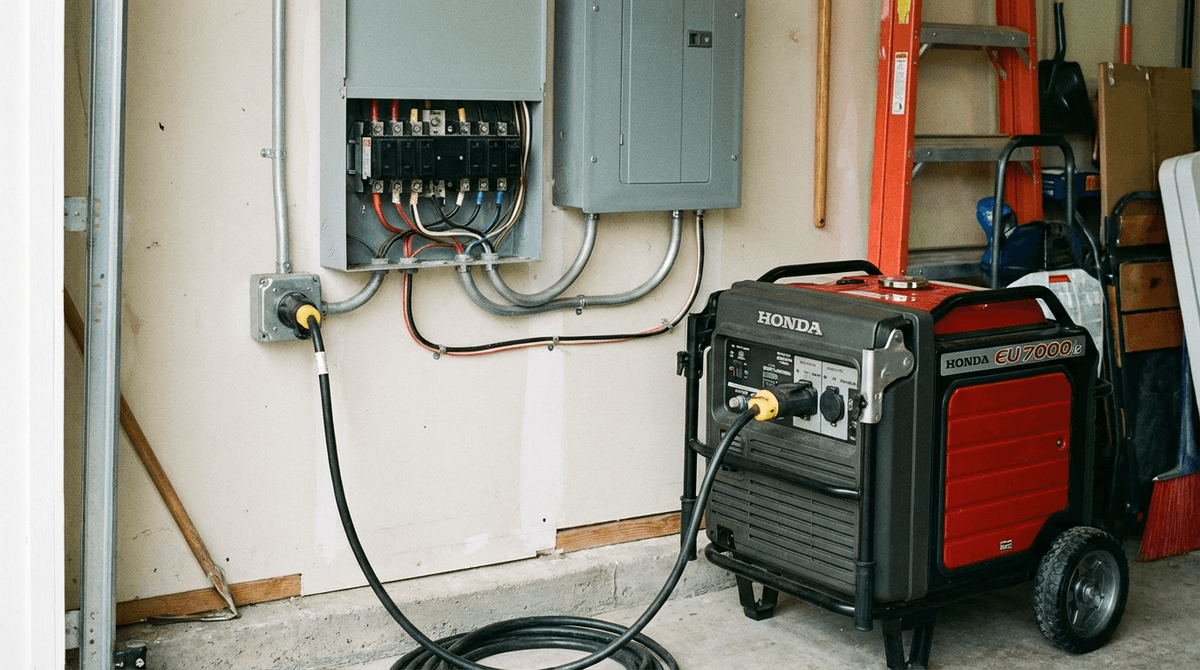
- Transfer switches and interlocks exist to prevent backfeeding the grid—a serious utility hazard. Ready.gov summarizes why proper connection matters for lineworkers and neighbors.
- Qualified electricians should verify neutral bonding rules for your setup; NFPA generator information reinforces outdoor operation and maintenance.
- Never run portable generators indoors or in attached garages.
FAQs
Is a 7,500 W generator “enough for most homes”?
For essentials-only, often yes—if your largest motor surge fits the unit’s starting capability and you manage overlap.
Can essential-circuit backup run central AC?
Usually not without moving into a much larger class—central AC is a different sizing thread than a fridge + blower essentials panel.
Should every bedroom outlet be essential?
Usually no—prioritize safety, food, communications, and medical needs first; expand only after surge math works.
How do I reconcile this with refrigerator watts from the blog?
Use How Many Watts Does a Refrigerator Use for typical bands, then confirm with your model’s LRA/startup behavior when available.
What if I have a well pump but no sump?
Well pumps often set the surge requirement—model them explicitly; do not average them away.
When should I jump from portable to standby?
When noise, fuel, automatic transfer, and multi-day runtime expectations exceed portable practicality—outside this article’s portable focus.
Sources
- Ready.gov: Power outages — safe backup practices
- NFPA: Generators — hazards and maintenance
CTA
Turn circuits into watts and surge watts without hand-waving. Use the WattSizing Calculator before you buy hardware.


