
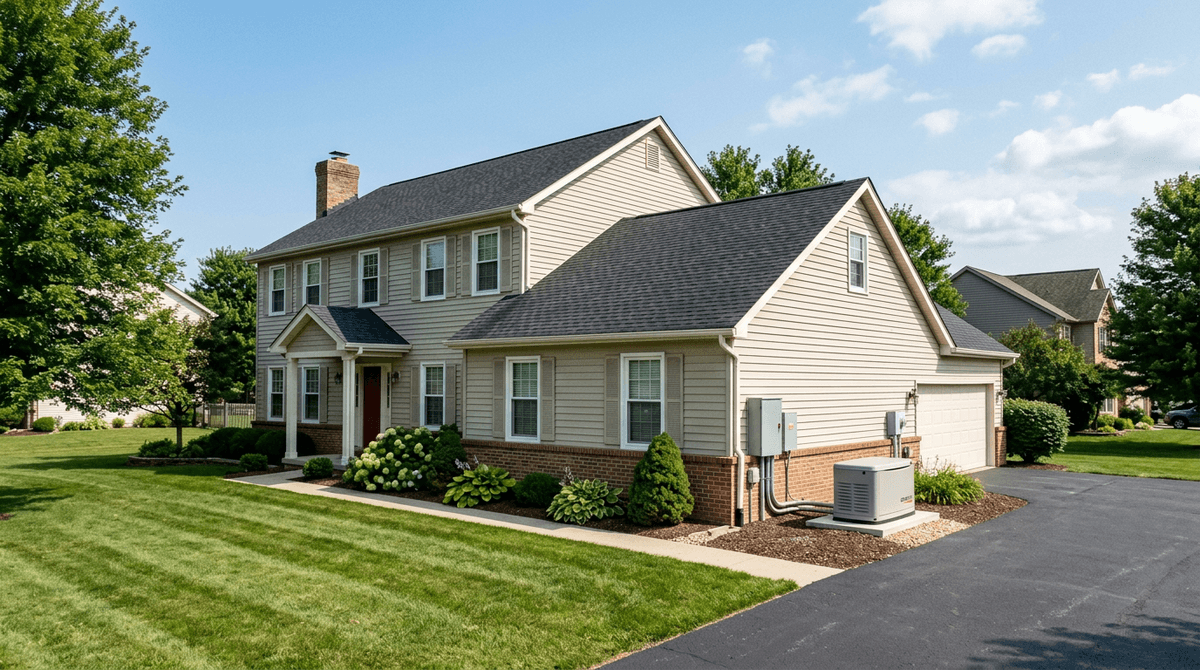
Short answer: 2,000 sq ft is only a clue. Backup size comes from which circuits you energize and which large motors or heaters can run together. Broad illustrative bands: essential-only backup often lands around ~7–12 kW class; one central cooling or heat-pump zone plus life-safety loads often ~10–16 kW or more; near whole-house with electric resistance heat can exceed ~18–25 kW unless loads are shed aggressively.
Use the WattSizing Calculator. For circuit-first thinking: What Size Generator for House Essential Circuits. Single-load deep dives: What Size Generator for a Refrigerator, What Size Generator for Well Pump, What Size Generator for Central Air Conditioner.
Why floor area is not a load calculation
Two 2,000 sq ft homes can differ sharply:
- Gas furnace + gas water heater → lower electric winter load (blower and controls mainly).
- Heat pump + large tank + EV charger branch circuits → higher stack risk.
Tiered stacked scenarios (planning)
| Tier | What you keep | Illustrative running band | Illustrative surge posture |
|---|---|---|---|
| 1. Essentials | Fridge, freezer, selected lights, router, a few outlets | ~1.5–3.5 kW | Fridge compressor start |
| 2. + HVAC helper | Furnace blower or one mini-split head | ~2.2–5 kW | Blower or fan motors |
| 3. + water movement | Well or sump pump | +0.9–2.2 kW running | Pump surge on top of tier 2 |
| 4. + central cooling | One AC compressor zone | +large compressor surge | Often drives generator class |
| 5. Broad electric heat | Strip heat, large tank, multiple cooking loads | Highly variable | May require standby + smart shed |
This table is illustrative—your panel and transfer list dictate the real answer.
Illustrative full-house example (hypothetical)
Hypothetical essential stack:
- Fridge + freezer running: 700 W (illustrative)
- Plan cold-appliance surge separately from steady watts
- Furnace blower + controls: 800 W running (illustrative)
- Lighting + outlets + internet: 700 W
- Sump pump: 900 W running, ~2,200 W brief peak (illustrative)
Step 1 — Running total: 700 + 800 + 700 + 900 = 3,100 W (if all on together—adjust to your transfer list).
Step 2 — Largest single surge gap (illustrative): sump ~2,200 − 900 = 1,300 W extra during start.
Step 3 — Startup-capable floor (rough): 3,100 + 1,300 = 4,400 W before margin.
Step 4 — Add ~20% margin: ~5.3 kW continuous need in this toy math—real installs often round up to the next common generator class and re-check surge.
Conservative class guidance
- Never buy from square footage alone.
- Assume the worst honest overlap you will allow during an outage.
- Prefer labeled transfer circuits over hope and extension cords.
Safety
- Listed transfer gear (U.S. DOE – Portable Generators).
- Carbon monoxide: operate portables outdoors only (NFPA generator safety).
FAQs
Is 10,000 W enough for a 2,000 sq ft house?
Often for tier 1–2 style backup; it may fail for full central HVAC plus heavy electric cooking without staging.
Can I run all central AC and everything else at once?
Sometimes with very large sets or automatic load management—not on a typical mid-size portable.
Portable vs standby at this home size?
Depends on automation, noise, fuel storage, and how many circuits you insist on energizing.
Does a bigger house always need more kW?
Not automatically—electric appliances and HVAC type matter more than footprint.
Should I size for EV charging?
Usually no for first-line outage backup—drop EV loads or charge when grid power returns.
Where do I build my real list?
Sources
- U.S. Department of Energy: Portable Generators
- U.S. Energy Information Administration: Electricity Explained
- Generac: Generator Sizing Guide
CTA
Replace square-footage guesses with circuit and appliance data in the WattSizing Calculator.


