
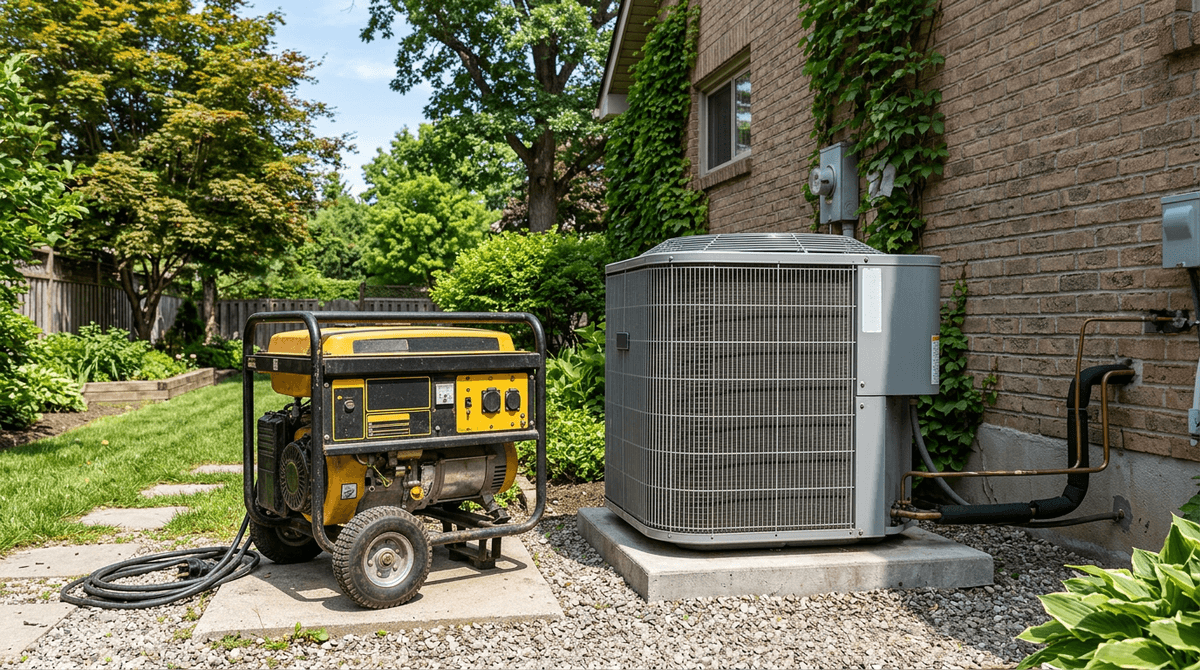
Short answer: A 3 ton residential split is often ~36,000 BTU/h cooling capacity, but electrical sizing is about compressor inrush plus indoor blower and whatever else stays online during an outage. Rough conservative planning: many homes land near ~9–12 kW generator class (nameplate running + adequate surge) for 3 ton + typical essentials; tighter scenarios only with strict staging, minimal other motors, or verified soft-start / favorable LRA.
Use the WattSizing Calculator with your real labels.
Why 3 ton trips small generators
Undersized picks usually fail because:
- Startup current far exceeds steady “running watts” marketing.
- Fridge, well, or sump motors cycle during AC restarts.
- Heat and altitude derate the engine.
Illustrative electrical bands (condenser + air handler)
| Component | Illustrative running W | Illustrative surge / planning context |
|---|---|---|
| Outdoor section (3 ton class) | ~2,500–4,000 W | Compressor start often dominates |
| Indoor blower / air handler | ~400–900 W | Adds to running; may add blower start |
| Combined AC (illustrative) | ~2,900–4,900 W | Surge planning often well above running |
Add ~1,000–2,500 W for fridge, lights, router unless you shed them.
Conservative generator classes (planning shorthand)
| Posture | When it might apply | Illustrative class |
|---|---|---|
| Strict / staged | AC-only priority panel; few other loads; ideal surge data | ~7.5–8.5 kW—easy to get wrong |
| Typical comfort backup | AC + fridge + lights + network | ~9–12 kW common target |
| Margin / hot restarts / extra motors | Well pump overlap risk, large fridge, want slack | ~12–14 kW+ |
Soft-start hardware may lower required surge—confirm with HVAC + generator documentation.
Stacked scenarios (read your outage)
| Scenario | What to respect |
|---|---|
| AC + fridge only | Fridge compressor may align with AC restart |
| AC + well or sump | Two large motor systems—size up or stage |
| AC + microwave | Overlap only if math clears both |
Illustrative examples (hypothetical)
Example A — AC + modest essentials
- AC running (illustrative): 3,800 W
- Fridge (illustrative): 700 W
- Lights + network + TV (illustrative): 500 W
- Running: ~5,000 W
Planning posture: ~9–11 kW class often appears in illustrative worksheets—verify surge against nameplate.
Example B — AC priority only
- Other loads locked out during cooling.
Tighter continuous watts may suffice—surge still rules.
Checklist before you buy
- Capture LRA / RLA / FLA from condenser and air handler.
- Decide which circuits transfer.
- Use listed transfer gear—never backfeed (U.S. DOE – Portable Generators).
- Exercise starts on a hot day.
Further reading: How Many Watts Does a Central Air Conditioner Use, How Many Watts Does a Refrigerator Use.
Safety
Outdoor-only operation; follow NFPA generator safety.
FAQs
Is 7,000 W enough for a 3 ton AC?
Sometimes in narrow cases—often no for reliable home backup with typical extras.
Do I need an inverter generator?
Not strictly for AC compatibility—inverter helps electronics and noise; conventional units work when correctly sized.
Does soft-start reduce generator size?
Often on surge-limited plans—get documented reduction for your compressor.
Why not size to “running watts” alone?
Running ignores inrush that trips breakers and stalls small units.
Can I use the numbers in this article as a permit package?
No—illustrative; your AHJ and installer need project-specific calcs.
Where do I enter my actual tonnage and loads?
Sources
- U.S. Department of Energy: Portable Generators
- U.S. Energy Information Administration: Electricity Explained
- Generac: Generator Sizing Guide
CTA
Put 3 ton data and stacked motors into the WattSizing Calculator.


