
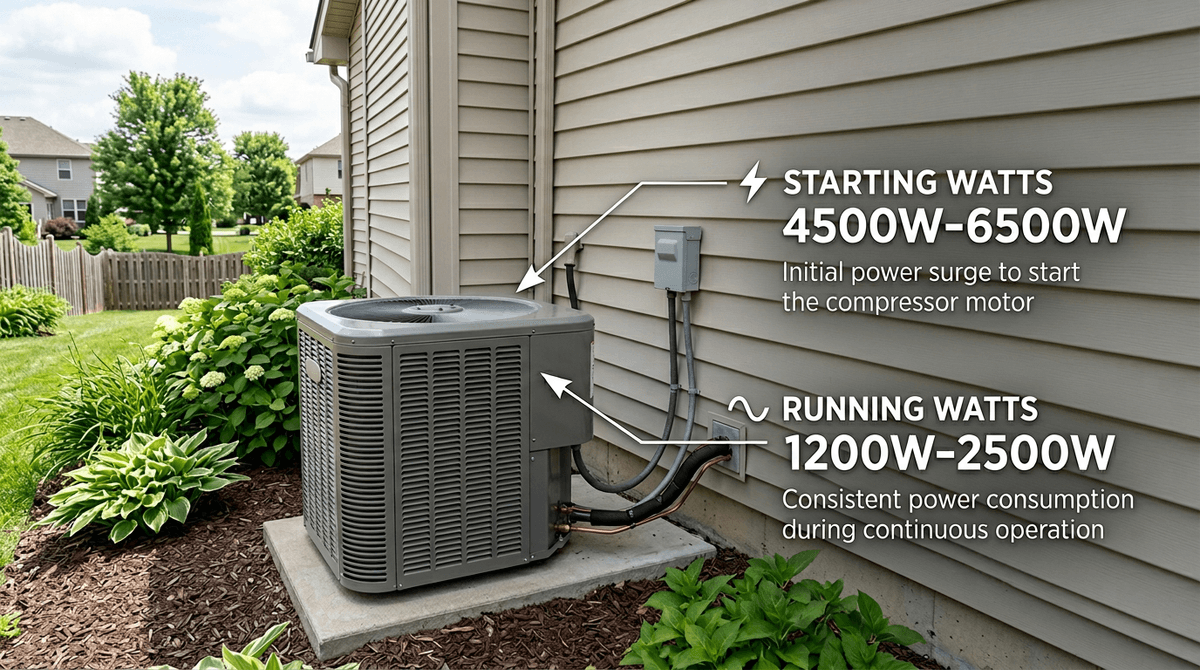
A split central system has an outdoor condenser (compressor + condenser fan) and an indoor air handler or furnace blower that moves ducted air. Your bill and your backup list need the whole machine—the outdoor nameplate by itself is an incomplete model. Running watts track tonnage, SEER, charge, and blower type; the painful number for many portables is LRA on the compressor, the nameplate’s locked-rotor story at start.
How to calculate kWh from watts and hours and Daily off-grid use in Wh turn W into summer rows. Generator running watts vs starting watts is the right frame for AC + refrigerator overlap. Window AC and mini splits are different surge stories. Heat pump systems (cooling and heating) share the same nameplate language; defrost in winter is a different W shape from a cooling-only day. Add rows in the WattSizing calculator.
1) Ballpark running W by ton (illustrative; your sticker wins)
A cooling “ton” is 12,000 BTU/h of capacity—not weight, not kW. Installed W varies with equipment age, line set, and airflow. Treat the table as a conversation starter, not a code calculation.
| Size (ton) | Running W (very rough) | Why surge can still matter |
|---|---|---|
| 1.5 | ~1,800–2,800 | LRA on small systems can outrun a portable |
| 2.0 | ~2,200–3,200 | Common residential class |
| 3.0 | ~3,000–4,500 | Frequent one-system homes |
| 4.0 | ~4,000–5,800 | Often 240 V outdoor + large indoor |
| 5.0 | ~5,200–7,200 | High run W; LRA is not gentle |
Variable-speed outdoor sections and a good indoor match can soften both LRA and real-world kWh versus old single-stage “same ton” rules of thumb.
2) Where the W goes: compressor, outdoor fan, indoor blower
Most kWh is the compressor; the outdoor fan and indoor blower add steady W every minute the system is in call. A blower left on “fan 24/7” is a separate habit. Ceiling fans can change comfort for modest W without spinning the compressor.
3) RLA, LRA, FLA: read the condenser, then add the air handler
- RLA (Rated load amps): running current for the compressor in normal conditions—W is roughly RLA × supply V (many outdoor sections are on ~240 V split, but read your tag for voltage and phase).
- LRA (Locked rotor amps): a stressed inrush/locked-rotor value that drives the candid running vs starting conversation and any licensed soft-start or ramp product discussion—field results vary; tables are not a permit.
- FLA on the outdoor fan: add to the outdoor run picture. The indoor blower is often a separate overcurrent and label—do not forget it in system W.
A clamped A in active cooling (where you can do so safely) plus blower context beats a blog for your house.
4) kWh: climate, duty cycle, and a worked example
If the cooling stack averages 3,800 W for 10 h of that kind of day, that is 38 kWh—kWh from watts and hours math. A mild week or a tight, shaded home can be far lower; poor insulation plus extreme heat and solar gain is a different curve. To talk dollars, you need kWh first—EIA electricity explained is a solid U.S. retail anchor.
5) Generators, transfer gear, and stacking the rest of the house
- LRA sets part of the “can the backup source start it?” story—running vs starting for the same fridge, well pump, and an electric water heater if that circuit is on the same backup.
- A listed soft-start (compressor ramp) is designed and commissioned by qualified trades; treat marketing “percent off LRA” as a reason to test, not a promise that a small gen will start every 3-ton in every install.
- U.S. DOE portable generators: outdoors, listed transfer, no backfeed.
6) Ducts, filter, and thermostat: cheap levers
- Duct leak in a hot attic can waste kWh before the unit is “bad” on its own.
- A clogged filter and poor airflow can extend run time or risk freeze-up behavior; 1-inch pleated filters are often a 30–60 day cadence in real dust (YMMV).
- Dropping the thermostat 10 °F below your target on single-stage equipment does not “rush” cooling faster—it just runs longer. A ceiling fan plus a few °F on the setpoint is usually a better kWh play than a fictional “fast” cool.
7) Comparing to other equipment you might size instead
- Mini splits (ductless): often kinder part-load and zoned kWh; YMMV by install.
- Window AC: one room, one (often 15 A) receptacle class story.
FAQs
Is “3 tons” the same as “X thousand running watts”?
No. Tons are cooling capacity; W is electrical input at your SEER and field conditions, and the blower is part of the system story.
Why is LRA so much higher than RLA on the tag?
LRA is a stressed inrush/locked-rotor ceiling for the compressor, not a continuous day-long amp draw. It still matters for backup and ramp devices because starting is when things stall or trip.
Can a 7,500 W portable start central AC?
Sometimes on a small tonnage with favorable LRA and no other big surges; often not for larger tonnage without a field strategy—see running vs starting and get a licensed opinion before you bet comfort on it.
Do I include the indoor air handler in “central AC watts”?
Yes for real bills and real backup. The system does not cool with an outdoor box and imagination—air moves in ducts.
Does high SEER always fix a high summer bill?
No if the envelope and gains are bad. A modest SEER in a tight home can beat a trophy number on a leaky one in kWh/°F terms.
Is daily kWh just running W × “hours the AC is on”?
Roughly, with cycling and, on heat pumps, defrost complicating a one-number model—use kWh from watts and hours on measured or submetered data when the stakes are high.
When is ducted central still competitive on kWh with mini splits?
When ducts are sealed, charge is right, and the blower is not fighting the coils—compare installed kWh, not a headline W from a chart.
Recap: model outdoor + indoor; anchor LRA, RLA, and fan or blower labels to your install; use running vs starting for generator rows; use kWh from watts and hours and daily off-grid use in Wh for summer energy math. Enter honest numbers in the WattSizing calculator.


