
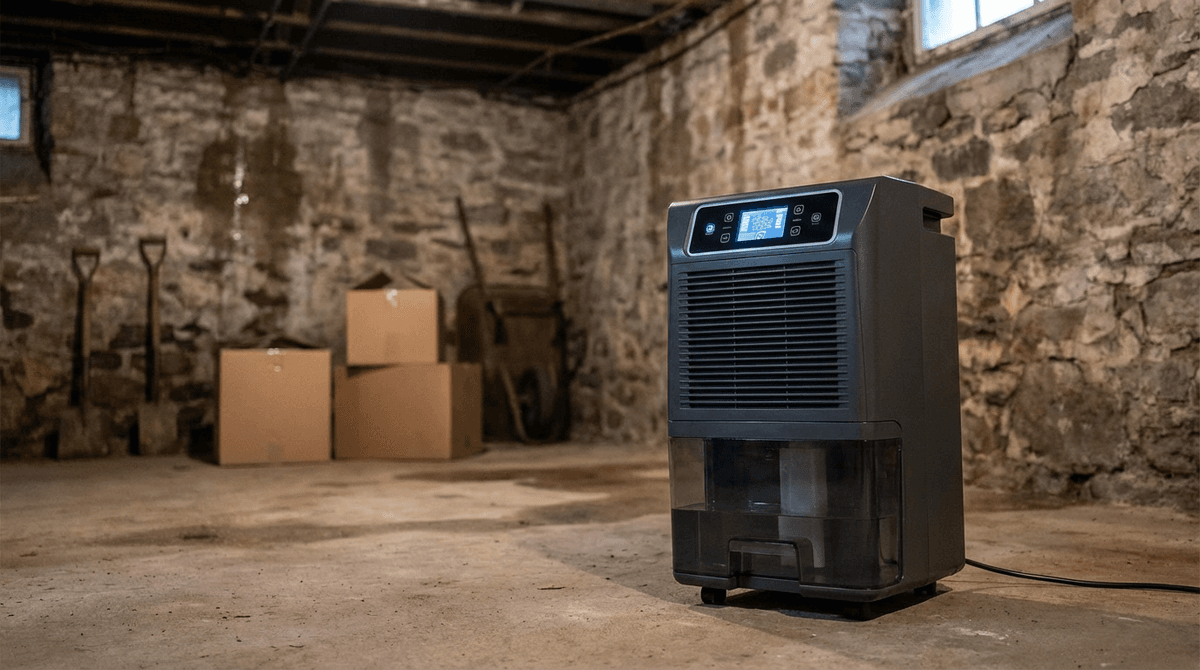
A compressor dehumidifier pulls air over a cold coil to condense water, then over a hot condenser before it leaves the grille—same family of physics as a small portable AC or window AC, usually at lower total W than central air. A humidifier (evaporative or ultrasonic) is a different electrical story. Running W and kWh track pints-per-day class, humidity setpoint, and how often the compressor cycles; surge at start still matters for small inverters and portables—see generator running watts vs starting watts.
How to calculate kWh from watts and hours and Daily off-grid use in Wh turn “hours at W” into a season row. Stack a sump pump and refrigerator honestly in the WattSizing calculator. An air purifier moves air without a compressor surge in the same way.
1) Running W by pint class (ballpark; read the nameplate)
DOE test and label rules changed around 2019—energy.gov on dehumidifiers explains the pints number. The same physical machine can read “50-pint” today where it once said “70-pint”; use the sticker W, not the year you bought it.
| Modern label class (pints/day) | Typical run W | Surge to respect (brief) |
|---|---|---|
| ~20–30 | ~250–450 | ~0.9–1.4 kW |
| ~35–40 | ~350–550 | ~1.2–1.7 kW |
| ~50+ | ~450–750 | ~1.5–2.2+ kW |
Internal pump kits, low-temperature modes, or dirty filters can move run W and cycle time.
2) Why “600 W running” is not the whole backup story
Compressors present a start current that can exceed steady W for a short window—enough to trip a tight portable power station or a margin-starved gen. Running vs starting is the frame: size for concurrent peaks if a sump pump and dehumidifier could both demand in the same second of a storm.
3) kWh: setpoint, duty cycle, and continuous drain
Example: 550 W average when the compressor is on, 12 h of mixed on/off in a day ≈ 6.6 kWh that day if the average holds—kWh from watts and hours. 50% relative humidity is a common target band for mold comfort; chasing 35% all summer can buy extra kWh for little comfort gain. A gravity or pump drain so the unit does not stop on a full bucket saves humidity spikes, not necessarily W at the cord, but it saves off-time gaps you would rather not have.
4) Generators and “basement backup” stacking
- Dehumidifier + sump pump: add surge W the way running vs starting describes—worst-case overlap is a real design case, not trivia.
- + fridge + router: same list math.
- U.S. DOE portable generators: outdoors, listed transfer, no backfeed.
5) Cheaper kWh: filter, placement, and airflow
- Clean the air filter on the schedule the manual suggests—restriction raises fan W and can ice coils in borderline conditions.
- Give the unit clearance on all sides per the manual; a stuffy corner lengthens run time.
- If the space is cold, compressor models can ice; desiccant designs are a different nameplate and kWh story for near-freezing or garage-like spaces.
6) Desiccant vs compressor (two kWh shapes)
Desiccant units use a rotor and a small regeneration heat section instead of a big compressor. Surge and run W are not the same as a pint-class compressor cabinet—read the nameplate; “no surge” is a sales claim, not physics you should bank a gen size on.
FAQs
Why does my dehumidifier blow warm air out the top?
Normal for a compressor unit: heat removed at the evaporator is rejected at the condenser in the same airstream. It is not a “broken AC” behavior.
How many kWh is 600 W for 12 hours of compressor “on” time?
600 × 12 ÷ 1,000 = 7.2 kWh—kWh from watts and hours. Real days cycle; measured kWh or a utility trend beats one W and a guess at duty cycle.
Can a 1,000 W power station run a “600 W” dehumidifier?
Only if the inverter’s continuous and surge ratings (with your measured start) clear the load with margin—inverter sizing and running vs starting apply. A laptop on the same AC is a separate row.
Can I share a power strip with a dehumidifier and a space heater?
Stagger or use separate branches. A compressor + high-W resistive neighbor (for example a kettle) on a cheap strip is how nuisance trips happen.
Why does my new “50-pint” dehumidifier look like my old “70-pint” unit?
DOE test and label rules changed; the W and pints on the new sticker are what matter for kWh, not the print ad from five years ago.
In a long outage, do I run the dehumidifier or the chest freezer first?
Use running vs starting: you can only add loads that your source can start in the same moment—food safety, sump pump duty, and flood risk are judgment calls, not a single W number.
Are commercial or “whole-home” dehumidifiers a different W class?
Often yes—higher continuous W, ducted or larger blowers, and a system-level install. Model blower + compressor W together like any other central air-class add-on and put honest rows in the WattSizing calculator.
Recap: use modern DOE pint labels and the nameplate for run W; use running vs starting for sump + dehumidifier + fridge backup; use kWh from watts and hours and daily Wh for damp-season energy. Add honest numbers in the WattSizing calculator.


