
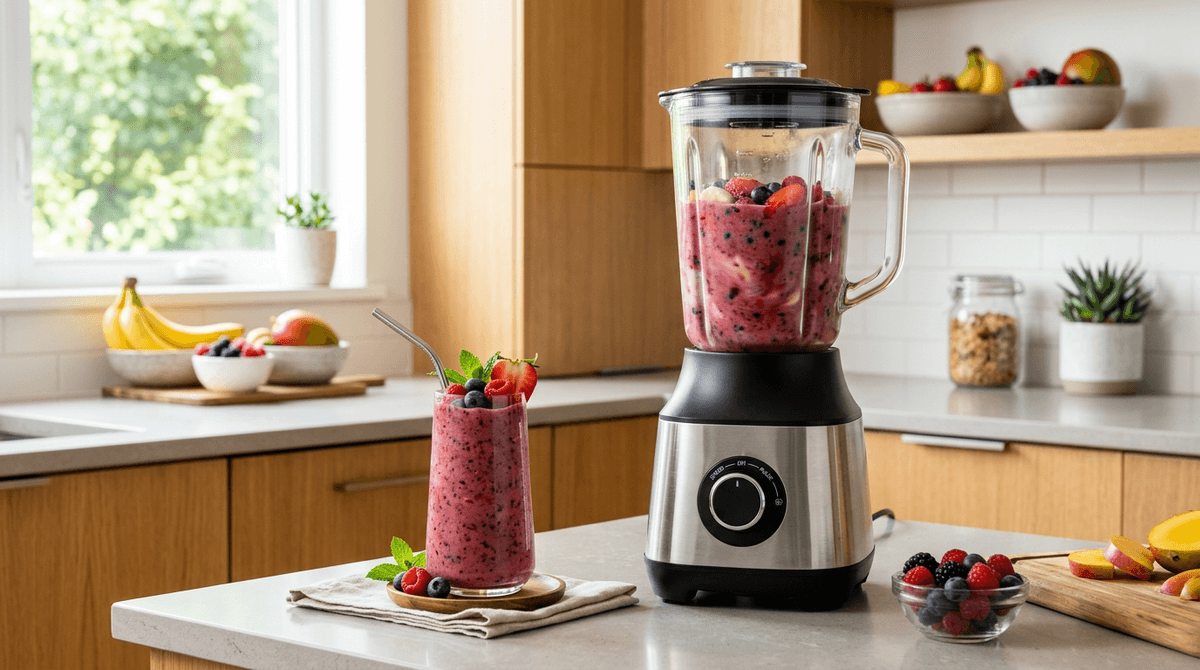
A blender is usually a universal motor in 120 V countertop models (a few premium lines use a brushless drive). Watts are highest with thick or icy loads and a high speed dial, and lower with thin liquids and low speed. A brief inrush from a dead start is normal; a sustained high current while the motor fights nut butter or ice can read above a single nameplate “running” number in the real world. That makes a short kWh story and a high-watt, short-moment story for inverters and small generators at the same time.
How to calculate kWh from watts and hours and Daily off-grid use in Wh turn seconds into kWh. Generator running watts vs starting watts is the right frame when a refrigerator, microwave, or coffee maker is on the same leg. Inverter sizing for off-grid solar and Pure sine vs modified sine matter if you run this on shared AC with a laptop or router. The WattSizing calculator adds the list honestly. For another kitchen motor, vacuum covers boost versus steady run.
1) Running watts by class (illustrative; nameplate wins)
| Class | Running W (ballpark) | Inrush you still respect |
|---|---|---|
| Personal / single-serve | ~200–500 | ~500–1,000+ in bad starts (brief) |
| Standard countertop | ~500–800 | ~900–1,500+ in worst cases |
| High-performance (large base) | ~1,200–1,500+ | ~1,800–2,500+ with heavy ice or thick load |
Variable speed: watts track the dial and the food—sticker W is not the only number in every second.
2) Inrush vs the nameplate (why your clamp disagrees)
Universal motors draw extra current in the first moments from 0 to run. A stiff batch (ice, nut butter) also raises sustained current, so a peak and a 5 s average from a kill-a-watt or clamp can both diverge from one sticker line.
Generator running watts vs starting watts is still the right mental model for overlap: blend in the same minute a fridge inrushes and you are modeling a real outage or cabin scenario, not a lab chart.
3) kWh: seconds matter for W, not for the monthly bill
1,200 W for 1 min ≈ 0.02 kWh—How to calculate kWh from watts and hours. A daily smoothie is a rounding error on many bills; a 1.2+ kW moment is not a rounding error to a 1 kW inverter. Central air is a different kWh class entirely.
4) 12 V, BMS, and the DC bus: W versus Wh
P ≈ V × I. A 1,200 W AC load on a 12 V inverter implies hundreds of amps on the DC lugs for short pulses when you include conversion losses. That is a BMS-, fuse-, and cable-headroom problem for W and A, not a huge Wh drain if the run is under a minute—unless the inverter will not start the motor at all. Sizing is “can it surge?” first; daily Wh is second.
5) 15 A kitchen branches: stacking, strips, and extension cords
A microwave, toaster, and blender can each sit in hundreds to low thousands of watts. Stagger high draws or split across branches. A long, thin extension cord raises resistance, drops voltage at the blender, and can trip breakers or make the motor sound unhappy without changing your bill math (see toaster and kettle FAQs on the same drop problem). Trip history beats debate.
6) Generators: concurrent peaks in one window
- A fridge inrush plus blender start plus coffee: add watts the way running vs starting explains—concurrent peaks, not nameplate daydreams.
- Smaller portables: a 1.2 kW-class continuous with surge for your measured inrush, or a habit of not blending when the microwave is full power.
Use generators outdoors with listed transfer; the U.S. DOE portable generator page is a sensible safety anchor.
7) Dimming lights, pure sine, and modified wave
When kitchen lights dip at blender start, you are seeing I × R in the house wiring. A pure sine wave inverter and short, fat cords are kinder to universal motors and to anything sensitive on the same AC (think laptop brick noise).
8) Use fewer watts when the task allows
- Thaw or crush ice in the jar a bit so the first seconds are not “solid lock.”
- For soups, an electric kettle is often a simpler resistive kWh line than a long blend—then finish with a short pulse if you need texture.
- A food processor (different motor story) or hand tools can replace a high-W base for some chores.
FAQs
How many kWh is a 60-second blend at 1,200 W?
1,200 W × (60 / 3,600) h ≈ 0.02 kWh—see kWh from watts and hours. Bills barely notice; a 1 kW inverter can still object.
Why will my 1,000 W inverter not run a “1,200 W” blender?
Inverters are rated for continuous and surge; a universal motor can exceed 1,000 W in sustained load and show a higher first-moment inrush. Measure in the mode you use; add voltage drop if you are on a long cord.
Do blenders have “starting watts” like a fridge?
A fridge compressor has a longer, legible inrush story; a blender is a briefer motor spike— still enough to stack with other motors in a generator total.
Is running watts on the box the only number I need?
No. The box is a summary; thick loads and max speed can sit above that line for seconds a clamp meter will see in the real jar.
Can a blender and a microwave run on the same 15 A circuit?
Often one at a time at full load is fine. A full-power microwave plus a 1.2 kW-class blender in the same moment is a common path to nuisance trips—stagger them.
On 12 V, how many amp-hours is one smoothie?
Convert W to Wh (short run), add inverter and wire losses, divide by nominal pack voltage. The BMS and fuse must pass the amperes for the surge window, not only the Wh average.
Does nut butter use more watts than a thin smoothie?
Usually yes—sustained higher current in a stiff mix is harder on the motor and on inverter headroom than a fast, liquid cycle.
Recap: use receptacle-level W, sustained load in thick mixes, and measured inrush when a 1 kW-class inverter or a tight generator is in play; use minutes to kWh for bills. Enter the row in the WattSizing calculator.


