
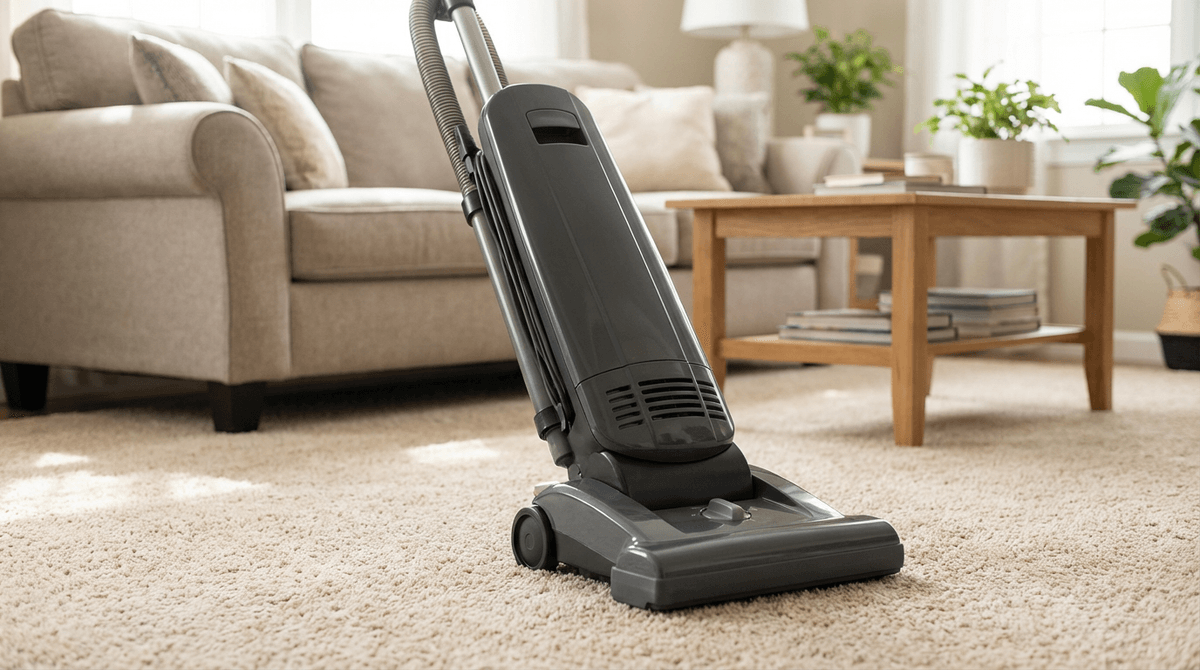
A vacuum is a blower story first: a universal or modern brushless motor pulls the largest share of watts; a separate brush-roll motor, lights, and control electronics add a little on top. Marketing numbers like air watts (sealed-suction test figures) help compare models—they do not replace the A × V story at the receptacle for backup math.
Turn minutes into energy with How to calculate kWh from watts and hours. For whole-house lists, the WattSizing Calculator and Daily off-grid use in Wh keep a vacuum row in proportion next to washer, dryer, and refrigerator lines.
1) Running vs a short start: it is a motor, not a toaster
Running watts are what you feel as steady suction. Inrush at power-on (or right after a brush stall clears) can sit above running draw for a fraction of a second to a few seconds—enough to matter for a small inverter or a tight generator headroom, but not a well-pump-style multi-second saga. Generator running watts vs starting watts is still the right mental model: stack what can be on in the same moment.
2) Corded classes (ballpark; nameplate and meter win)
| Style | Typical running W (normal / eco) | What to add mentally |
|---|---|---|
| Full-size upright | ~700–1,400+ | Boost can add a large W chunk for a few minutes |
| Canister | ~600–1,200 | Hose restriction changes load; clogs read as “weak battery” in cordless land |
| Light corded stick | ~500–900 | “Max” is not free |
| Shop / wet-dry (plug-in) | ~800–1,600+ sustained | Often the highest sustained W in residential cleaning; two with a saw on a small gen is a staggering game |
Boost / max is a second line item for inverter continuous rating, not a vibe setting.
3) Cordless sticks: two numbers—hand and wall
- In use (battery feeding the hand unit): think hundreds of watts in high modes; BMS and pack voltage set the ceiling, not a wall sticker.
- Charger at the outlet: often tens of watts for long times—trivial for monthly kWh, a separate row if you are counting receptacles on one strip (fire A risk with heaters is different from a 6 A hand motor).
4) Robots: low W, sometimes long hours
Drive + brush in operation are often tens of watts class. Dock features (self-empty fans, small pumps, mop heat) can add a separate scheduled bump—meter the outlet if the dock is what you back up, not a headline “30 W” figure from a spec chart.
5) kWh: chores are short; bills stay quiet
Example: 900 W corded for 20 min/day → 0.3 kWh/day (same formula as the kWh explainer). That is a rounding error on many bills but still a loud load to a 1,200 W inverter for those 20 minutes if the rest of the house is already on the edge.
6) 120 V, 15 A circuits: stacking reality
A NEC-sized 15 A branch is not an invitation to run a 1.2 kW+ microwave and a 1 kW+ vac on the same moment with margin for inrush. Stagger high draws or move one load to another branch. Trip history > theory.
7) Generators, job-site stacks, and shop vacs
- Upright while a fridge inrushes, or a microwave steps to full: add W the way running vs starting explains—concurrent peaks in one window.
- Shop vac + table saw (or miter) on a portable gen: two motor personalities; stagger or up-size the set.
- 12 V off-grid: Inverter sizing for off-grid solar and Pure sine vs modified sine—universal motors and cheap modified inverters are a poor long-term friendship.
Portable generator safety (outdoors, listed transfer, no backfeed) is non-negotiable; the U.S. DOE portable generator page is a sensible starting read.
8) Ways to use fewer watts and fewer trips
- Default to normal; reserve boost for real carpet pulls.
- Clean filters and remove clogs—restriction raises motor load.
- On backup, avoid a shop vac the same minute a big thermal or motor load is already ramping (for example the AC or a washing machine in high-speed spin).
FAQs
Is a higher-watt vacuum always better at cleaning?
No. Sealing, head design, agitation, and filtration can beat raw W on the box.
Do vacuums have startup surge like a well pump?
A brief motor inrush is common, not an 8 s 5× event. It still nudges small inverters and adds to a fridge inrush if you size in isolation—see running vs starting.
Why does my 2,000 W inverter trip on a “1,000 W” vac?
Boost can push continuous W past inverter rating; inrush plus voltage drop in a long thin extension cord can also trip protection. Measure in the mode you use.
Is a shop vac a bigger problem than an upright for backup?
Often in sustained W and in concurrent job-site use with other cords on the same gen—treat it as a serious row in the add-W list.
Are robot vacuums expensive to run on kWh?
Usually low in W; kWh = W × hours. Long missions and power-hungry docks need a separate meter look, not a single spec W from a retail card.
Can a small portable power station run a 1,200 W corded vac?
Only if the inverter’s continuous and surge with your measured inrush clear it at the receptacle you use; many compact units are rated in a different reality than a 1 kW universal motor in boost.
Do cordless sticks change what my apartment “total” is?
The charger is a long low-A event; the in-hand motor is higher A for a few minutes—map both. Do not stack with a heater on a cheap strip.
Is time-of-use pricing changing the W?
No—it changes $/kWh (e.g. EIA electricity explained). The motor does not care about your rate schedule.
Recap: use receptacle and nameplate watts (and measured inrush when stakes are high) for inverters and generators; use minutes and kWh for bills and battery-day rows. Enter honest numbers in the WattSizing calculator.


