
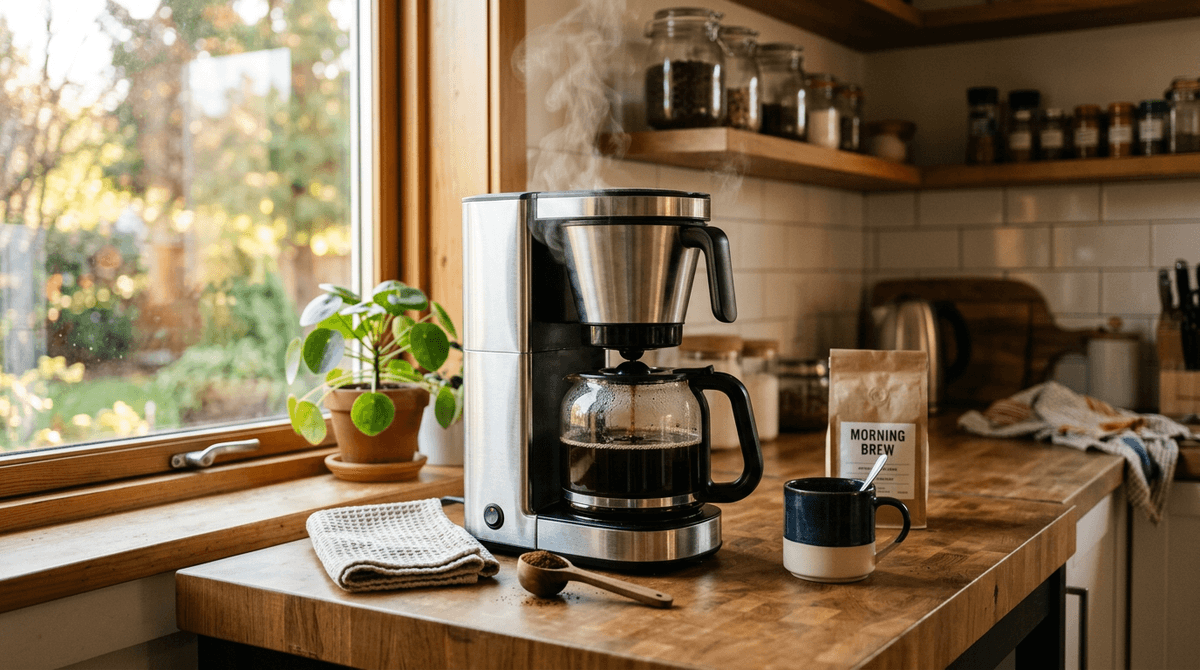
A drip coffee maker is mostly a water tank, small pump, and resistive heater, plus often a second carafe warm path after the brew. A single-serve (pod) machine may flash-heat a small slug of water at higher W for under two minutes. The A and V on the nameplate (or a short meter read) beat a cups per minute ad.
Model loads in the WattSizing Calculator. How to calculate kWh from watts and hours and Daily off-grid use in Wh cover time-to-kWh habits. Generator running watts vs starting watts applies when a refrigerator, microwave, electric kettle, or toaster share a tight backup minute. Inverter sizing for off-grid solar and Pure sine vs modified sine matter when the same AC also feeds a router and laptop chargers in one build.
1) Brew vs warm (typical drip)
| Phase | Plan in W (illustrative) |
|---|---|
| Brewing | ~800–1,200+ W for ~5–12 min on many 120 V drips—nameplate first |
| Warming plate | ~40–100+ W for as long as you leave it on |
Single-serve machines may hit ~1,200–1,500+ W in the heat step for under 2 min per cup. kWh per cup is small; the inverter still needs a 1+ kW headroom in that second.
2) By style (ballpark)
| Type | Brew-phase W | Notes |
|---|---|---|
| Small drip | ~600–900 | Shorter run |
| 10–12 cup drip | ~800–1,200 | Brew min + plate h = your kWh story |
| Single-serve / pod | ~1,200–1,500+ in flash | High W, short time; 15 A headroom on one receptacle |
| Home espresso (pump) | ~1,000–1,600+ in use | 120 vs 240 V on pro-style gear; dedicated feeds |
| Café / commercial (often 240 V) | Many kW | Dedicated panel feeds—outside this post's scope |
Surge (compressor sense): not the main story; overlap with a fridge inrush in the same minute still stings a small gen—running vs starting.
3) kWh per pot: high W, often modest kWh
How to calculate kWh from watts and hours. Example: 1,000 W for 10 min brew ≈ 0.167 kWh, plus 60 W warm plate for 1 h ≈ 0.06 kWh; ≈ 0.23 kWh for that routine if you leave the plate on. EIA electricity explained ties $ to kWh at your rate, not a W in isolation.
4) 15 A on 120 V: stagger the morning stack
A 1,000+ W brew at the same moment as a second heat load—microwave, electric kettle, or toaster—is how 15 A breakers and small portables earn their reputation. Stagger clicks: coffee, then toast—or the panel wins. Running vs starting still maps concurrent peaks.
5) Generators and portables
A 2,000 W (running) inverter generator can cover a ~1,000 W brew if the rest of the house is dark; add a fridge inrush or a 1,200 W toaster in the same 30 s and you want 3,000+ W (running) class or discipline. U.S. DOE portable generators—outdoors, listed transfer, no backfeed.
6) Inverters: Wh is not W
A large battery Wh bank does not fix a 500 W continuous inverter if brew needs 1,000+ W—Inverter sizing for off-grid solar. Pure sine vs modified sine on the same AC as mixed electronics is a sane default.
7) Habits that trim kWh
- Disable the warm plate or use auto-off when the manual allows.
- Descale on schedule; restricted flow can lengthen brew time and stress the element.
8) Fuel-first options (0 W at the meter)
French press, AeroPress, or a stovetop kettle on propane or natural gas—with ventilation and CO sense—uses no grid W for the heat step when a small inverter cannot clear a 1.5 kW brew.
FAQs
Does a coffee maker have a startup surge like a fridge?
Not in the compressor sense. The heating path is mostly sustained W; the overlap problem is still fridge + coffee in the same minute—running vs starting.
Why do single-serve brewers list 1,500 W?
They flash-heat a small volume quickly; high W for short s. kWh per cup can still be small; the inverter must clear the flash W.
Can I run a coffee maker on a 1,000 W inverter?
Only if brew nameplate and any pump peaks stay under the inverter continuous rating with margin—usually no for 1,200+ W drips—see inverter sizing.
Is the warm plate a big kWh leak?
It can be: 40–100 W for hours beats a 10 min brew on some days. Turn it off or use auto-off.
Can I use a smart plug on a coffee maker?
Only if the plug is rated for the A at 120 V (often 15 A class for a 1 kW+ brew). Read both nameplates.
Why do 230 V regions list higher-watt kettles and brewers?
Higher mains voltage and local plug ratings allow higher W elements for faster heat-up; kWh to raise a given water mass by ΔT is still physics, not a discount—see EIA on kWh and bills.
Is pod coffee cheaper to run than drip on kWh?
Depends on minutes at W and whether you leave a plate on. Measure your routine with a meter or use the calculator.
Recap: use nameplate brew W and warm W × time; add honest overlap for backup; enter real numbers in the WattSizing calculator.


