
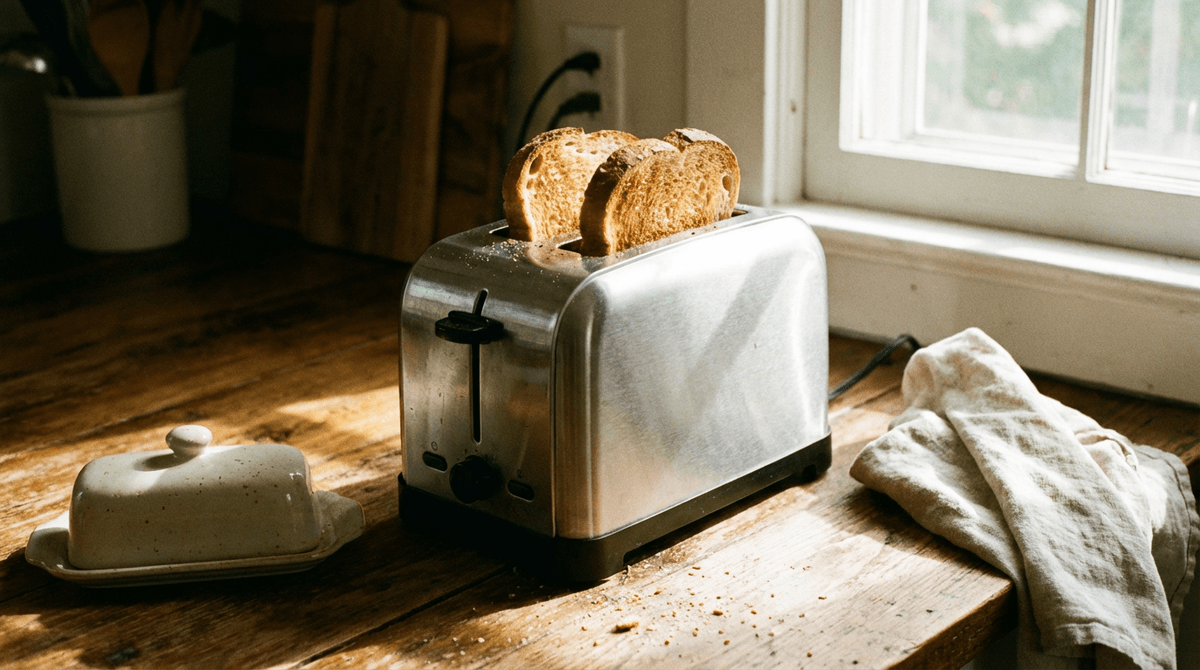
A pop-up toaster runs Nichrome-style elements at about nameplate W from lever-down to pop: no compressor-style start, but a sustained high current for 1–3 min. A toaster oven has a similar peak W when the heating element is on; a thermostat may cycle on and off for longer bakes—plan the on-time W for sizing, not only a long “average” over a 20 min program with off periods.
How to calculate kWh from watts and hours and Daily off-grid use in Wh turn minutes into kWh. Generator running watts vs starting watts matters when a refrigerator inrush, coffee maker brew, or microwave line up. Inverter sizing for off-grid solar and Pure sine vs modified sine apply on a shared off-grid AC bus with a router or laptop. Use the WattSizing calculator for a full list.
1) Pop-up: 2-slice vs 4-slice (illustrative 120 V)
| Style | W while toasting (ballpark) |
|---|---|
| 2-slice | ~800–1,200 |
| 4-slice | ~1,200–1,800+ |
Steady W with the lever down; off at 0 for a classic mechanical design (no smart standby). Sticker and clamp beat the box art.
2) Toaster oven vs pop-up
- Pop-up: a 2–3 min rectangle of W in kWh = tiny on the bill; still 1.2+ kW to the inverter for that span.
- Oven mode: 1,500–1,800+ W when elements are on; total kWh = (W × minutes on) ÷ 1000 over the bake—see the kWh page.
3) kWh per breakfast: loud W, quiet kWh (often)
Example: 1,200 W for 2.5 min = (1200 × 2.5 ÷ 60) ÷ 1000 ≈ 0.05 kWh per toast run—EIA electricity explained for how $ follows kWh at your rate, not a W in a vacuum.
4) 15 A on 120 V: the breakfast stack
A 1,200+ W toaster plus a second heat load—electric kettle, coffee maker brew, or microwave—on the same moment is how 15 A branches and 2,000 W portables earn their reputation. Stagger or split branches. Running vs starting still maps concurrent peaks with a fridge.
5) Generators
A 2,000 W (running) inverter generator can run many 2-slice toasters if the rest of the house is dark; 4-slice + coffee + fridge inrush wants 3,000+ W (running) class or discipline. U.S. DOE portable generators—outdoors, listed transfer, no backfeed.
6) Inverters
A big Wh bank does not fix a 1,000 W continuous inverter if the toaster needs 1,200+ W—Inverter sizing for off-grid solar. Pure sine vs modified sine is a sane default when the same AC feeds mixed loads.
7) Extension cords and dimming
Sustained 10–15 A on a thin, long cord is a fire and voltage-drop story: use short 12 AWG (or heavier for long runs), listed for the load. Lights dim on a shared branch when I steps and V at the lights sags—not a “toaster surge” myth.
8) Fuel-first toast (0 W at the meter)
Camp stove grill plates, cast iron on propane, or a broiler in a propane oven—with ventilation and CO sense—use no grid W for the heat step when a small inverter cannot clear a 1.5 kW toaster or oven element.
FAQs
Does a toaster have startup surge?
Not like a well pump—it is resistive W while on; running vs starting still matters for overlap with other loads.
Why does a 2,000 W generator trip when I add toast to coffee?
Coffee brew + toaster can be 2,200+ W sustained—above a strict 2,000 W running rating. Stagger or size up—see coffee maker.
Toaster oven vs pop-up for kWh?
Oven bakes add many minutes at on-W (thermostat cycles); pop-up is 1–3 min at nameplate. Add (W × minutes on) ÷ 1000 over the session—kWh math.
Can I use a cheap extension cord?
No for sustained 10–15 A on 16 AWG indoor cord. Short 12 AWG (or heavier) appliance cord if you must.
Do smart toasters have phantom load?
Classic mechanical lever units: ~0 W idle. Wi‑Fi or touch models can draw 1–3 W standby—read the manual.
Why do my kitchen lights dim when I push the lever?
Voltage drop on a shared branch when a large current step hits the wire—same idea as an electric kettle on the same circuit.
Is a 1,000 W inverter enough for a 1,200 W toaster?
No if 1,200 W is continuous need and 1,000 W is the inverter limit—inverter sizing.
Recap: nameplate W while toasting (or element-on in an oven); stagger breakfast heat on backup; kWh for bills; WattSizing calculator for lists.


