
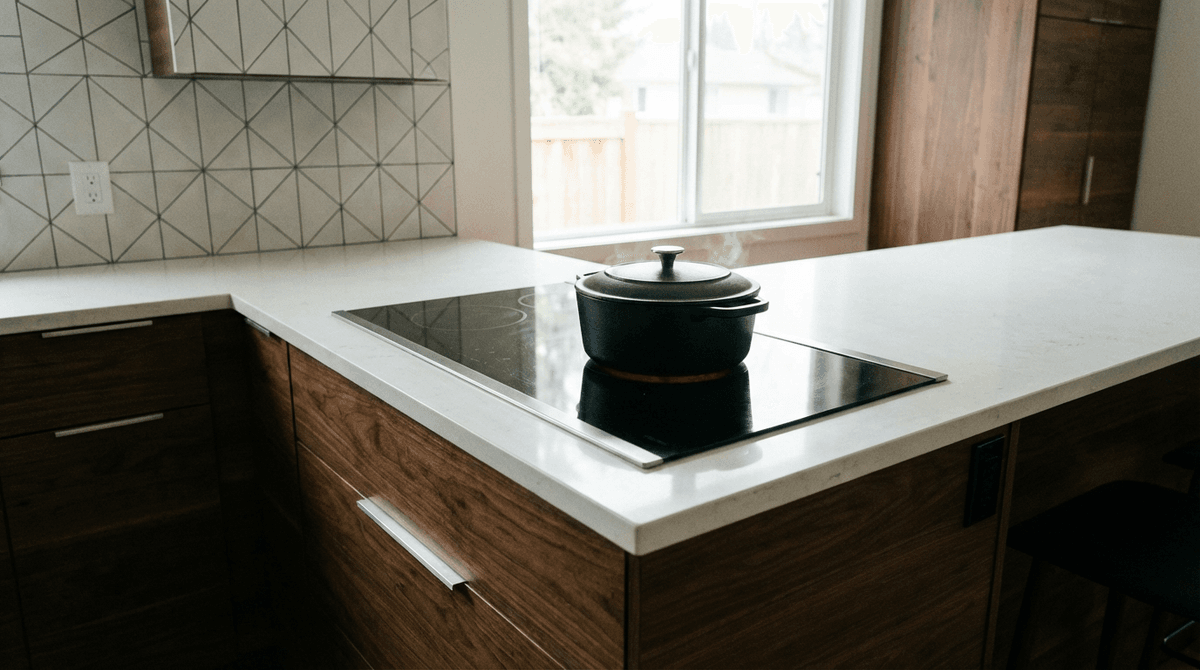
A U.S. kitchen range is often a cooktop with several burners or zones plus an electric oven in one enclosure—sizing a portable gen is about concurrent W on the cook you actually run, and the oven row if you preheat and sauté at the same time.
How to calculate kWh from watts and hours and Daily off-grid use in Wh turn minutes at a given W into kWh. Generator running watts vs starting watts is the right frame for stacking a 2+ kW burner with a microwave or refrigerator in the same outage minute—not a well-pump LRA story. Induction cooktop has a dedicated page for field-coupled zones; this article centers on coil and glass-top radiant elements—classic resistive cooktops. Inverter sizing for off-grid solar and Pure sine vs modified sine matter when a cook branch is part of a small AC system. Use the WattSizing calculator.
1) Per-burner W (North America, ballpark; nameplate wins)
| Burner or zone | Typical on-high W (order of magnitude) | Notes |
|---|---|---|
| Small | ~1,000–1,500 | Simmer, small pan |
| Medium | ~1,500–2,000 | Common daily driver |
| Large | ~2,000–3,000+ | Big stock pot, fast boil |
Low and med dials cycle the element—average W for the hour is often below the on-high nameplate.
2) Range plus oven: add the right rows
A freestanding electric range adds electric oven and broil/self-clean rows to whatever you run on the cook. For planning, add active burner W and oven/bake W for the same clock window, not a single nameplate.
3) 240 V feed vs what you feel at the pan
In North America, many ranges land on 240 V circuits, often 40–50 A class—your branch size is a panel and wire question. Per-burner or per-zone W on the label is still the row for a backup list; the service feed tells you the ceiling, not a single pot story.
4) kWh: one busy dinner (sketch)
Example: 2,000 W average across cycling for 0.75 h is about 1.5 kWh; see kWh from watts and hours. EIA: Electricity explained.
5) 15 A 120 V breakfast vs a 240 V range
Countertop electric kettle, toaster, and griddle on one 15 A 120 V strip is a different stack than a 240 V range with four zones—do not mix up branch math. Stagger the small stuff or split circuits; see running vs starting for overlap language.
6) Generators: sum burners you actually use
A 2,500–3,000 W large burner is easy for a 5 kW (running) portable by itself. Two large burners plus a preheating electric oven and a microwave in the same minute is a different running total. U.S. DOE: portable generators (outdoors, listed transfer, no backfeed).
7) Inverters: continuous W, same as a kettle
Resistive elements are usually sine-tolerant, but the inverter must still clear each zone nameplate W while it is on. A 3 kW continuous unit does not like three 1.2 kW zones and an oven if they overlap—see inverter sizing for off-grid solar; for mixed AC loads, lean pure sine vs modified.
FAQs
Does a stove have a well-pump style surge?
No. Burners and radiant elements are resistive; backup overlap is the story, not a locked-rotor motor peak.
Is full nameplate W running all the time on medium?
Not usually. Lower settings often cycle, so average W for the hour is below the high dial sticker.
Electric stove vs microwave for backup?
A high microwave input can rival one burner, but a stove with multiple high zones and an oven is usually the heavier concurrent stack. Log both in the same minute.
How many burners on a 5 kW (running) generator?
Depends on the zones you use and whether the oven is on. Add each active burner W; leave margin for a fridge in the same outage list.
Coil vs glass smooth top vs induction?
Nameplate W can overlap; induction couples into the pan—see the dedicated page. Here we focused on traditional resistive tops.
Stove and dishwasher on the same backup?
Dishwasher heat and pump rows add; stagger if the running total is tight.
Why did my 2000 W portable not run dinner?
Likely the sum of burners, oven, and something else in the same moment on the running W list—not a single burner at 2000 W.
Recap: add each active burner and oven row; use kWh from watts and hours for session energy; use running vs starting for overlap; then tune the list in the WattSizing calculator.


