
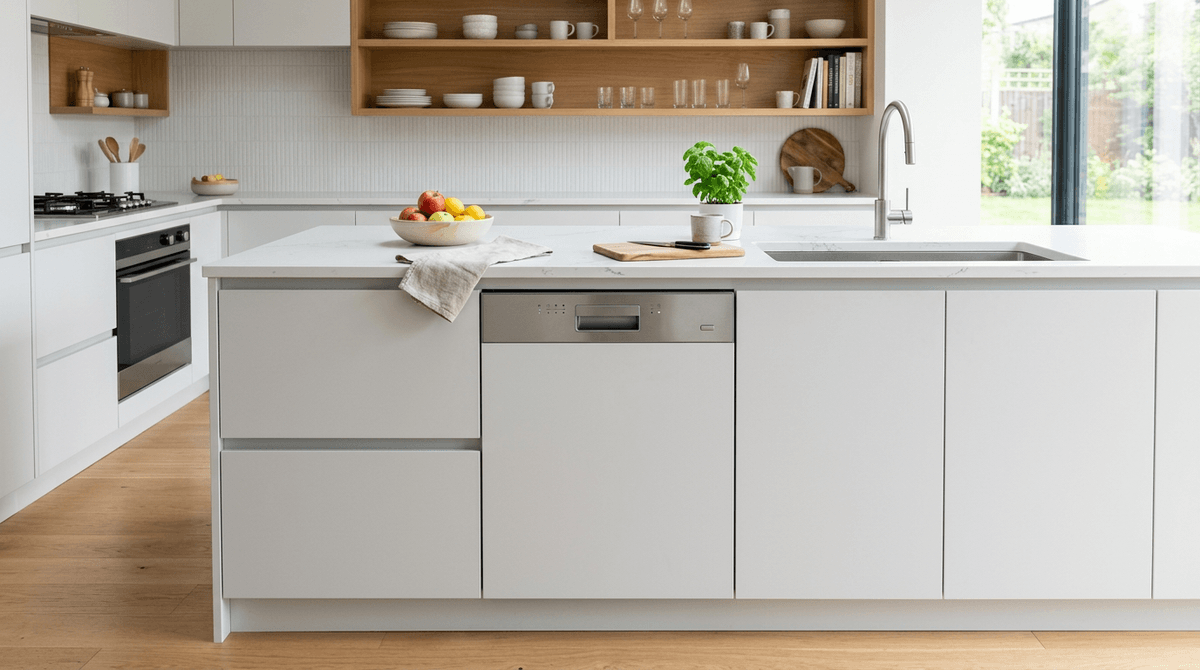
If you only track one number, track two: the short bursts from the water heater in the bottom of the tub (this sets peak watts for wiring and inverters) and the kWh per cycle (this sets your battery and daily solar budget). A dishwasher is not “like a small motor forever”—it is a small motor sometimes and a water heater sometimes, and the water heater is what can overlap badly with a fridge, microwave, or other heat on backup power.
Model loads with the WattSizing Calculator. For waveform questions on sensitive boards, read Pure sine vs modified sine wave inverters; for overlapping peaks on a generator, also see Generator running watts vs starting watts.
1) What actually pulls power: pump vs element vs extras
- Wash pump and diverter (spray arms): Often ~80–300 W while spraying—this can run a long time on efficient cycles.
- Drain pump: A shorter interval, often ~100–250 W while pushing water out.
- Fill and controls: Trivial in watts; detergent/dispensing and sensors add a little, but the headline is not there.
- Resistive boost heating (onboard “instant” water heat): Often ~1,200–1,800 W when the software decides the incoming water is too cool or the program demands high temperature.
- Heated dry / heated rinse trade-offs (if enabled): Another ~900–1,500 W class stretch that can double the electrical story of the cycle, even if total kWh is moderate because it is not on the whole time.
Why manuals feel vague: the marketing label is often a kWh per cycle (annual-style testing), not the instant watts your breaker and inverter see.
2) Typical on-cycle power shape (not a single flat “wattage”)
| Phase (typical) | What you are paying for | Order-of-magnitude instant draw |
|---|---|---|
| Fill | Valves, light controls | very low (often < 50 W effective) |
| Main wash (spray) | Pump and spray logic | ~150–300 W common |
| Heat boost to target temp | Resistive element (the big one) | ~1,200–1,800 W when active |
| Drain | Drain pump | ~100–250 W |
| Options: sanitize / heavy / pots | More heat time | more kWh and longer 1,200–1,800 W segments |
| Options: heated dry / extra dry | More element time | ~900–1,500 W segments; easy to avoid in settings |
Sanitize and heavy cycles often win on germs and baked-on food by buying time at temperature, not by raising the nameplate of the element—but that still shows up as more kWh on the meter.
To translate peaks into stored energy, use How to calculate kWh from watts and hours with honest minutes per phase.
3) The number your bill cares about: kWh per load
A useful planning band for a modern full normal cycle:
- ~0.5–0.8 kWh with no heated dry and no long sanitize stretch (best-case behavior).
- ~1.0–1.6 kWh for “typical” mixed use with a manufacturer default mix of heat time.
- ~1.6–2.2+ kWh if you run hot defaults, heated dry on, and frequent heavy/sanitize programs.
Off-grid point: well-designed homes often still prefer a dishwasher to endless sink hot water: the machine usually wins on gallons per place setting, and pumping water is its own load on solar.
4) Your panel reality: 120V plug, 15A vs 20A, and what “1,800W” implies
Most North American install guides assume a 15A or 20A, 120V kitchen branch (often 15A on older homes). A 1,500–1,800W heating burst is a large fraction of a 1,800W theoretical cap on a 15A circuit before you add anything else on the same breaker.
- If lights or another small kitchen load shares that branch, a bad overlap is a nuisance trip—not a moral failure, just a wiring plan issue.
- Some homes use a dedicated 20A for the dishwasher; that headroom is real watts you can feel at the breaker.
- A minority of high-end or regional installs are 240V-oriented; if your unit is 240V, the amps and breaker story change—read the nameplate, do not copy this article’s 120V mental model blindly.
This section is the “what most watt tables skip”: infrastructure, not a sticker on the pump.
5) Generators: plan for the overlap, not a dishwasher alone
A dishwasher is often compatible with a modest inverter generator only when you treat 1,200–1,800W as a sustained minutes-long need while heat runs—not a millisecond “surge” story. The real outage failure mode is dishwasher heat + fridge compressor + microwave deciding to be rude in the same ten minutes.
Practical floor for a “normal kitchen on backup” (illustrative, not a code stamp):
- Dishwasher + lights only: a 2,000W-class running-rated unit can work if nothing else big shares the plan—but margin is thin.
- Dishwasher + full-size fridge in the same window: think 3,500–4,500W running capacity as a planning band so overlapping peaks do not drag voltage.
Always convert your plan to kWh and minutes for the day, not a single “appliance label.”
6) Off-grid inverters: peak watts still matter, even if daily kWh is small
A battery day might only “see” ~1.2 kWh for a smart cycle—but the inverter still has to pass 1,500W-class while the element is on. A 1,000W inverter is the wrong product even if the daily kWh is tiny.
- Prefer pure sine for modern appliance electronics; see the inverter comparison link above.
- If you must cut electrical headroom, turn off heated dry and delay starts to sunny hours—behavior is cheaper than buying the wrong inverter twice.
7) Lower the bill and the load without a new machine
- Kill heated dry when you can—open the door a crack and let steam escape. That one settings change is often the biggest kWh win.
- Run full loads—a half load usually spends nearly the same fixed costs per cycle.
- Scrape, don’t pre-wash to spotless—enzyme detergents need soil to do chemistry; you save hot water and soap Life from the sink.
- If your home water heater is efficient and the plumbing path is short, inlet water temperature can shift how much the dishwasher resists. This is not universal—measure your inlet temp in winter if you are off-grid and suspicious.
FAQs
Why do “watts” online vary from 200W to 2,000W for the same machine?
They are often answering different questions: pump-only idling, heating burst, or label kWh divided by a guessed hour. Use peak watts for wiring and inverters, kWh per cycle for solar budget.
Does a dishwasher have a big motor “surge” like a well pump?
Usually no in the 3×–5× sense. The annoying peak is a sustained heat load, not a one-second inrush. Treat overlap as a power budget problem, not a traditional motor surge table.
Can I run a dishwasher on a 2,000W generator?
Often yes, briefly alone—if heated dry and other kitchen monsters are not stacked in the same minutes. The failure mode is concurrency, not the dishwasher in isolation.
Will a modified sine inverter run my dishwasher control board “fine”?
It might—but modern boards are the wrong place to gamble. Prefer pure sine (see the linked article) if you are buying hardware.
If I need one rule for off-grid, what is it?
Schedule the high-heat minutes when solar or generator headroom exists, and turn off dry modes you do not need. That is often worth more than chasing the last 50W on a pump.
Where does this fit in a full house load list?
Add both a 1.5–1.8 kW budget line for a possible heat window and a kWh line for the day’s cycles—Calculate daily off-grid energy in Wh shows the discipline.
Next step: build an honest list of overlapping devices, then use the WattSizing calculator for backup and solar math that matches your house, not a generic “dishwasher wattage” number from a three-word Google answer.


