
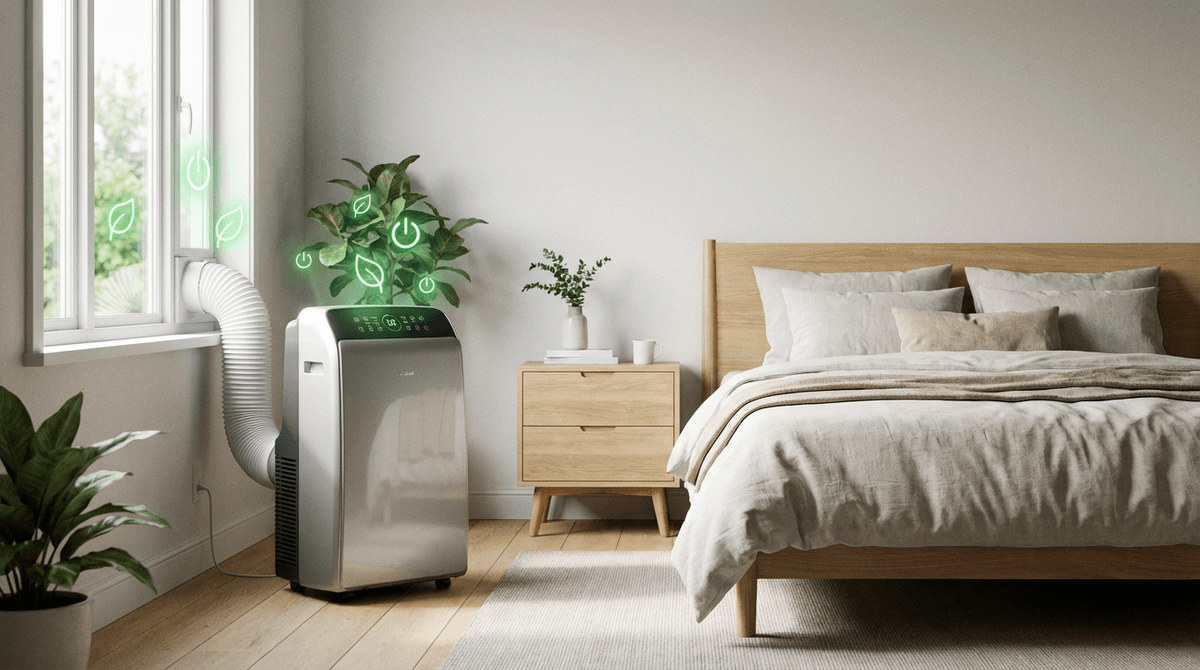
Portable AC units commonly use 900 to 1,800 running watts, with startup spikes often in the 1,800 to 3,200 watt range.
For full system planning, use the WattSizing Calculator.
1) Load shape and what changes draw
Appliance power draw usually has two numbers: running watts and starting (surge) watts. Running watts represent steady operation. Starting watts are short spikes when motors or compressors begin. For backup systems, inverter sizing, or generator sizing, you should account for both.
Real usage also depends on duty cycle, ambient temperature, maintenance state, and load profile. That is why nameplate wattage alone can under- or overestimate daily energy consumption.
2) Typical watt ranges (label first)
| Device Size / Type | Typical Running Watts | Typical Starting Watts |
|---|---|---|
| 8,000 BTU | 800 - 1100 W | 1500 - 2200 W |
| 10,000 BTU | 900 - 1300 W | 1800 - 2600 W |
| 12,000 BTU | 1100 - 1500 W | 2100 - 3000 W |
| 14,000 BTU | 1300 - 1800 W | 2400 - 3200 W |
| Dual-hose 12,000 BTU | 1000 - 1400 W | 1900 - 2800 W |
3) Session or daily kWh example
Example: A 12,000 BTU portable AC averaging 1,300 W for 6 hours/day uses 7.8 kWh/day. At $0.17/kWh, monthly cost is about $39.78.
If you need to convert this into battery and solar sizing, start with our guide on How to Calculate Daily Energy Use and then size your inverter using Inverter Sizing for Off-Grid Solar.
Generator and Off-Grid Sizing for Portable ACs
Compressor restarts repeat whenever the room thermostat cycles—generators and inverters see many starts on a hot day, not just one. Size for starting watts and the worst stack you will run (lights, fridge, router) at the same time.
BTU-based generator classes (illustrative)
| Portable BTU | Typical running W | Typical starting W | Typical generator class |
|---|---|---|---|
| 8,000 | 800–1,100 | 1,500–2,200 | 2,500–3,500 W |
| 10,000 | 900–1,300 | 1,800–2,600 | 3,000–4,200 W |
| 12,000 | 1,100–1,500 | 2,100–3,000 | 3,500–5,000 W |
| 14,000 | 1,300–1,800 | 2,400–3,200 | 4,200–6,000 W |
Dual-hose units may run more efficiently, but electrical peaks still follow compressor behavior.
Stacked home loads (illustrative): a 12k BTU class portable (1,100–1,500 W while the compressor is on), LED lights + router (60–150 W), fridge (120–220 W running; watch compressor start), and optional box or pedestal fans (40–120 W).
Worked example (illustrative): 12,000 BTU portable 1,350 W run / 2,800 W start; lights + network 140 W; fridge 190 W run. Running: 1,350 + 140 + 190 = 1,680 W. Start peak (simplified): 2,800 + 140 + 190 = 3,130 W before margin. Add ~20% margin: 3,130 × 1.2 ≈ 3,756 W—a ~4,200–5,000 W class is a common bracket if you want headroom for a microwave or other kitchen peaks later.
Off-grid portable AC is a two-part problem: watts (can the inverter start the compressor?) and kilowatt-hours (can the battery sustain the hours you insist on cooling?). Inverters are rated for continuous output and a short surge; if surge fails, running rating does not matter. Single-hose portables can increase runtime load by pulling in unconditioned air; dual-hose designs often reduce that penalty—you may use fewer kWh for the same thermostat, but you still size peak the same. If a 12,000 BTU class averages 1,300 W for 5 h/day, that is about 6.5 kWh/day for cooling alone—add inverter loss, other loads, and any days of autonomy you design for. Cloudy stretches may still need generator backup if comfort is non-negotiable.
Safety: use short, sealed exhaust hoses; run portable generators outdoors only; use proper transfer gear for house wiring; use heavy-gauge cords for continuous AC loads. See the U.S. DOE on portable generators and room air conditioners.
RV, apartment, and “per day / peak hours” (queries old spin‑off pages used to answer)
- In an RV — Venting, BTU, and available 30 A/50 A or inverter capacity drive whether a unit is realistic. The W and start in the table still apply; the install and seal determine duty cycle. Compare What Size Generator for an RV Air Conditioner if you are pairing cooling with a portable or rooftop plan.
- In an apartment — 15 A @ 120 V circuits (~1,800 W practical before nuisance trips) and lease rules matter as much as BTU. Watts to the unit do not know you live upstairs; the panel and extension cord do.
- Off‑grid and backup — Already covered in the block above. Reminder: restarts on a hot day, not one surge.
- kWh per day and monthly cost — Use (average running W while compressor is on) × (hours the compressor is effectively on) ÷ 1,000; a thermostat can cycle many short-on periods, so a kill‑a‑watt or utility data beats guessing.
- Summer heat vs “rainy” humid days — Humidity changes comfort and sometimes reheat/condensation behavior; the nameplate and compressor still set electrical peaks. A dehumidifier or fan is a different load if you add it to the same backup stack.
- “Peak hours” (utility time‑of‑use) — Changes price per kWh, not the instant watts in the table. You still need W and surge for the hardware.
4) Practical ways to reduce energy impact
- Use dual-hose models where possible for better efficiency.
- Keep exhaust hose short, straight, and insulated.
- Close blinds and block solar heat gain.
- Use dry/dehumidify mode when humidity is the main issue.
5) Backup sizing context
Use Generator running watts vs starting watts to model overlap with other home loads, not this row in isolation. For small systems, validate Inverter sizing for off-grid solar and waveform trade-offs in Pure sine vs modified sine.
FAQs
Do portable air conditioners have startup surge?
Yes. Compressor-based cooling can draw significantly more at startup and on each thermostat restart than during steady running—plan for that repeat behavior on hot days, not a single inrush.
Can I run a portable AC on a small inverter or generator?
Only if the device can deliver enough starting watts with margin, plus any loads you run at the same time. For compressors, size for surge first, then check continuous rating.
Does a dual-hose portable AC shrink the generator on paper?
It can reduce runtime energy in some conditions, but starting watts still follow the compressor—size from the tables above first.
Is “eco mode” a fix for generator overload on a portable AC?
Eco modes can help steady-state efficiency, but they do not remove compressor start—still plan for surge.
How do I estimate daily kWh quickly?
Use: kWh/day = (average watts × hours used) / 1,000. Then compare with your utility rate or battery/solar budget.
Can I run a portable air conditioner in an RV on a 2000 W generator?
Maybe, for smaller BTU and careful stacking—compare your unit’s running + start in the table to the generator’s continuous and surge specs, and add margin for a fridge or router you refuse to turn off.
Does a portable AC use more watts in summer at night than in the day?
It can run longer at night if it is still hot; instant compressor watts are similar. “Night” is not a different physics mode—thermostat, insulation, and outdoor temperature are.
How many kWh per day for a 12,000 BTU portable AC?
Depends on how many hours the compressor is effectively on. Example: 1,300 W average while cooling × 5 h compressor-on time ÷ 1,000 = 6.5 kWh for the cooling part that day; real homes vary widely.
Sources
- U.S. Energy Information Administration (EIA) - Electricity explained
- U.S. Department of Energy - Energy Saver
- ENERGY STAR - Save Energy at Home
CTA
Ready to size your setup accurately? Use the WattSizing Calculator to estimate panel, battery, and inverter requirements from your real appliance loads.


