
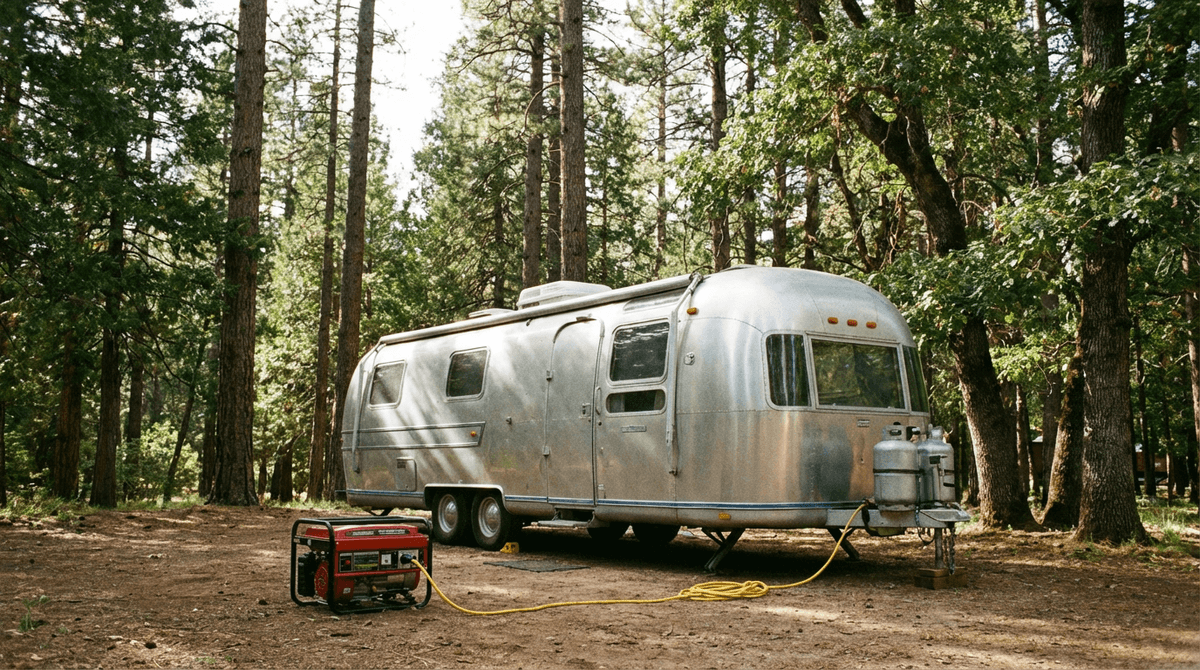
Short answer: If you only need lights, outlets, and battery charging, many trailers stay comfortable on a ~2,000–2,500 W inverter generator. The moment you add a roof air conditioner, compressor startup usually dominates sizing—often pushing you toward ~3,000–4,500 W continuous class (sometimes more), or two smaller inverters in parallel, especially if the converter is charging hard while the AC tries to start. Treat AC + microwave or AC + high charge current as stacked scenarios, not averages.
For your exact trailer, use the WattSizing Calculator. For solar-first planning, Off-Grid Solar RV Campervan Sizing is a useful companion read.
Scope: trailer power is a stack, not one number
- 30 A vs 50 A service on the trailer does not automatically tell you generator size—you care about which loads you actually run and what starts first.
- Soft-start kits for RV AC can lower required surge; results vary by install and unit.
- All numbers below are illustrative; read your AC, converter, and appliance labels.
Stacked scenarios (plan for the worst trip you actually take)
| Scenario | What is usually on | Conservative generator class (planning) |
|---|---|---|
| A. No roof AC | LED lights, phone/laptop, small TV, converter at moderate charge | Often ~1.8–2.5 kW inverter |
| B. AC + basics | 13.5k BTU roof AC, some 120 V use, converter not maxed | Often ~3–4.5 kW; verify AC LRA-style surge |
| C. AC + heavy 120 V overlap | AC running + microwave or electric water heater element (if used) + converter | Often ~4.5 kW+ or parallel inverters |
| D. Larger 15k BTU AC | Higher running and surge than 13.5k class | Bias up vs scenario B |
Weak-guide mistake: quoting “running watts only” for the AC without the converter and simultaneous kitchen peaks.
Illustrative watt table (verify on your rig)
| Use pattern | Illustrative running W | Illustrative surge / start context |
|---|---|---|
| Lights + outlets + low converter | ~400–1,200 W | Modest |
| 13.5k BTU roof AC + trailer base | ~1,600–3,000 W | AC compressor start often adds large short-term demand |
| Add aggressive battery charging | +300–1,000+ W | Converter draw varies with battery state and charger setting |
Illustrative calculation (hypothetical 13.5k BTU setup)
Hypothetical loads:
- Roof AC: 1,600 W running, ~3,200 W brief start (illustrative)
- Converter: 500 W (depends on bank and charger)
- Lights, small misc.: 200 W
- Fridge on propane (controls only): ~120 W
Running total (illustrative): ~2,420 W.
Startup planning: worst case often ties to AC inrush while other loads are present—many owners target ~4.5–5 kW class or parallel ~2–2.2 kW inverters to combine surge capability if the manufacturer allows it.
Add 15–20% feel margin for altitude, heat, and aging—illustrative.
Campground-friendly operation
- Prefer inverter units for noise and voltage quality for electronics.
- Know quiet hours and decibel rules; position exhaust downwind of neighbors.
- Avoid AC + microwave unless your math shows surge headroom—stagger heavy 120 V loads.
Safety: CO, cords, and bonding
- Never run a generator inside the trailer, awning tent, or cargo box. Exhaust kills—see NFPA generator safety guidance.
- Use adequate gauge cords; long thin cords drop voltage and stress motors. General portable guidance: U.S. DOE Energy Saver – Portable Generators.
FAQs
Is a 2,000 W generator enough for a travel trailer?
Often yes for no AC and light charging; usually no for roof AC startup unless you have soft-start and very controlled loads.
Can I parallel two 2,000 W inverter generators for AC?
Often yes when the manufacturer supports paralleling with the correct kit—combined running and surge must clear your AC’s needs.
Do I need 30 A or 50 A from the generator?
Match your shore power cord and panel, but electrical size still comes from loads + surge, not the plug shape alone.
Why does my generator stall when the battery bank is low?
The converter may pull high current while the AC tries to start—stacked demand. Reduce charge rate temporarily or stage loads.
Will a soft-start always let me downsize?
Not always—it helps surge; you still need enough continuous watts for running AC + converter + basics.
Where do I put real trailer numbers?
Use the WattSizing Calculator and your nameplate data.
Sources
- U.S. Department of Energy: Portable Generators
- U.S. Energy Information Administration: Electricity Explained
- Generac: Generator Sizing Guide
CTA
Map stacked trailer loads—AC, charging, kitchen—in the WattSizing Calculator so your next trip is not limited by a single missed surge.


