
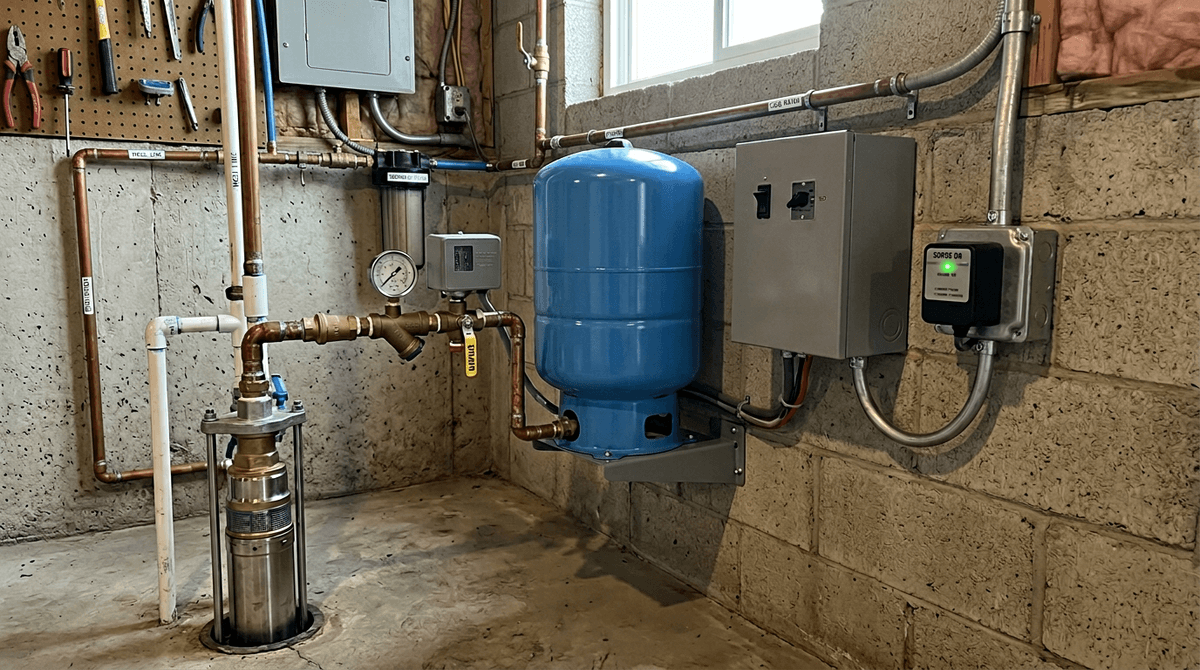
If you live in a rural or off-grid setting, a functioning well pump is the literal lifeline of your home. During a multi-day power outage, losing the ability to flush toilets, take showers, or drink clean water turns a minor inconvenience into an immediate crisis.
Because well pumps are heavy, motorized loads often submerged hundreds of feet underground, they demand an immense amount of electrical power to overcome the weight of the water column. While a 1 HP well pump might pull 1,500 running watts, the sudden startup surge can easily exceed 4,000 watts.
In this comprehensive guide, we will break down well pump wattage by Horsepower (HP), explain the terrifying reality of deep-well startup surges, and walk you through the exact math required to size a backup generator or off-grid solar system.
To model your specific well pump alongside your other household loads, use our free WattSizing Off-Grid Calculator.
The Quick Answer: Well Pump Power Draw
Most residential submersible well pumps operate at 240 Volts and draw between 700 and 2,000 running watts depending on their horsepower (usually 1/2 HP to 1.5 HP).
However, because the pump must instantly overcome the static head pressure of water sitting in the drop pipe, the startup surge is incredibly violent—typically 2.5 to 3 times the running wattage.
- 1/2 HP Pump: ~1,000 Running Watts / ~2,500 Starting Watts
- 1 HP Pump: ~1,600 Running Watts / ~4,000 Starting Watts
Well Pump Wattage by Horsepower (HP)
Well pumps are sized mechanically in Horsepower. The deeper your well (the static water level) and the higher your home's water pressure requirements, the larger the HP you need.
Here is a realistic look at what different sizes of submersible well pumps will pull from your electrical panel or generator:
| Pump Size (Horsepower) | Typical Running Watts | Typical Starting (Surge) Watts | Minimum Generator Size |
|---|---|---|---|
| 1/3 HP (Shallow) | 500 - 800 W | 1,200 - 1,800 W | 3,000 W |
| 1/2 HP | 700 - 1,200 W | 1,500 - 2,800 W | 4,000 W |
| 3/4 HP (Most Common) | 900 - 1,600 W | 2,000 - 3,500 W | 5,000 W |
| 1 HP | 1,200 - 2,000 W | 2,800 - 4,500 W | 6,500 W |
| 1.5 HP | 1,800 - 2,800 W | 3,800 - 6,500 W | 8,500 W |
| 2 HP (Deep / Agri) | 2,200 - 3,600 W | 4,800 - 8,000 W | 10,000 W+ |
Note: 1 Mechanical Horsepower equals 746 Watts of output power. However, because electric motors are only about 60% to 70% efficient, a 1 HP pump actually pulls closer to 1,200 input watts from the wall.
What Size Generator Do I Need for a Well Pump?
Sizing a generator for a well pump is the number one reason homeowners accidentally destroy their new portable generators. If your generator cannot handle the massive LRA (Locked Rotor Amps) spike when the pump starts, the generator's engine will stall, or worse, the alternator will burn out.
Furthermore, almost all well pumps larger than 1/2 HP require 240V split-phase power. Many small 2,000W to 3,500W portable inverter generators only output 120V. You cannot run a 240V well pump on a 120V generator, regardless of the wattage.
Generator Sizing Guidelines
- 1/2 HP Pump (Basics Only): You need a 3,500W to 4,500W generator that has a 240V outlet (usually an L14-30R plug).
- 3/4 HP Pump + Refrigerator & Lights: Aim for a 5,000W to 7,500W generator. This allows the pump to surge to 3,500W without dimming the lights or stalling if the fridge compressor is also running.
- 1 HP to 1.5 HP Pump: You are entering heavy-duty territory. You need an 8,000W to 12,000W generator.
Worked Generator Sizing Example
Imagine a winter storm knocks out your grid power. You need to run:
- A 3/4 HP Well Pump (Running: 1,200W / Surge: 3,200W)
- A Refrigerator (Running: 200W / Surge: 1,200W)
- A Gas Furnace Blower Fan (Running: 400W)
- LED Lights & Wi-Fi (100W)
The Math:
You must assume the worst-case scenario: The well pump turns on at the exact moment the other appliances are running.
3,200W (Pump Surge) + 200W (Fridge) + 400W (Furnace) + 100W (Lights) = 3,900W Peak Load.
Add a 25% safety margin to account for voltage dips during motor starts: 3,900W × 1.25 = 4,875W.
Recommendation: A robust 5,000W to 6,000W 240V generator will perfectly protect your home's water and heating systems in this scenario.
Off-Grid Solar & Battery Sizing for Well Pumps
If you are building an off-grid cabin or home, the well pump is usually the single most expensive appliance to plan around.
Sizing the Solar Inverter
Just like the generator, your solar inverter must handle the surge and the voltage. To run a 1 HP, 240V well pump, you must install a 240V Split-Phase Pure Sine Wave Inverter rated for at least 6,000W peak surge. "Modified Sine Wave" inverters will destroy the pump's sensitive start capacitors.
Daily Energy Consumption (kWh)
While the surge is massive, the actual daily energy footprint of a well pump is quite low. The pump only runs when you use water, filling a pressure tank (usually 20 to 60 gallons) in the basement, and then shutting off.
Formula: (Running Watts × Total Hours Run) ÷ 1,000 = Daily kWh
Let's assume a family of four uses 300 gallons of water per day. A 1 HP pump (1,500W) pumping 10 gallons per minute only needs to run for 30 minutes total per day.
1,500W × 0.5 Hours = 750 Wh (0.75 kWh) per day.
In off-grid terms, 0.75 kWh is tiny. It consumes less battery power over 24 hours than running a coffee maker twice. The challenge is entirely in building an inverter and battery bank capable of the high-amperage discharge required for the 3-second startup.
The "DC Solar Pump" Off-Grid Hack
If you are building an off-grid property from scratch, do not install a 240V AC residential well pump. Instead, install a dedicated DC Solar Well Pump (like those from Grundfos or RPS). These pumps run directly off solar panels or 24V/48V battery banks. They have variable-speed "soft start" motors with zero startup surge, allowing you to build a significantly smaller and cheaper solar inverter system.
4 Tips for Connecting Your Well Pump to Backup Power
- Do Not Backfeed Your Panel (The Suicide Cord): Never build a double-male extension cord to plug a generator into a dryer outlet to power your well pump. This is highly illegal and deadly. You must install a proper manual Transfer Switch or a Generator Interlock Kit with the help of a licensed electrician.
- Verify the Voltage (120V vs 240V): Shallow well jet pumps are sometimes 120V, but almost all deep-well submersible pumps are 240V. Check the breaker in your main panel. If it's a "double-pole" breaker taking up two slots, your pump is 240V. Your generator MUST have a 240V output.
- Check the Pressure Tank: Your well pump does not turn on every time you open the faucet. It fills a pressurized air bladder tank. If your pressure tank is waterlogged (the internal bladder is ruptured), the pump will "short cycle," turning on and off violently every 5 seconds. This will instantly overheat and destroy both your pump and your generator.
- Use a Motor Soft Starter: If you have an oversized 2 HP pump and a small generator, you can install a well pump soft starter (like the Franklin Electric SubDrive). This device ramps up the voltage slowly, eliminating up to 60% of the startup surge.
Frequently Asked Questions
Why does my generator hum loudly and then stall when the water turns on?
This is a classic "Locked Rotor" failure. The generator's alternator is simply not large enough to supply the massive amperage required to break the pump motor's inertia. The engine bogs down, voltage plummets, and the breaker trips. You need a larger generator.
Can a 4,000-watt generator run a 1 HP well pump?
It depends heavily on the generator's surge rating. A 1 HP pump surges to roughly 4,000W. If your generator is rated for 4,000W Starting and 3,200W Running, it might barely start the pump if absolutely nothing else in the house is turned on. A 5,000W generator is much safer.
Do 3-Wire pumps use more power than 2-Wire pumps?
No. The power consumption is identical. A 3-wire pump simply houses its starting capacitor in a control box above ground (in the basement), while a 2-wire pump houses its starting capacitor internally down in the well. 3-wire systems are generally preferred because you don't have to pull the pump out of the well to replace a blown $15 capacitor.
Conclusion
A well pump is the ultimate test of a home backup system. It requires careful planning to ensure your generator provides both the correct 240V split-phase power and the massive surge capacity needed to kickstart a motor sitting 200 feet underground.
Stop guessing on generator size. Head over to our free Off-Grid & Backup Load Calculator, enter your well pump's horsepower and your other essential appliances, and get an exact sizing recommendation instantly.


