
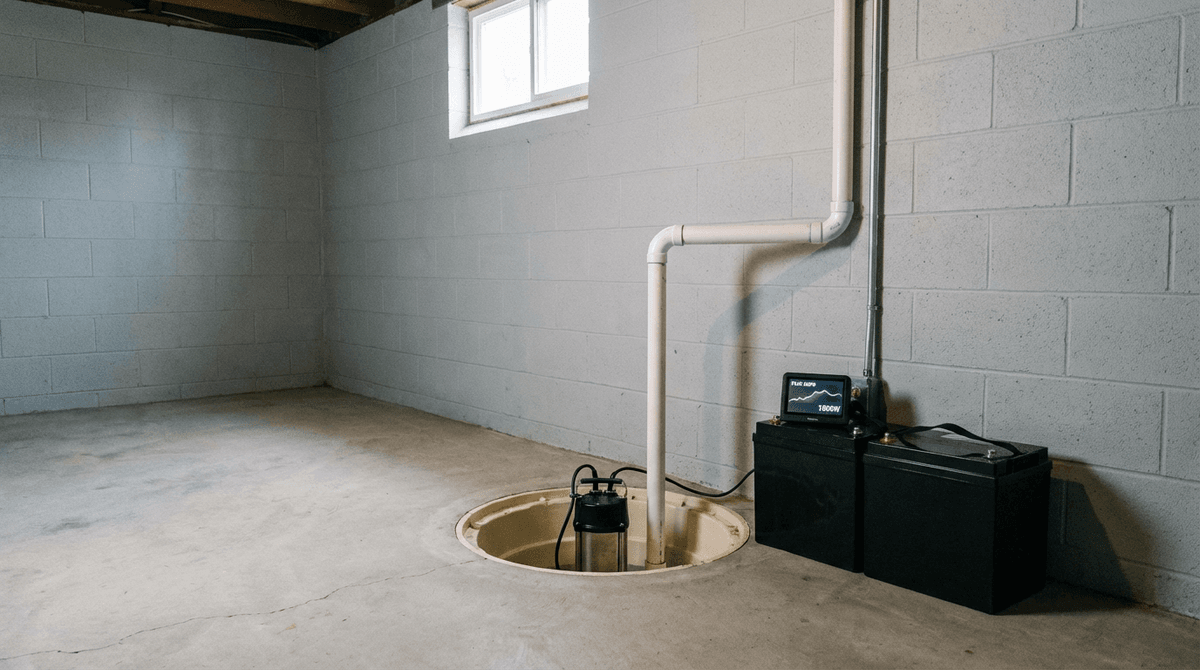
During a severe thunderstorm, a sump pump is often the only thing standing between your finished basement and catastrophic water damage. Unfortunately, severe storms are also the most likely events to knock out your electrical grid.
When homeowners rush to buy a portable generator to keep their sump pump running, they frequently make a critical mistake: they only look at the "Running Watts." A sump pump is a heavy, motor-driven load. While it might only draw 800 watts while pumping water, it can easily demand over 2,000 watts of surge power the exact second it kicks on. If your generator cannot handle that surge, the pump will fail to start, and your basement will flood.
In this comprehensive guide, we will break down sump pump wattage by Horsepower (HP), explain the terrifying reality of startup surges, and teach you how to properly size a generator or battery backup system.
For a complete backup power audit, use our free WattSizing Off-Grid Calculator.
The Quick Answer: Sump Pump Power Draw
A standard household sump pump usually draws between 700 and 1,500 running watts while actively pushing water out of the pit.
However, because the pump relies on an induction electric motor to overcome the weight of the water column instantly, the startup surge (inrush current) is typically 2 to 3 times higher, ranging from 1,500 to 4,000 watts for a fraction of a second.
Sump Pump Wattage by Horsepower (HP)
Sump pumps are categorized by their mechanical horsepower. A larger house with a deeper basement or a higher vertical lift (called "head") will require a higher-HP pump.
Here is what you can expect your sump pump to draw from your electrical panel or generator:
| Pump Size (Horsepower) | Typical Running Watts | Typical Starting (Surge) Watts | Minimum Generator Size |
|---|---|---|---|
| 1/4 HP | 300 - 600 W | 800 - 1,500 W | 2,000 W |
| 1/3 HP (Most Common) | 450 - 800 W | 900 - 1,800 W | 2,500 W |
| 1/2 HP | 700 - 1,200 W | 1,400 - 2,600 W | 3,500 W |
| 3/4 HP | 900 - 1,500 W | 1,800 - 3,200 W | 4,000 W |
| 1 HP (Heavy Duty) | 1,200 - 2,000 W | 2,400 - 4,200 W | 5,500 W |
| Effluent / Sewage Ejector | 1,400 - 2,400 W | 2,800 - 5,000 W | 6,500 W |
Note: The exact wattage depends on the motor's efficiency and how high it has to pump the water. Pumping water 15 feet vertically requires more wattage than pumping it 5 feet.
What Size Generator Do I Need for a Sump Pump?
Sump pumps are the ultimate test of a backup generator because they cycle on and off unpredictably. During a torrential downpour, your 1/2 HP pump might turn on every 60 seconds. Each time it kicks on, it slams your generator with a 2,500-watt surge.
Generator Sizing Guidelines
- 1/3 HP Pump (Basics Only): A 2,000W to 2,500W inverter generator is the bare minimum. It will handle the pump's surge, but you will not have room to run a refrigerator simultaneously.
- 1/2 HP Pump + Refrigerator & Lights: Aim for a 3,500W to 4,500W generator. This is the "sweet spot" for most homeowners. It provides enough headroom so that if the fridge compressor and the sump pump both start at the exact same millisecond, the generator will not stall.
- 3/4 HP to 1 HP Pump: You are stepping into heavy-duty territory. You need a 5,000W to 7,500W generator.
Worked Generator Sizing Example
Imagine a severe storm knocks out your power. You need to run:
- A 1/2 HP Sump Pump (Running: 900W / Surge: 2,200W)
- A Refrigerator (Running: 200W / Surge: 1,200W)
- Wi-Fi Router & Basement LED lights (100W)
The Math:
To be completely safe, you must assume the worst-case scenario: Both appliances surge simultaneously.
2,200W (Pump Surge) + 1,200W (Fridge Surge) + 100W (Lights) = 3,500W Peak Load.
Add a 20% safety margin: 3,500W × 1.2 = 4,200W.
Recommendation: A 4,000W to 4,500W generator will comfortably protect your home in this scenario without risk of overloading.
Sump Pump Battery Backups vs. Generators
If you are not home when the power goes out, a portable generator sitting in your garage is useless. This is why many homeowners install Battery Backup Sump Pump Systems.
How Dedicated 12V Battery Systems Work
Instead of plugging your massive AC sump pump into an inverter, a dedicated backup system installs a secondary, smaller 12V DC pump directly next to your main pump in the pit. This 12V pump is wired directly to a large Deep Cycle Marine Battery (or a Lithium LiFePO4 battery) and a trickle charger plugged into the wall.
- The Advantage: It is completely automatic. If the power dies and the water rises past the main pump, the 12V pump activates instantly. Because it is a DC motor running directly off DC batteries, there is zero efficiency lost to an inverter.
- The Limitation: 12V backup pumps are usually smaller (equivalent to a 1/4 HP) and cannot pump water as fast or as high as an AC main pump. Furthermore, a standard 100Ah lead-acid marine battery will only run the pump continuously for about 5 to 7 hours before dying.
If you live in an area prone to multi-day outages, a Battery Backup System is great for the first few hours, but a gas generator is still mandatory for long-term flood prevention.
Daily Energy Consumption (kWh) of a Sump Pump
If you are trying to calculate the impact of a sump pump on your monthly electric bill or size an off-grid solar array, you need to calculate Kilowatt-Hours (kWh).
Because sump pumps only run intermittently, their daily energy footprint is surprisingly low—even on rainy days.
Formula: (Running Watts × Total Hours Run) ÷ 1,000 = Daily kWh
Let's assume a heavy spring rainstorm hits. Your 1/2 HP pump (900W) turns on for 15 seconds every two minutes.
Over 24 hours, the pump is actively running for exactly 3 hours.
900W × 3 Hours = 2,700 Wh (2.7 kWh) per day.
At an average electricity rate of $0.15 per kWh, running your sump pump heavily for an entire day costs just $0.40. The power consumption is trivial; it is the power capacity (the surge) that requires careful planning.
Off-grid, apartments, RVs, and “rainy season” (topics old separate pages targeted)
- Off-grid homes — Surge watts still win; the battery must deliver current for locked-rotor behavior, not only the average kWh from the example above. Wet weeks that drive pump cycles while solar input is poor are the harsh case.
- Apartments / townhomes — Same HP table; practical limits are often building access, strata or landlord rules on generator use, and safe cord routing to the pit.
- RV — If you have a sump-style setup in a large mobile build, motor behavior matches the table. Many smaller RVs use 12 V backup pumps for different plumbing topologies than a full basement AC pump.
- “Peak hours” on the bill — Time-of-use rates change dollars per kWh, not the motor’s electrical surge. Rainy season mostly changes how often the pump runs (higher kWh/day and longer generator runtime), not the nameplate surge physics.
4 Tips to Ensure Your Pump Works During an Outage
- Test Your Setup Before the Storm: Do not wait for a hurricane warning. Pull your generator outside, run an appropriately sized, heavy-duty (10 or 12 AWG) extension cord to the basement, plug the pump in, and pour buckets of water into the pit to force it to cycle. Listen to the generator—does it bog down and stall, or does it handle the surge smoothly?
- Avoid Long, Thin Extension Cords: Pushing 2,500 watts of surge power through a cheap, 100-foot, 16-gauge orange extension cord will cause a massive voltage drop. The motor will be starved for voltage, run incredibly hot, and eventually burn out. Always use the shortest, thickest cord possible.
- Clean the Pit: A pump drawing 900 watts can suddenly draw 1,500 watts if the impeller is jammed with mud, gravel, or children's toys that fell into the pit. A straining motor draws more amperage, which can trip your generator's breaker.
- Install a High-Water Alarm: For $20, you can buy a battery-operated water alarm that hangs in the pit. If the water rises above the pump without it kicking on, an ear-piercing siren will alert you that there is a power or mechanical failure before the water hits your floorboards.
Frequently Asked Questions
Will a 2,000-watt generator run my sump pump?
If you have a small 1/3 HP pump, yes. A 2,000W generator can typically handle the ~1,500W surge of a 1/3 HP motor. However, if you have a 1/2 HP pump, a 2,000W generator will almost certainly trip its overload breaker when the pump tries to start.
Why does my generator stall when the sump pump kicks on?
This is a classic symptom of an under-sized generator failing to handle the "Locked Rotor Amps" (LRA) or starting surge. You must either upgrade to a larger generator or install a smaller 1/3 HP pump specifically for emergency use.
Can I run a refrigerator and a sump pump on a 3,500W generator?
Usually, yes. A 3,500W generator is large enough to absorb the surge of a sump pump and a refrigerator simultaneously, making it an excellent sweet-spot size for home backup.
Conclusion
A sump pump uses very little electricity over a 24-hour period, but it demands massive, violent spikes of power for a few seconds at a time. Whether you are buying a portable generator or building an off-grid solar battery bank, sizing for that 2,000W to 4,000W surge is the only way to guarantee a dry basement.
Ready to find the perfect generator size for your home? Use our free Off-Grid & Backup Load Calculator to enter your sump pump's horsepower, add your fridge and lights, and get an exact sizing recommendation instantly.


