
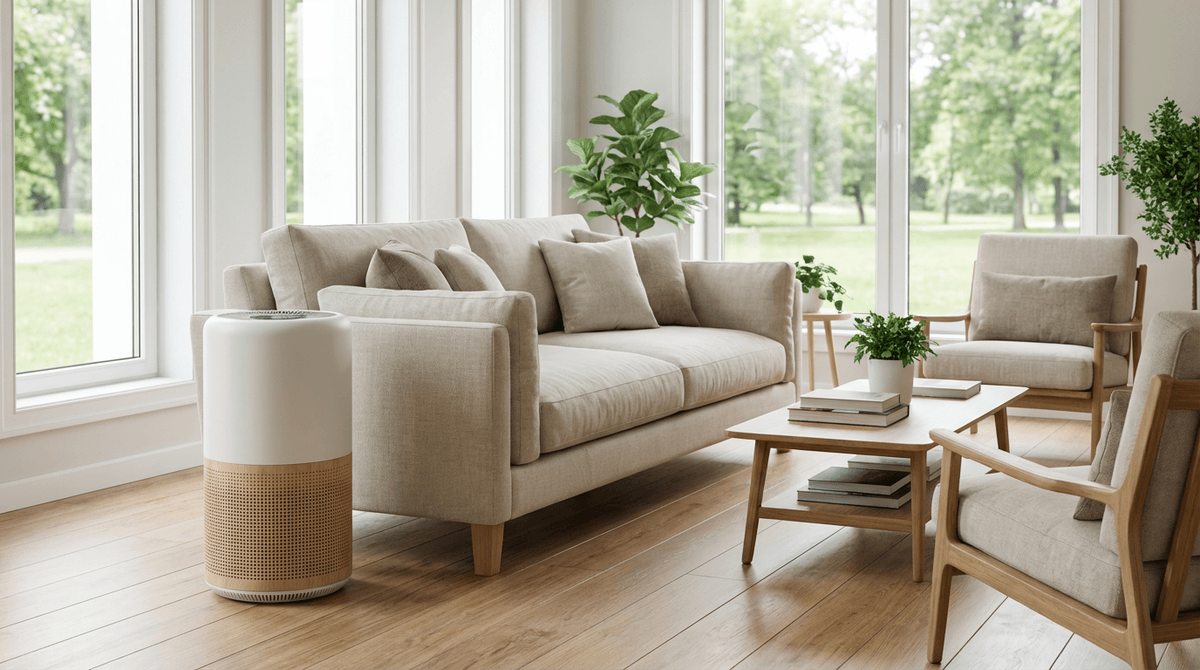
Most air purifiers draw about 5 to 80 watts depending on size and fan speed. Small bedroom units can sip power on low, while larger “whole living room” models can climb into the higher double digits on turbo.
If you’re planning off-grid runtime or you just want to see what it means in kWh and cost, use the WattSizing Calculator.
Quick Answer
A typical air purifier uses about 10 to 60 W on the settings most people actually live with. On sleep/low it may be 5–20 W, and on turbo/high larger units can be 70–120 W.
Detailed Explanation (What Drives Wattage)
An air purifier is mostly a fan motor pushing air through resistance (the filter). The power draw usually changes with:
- Fan speed: low vs turbo can be a huge difference.
- Room-size rating (CADR): bigger air throughput usually means a bigger fan.
- Filter loading: a clogged filter increases resistance; some units draw a bit more to maintain airflow (and get louder doing it).
- Extra features: UV, ionizer, Wi‑Fi, sensors usually add a small amount compared to the fan.
The way I think about it: watts aren’t “high,” but air purifiers can be always-on, so they’re worth accounting for in a home energy plan.
Watt Table (Typical Running Watts)
| Air Purifier Type / Setting | Typical Running Watts | Notes |
|---|---|---|
| Small room (sleep/low) | 5 - 15 W | Often used overnight |
| Small room (medium) | 10 - 25 W | Common day-to-day |
| Medium room (medium) | 20 - 45 W | Living room / open area |
| Medium room (high/turbo) | 40 - 80 W | Short bursts, wildfire season |
| Large room / high-output (turbo) | 70 - 120 W | Can be noticeable on a small inverter |
Simple Energy Estimate (Watts → kWh)
Even if you don’t know kWh yet, this conversion is the whole game:
- kWh = (watts × hours) ÷ 1000
So if your purifier averages 25 W and runs 24 hours:
- (25 × 24) ÷ 1000 = 0.60 kWh/day
If you want a per-day breakdown with monthly cost examples (the part most people care about), see How Many Watts Does a Air Purifier Use Per Day.
Related Reading (Internal Links)
If you’re building a realistic “always-on” home load list, these tend to sit in the same category:
FAQs
Does HEPA automatically mean higher watts?
Not automatically. HEPA increases filter resistance, but design matters more than the label. A well-designed HEPA unit can still be pretty efficient on low and medium.
Do air purifiers have a big starting surge?
Usually no. They behave more like a fan than a compressor. Still, if you’re sizing an inverter, don’t run it right at the edge—leave headroom for other loads.
What’s the fastest way to get the real wattage?
Use a plug-in power meter for a minute on each speed. It’s one of the easiest appliances to measure accurately.
CTA
If you know the watts (or can measure them), the WattSizing Calculator will convert it into kWh and cost, and help you see what it means for batteries, inverters, or a whole-home load plan.


