
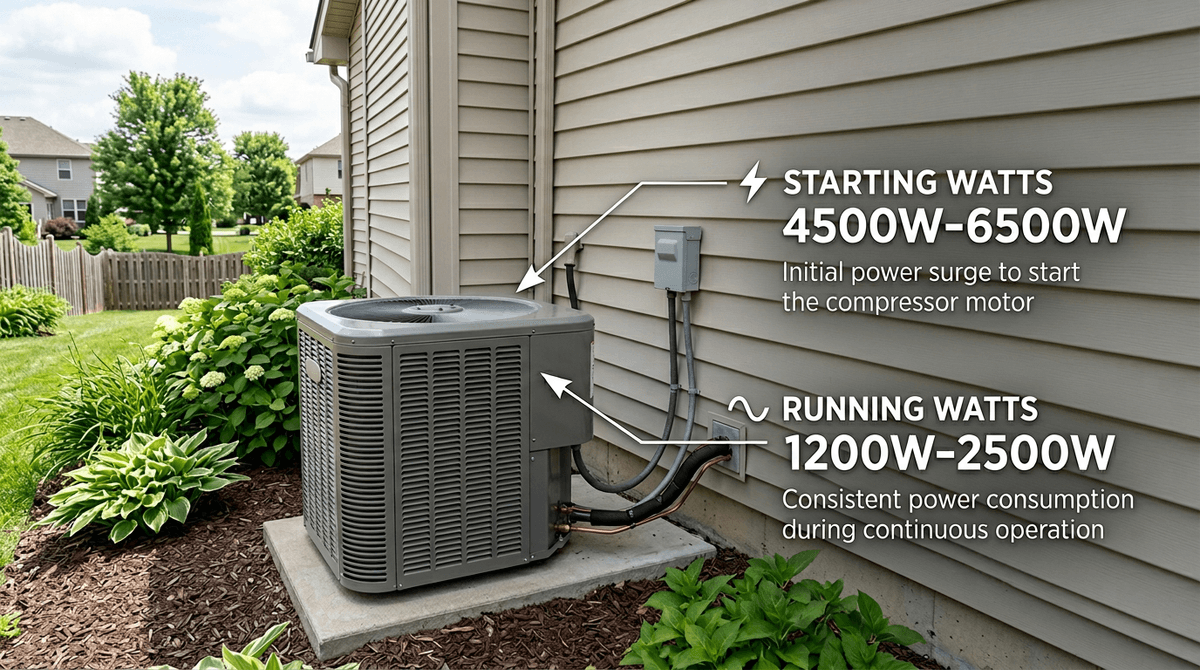
Central air during outages is possible, but it is usually the dominant load and can rapidly consume fuel or battery reserves.
For full system planning, use the WattSizing Calculator.
Quick Answer
On backup power, central AC usually needs about 2,500 to 5,500 W running and a safely managed startup margin, with typical consumption of 8 to 30 kWh/day depending on runtime strategy.
Detailed Explanation
Backup design is mostly about trade-offs: comfort versus endurance. Running central AC continuously can exhaust small generators or battery banks quickly, so many households use cycle windows, higher setpoints, or partial-hour operation.
For supporting guides, see What Size Generator for Central Air Conditioner and How to Calculate Battery Runtime for Appliances.
Watt Table
| Backup Strategy | Typical Running Watts | Typical Daily Energy |
|---|---|---|
| Limited cooling windows | 2,500 - 3,300 W | 8 - 14 kWh/day |
| Moderate comfort backup | 3,000 - 4,200 W | 12 - 22 kWh/day |
| Extended outage cooling | 3,800 - 5,500 W | 18 - 30 kWh/day |
Calculation Example
If AC averages 3,400 W for 4 hours/day during an outage:
kWh/day = (3,400 x 4) / 1000 = 13.6 kWh/day
Tips
- Start AC after other large loads have stabilized.
- Use higher thermostat setpoints to extend runtime capacity.
- Keep generator maintenance current before storm season.
- Track fuel or battery SOC with a strict cutoff target.
FAQs
Can a small portable generator run central AC?
Usually not reliably unless the AC system is very small and startup is managed.
Is soft-start hardware useful for backup?
Yes, it often reduces startup stress and improves compatibility.
Should I cool only certain hours during outages?
Yes, timed cooling blocks can dramatically extend backup endurance.
CTA
Build an outage-ready cooling plan with the WattSizing Calculator and test generator or battery runtime before emergencies.


