
Wet weather often lowers outdoor temperature but raises humidity, so central AC systems may run fewer full-cooling cycles yet more moisture-removal cycles.
For full system planning, use the WattSizing Calculator.
Quick Answer
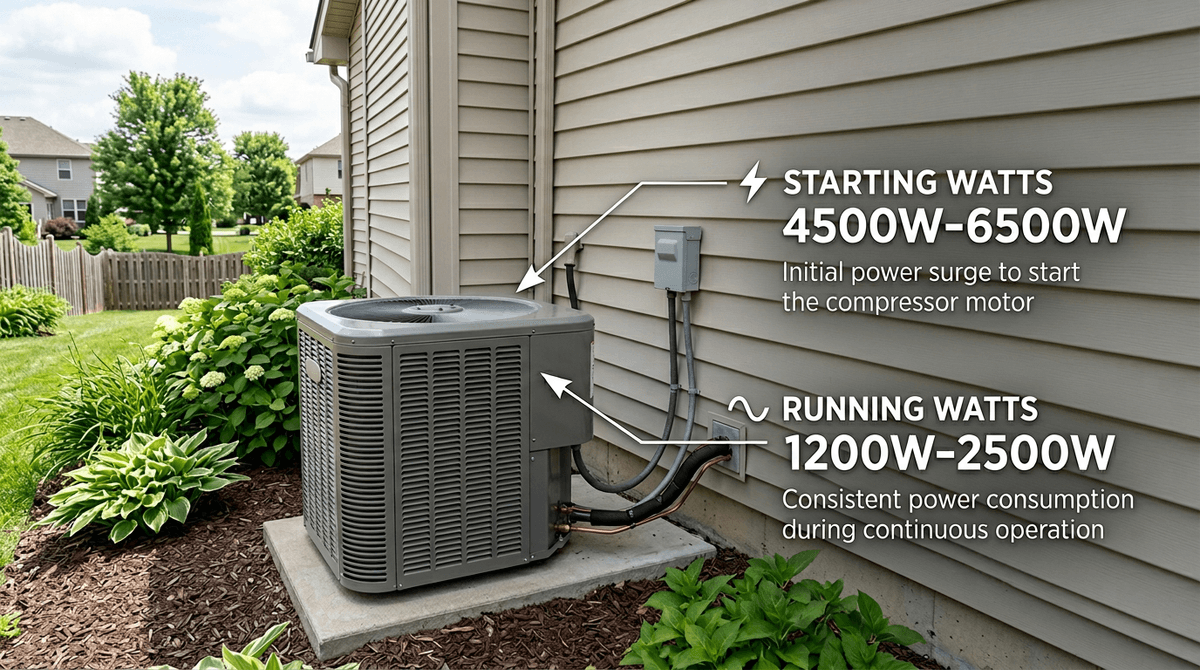
A central air conditioner in rainy season commonly runs around 2,200 to 4,800 W, with many homes landing near 10 to 28 kWh/day depending on humidity and insulation.
Detailed Explanation
In this context, comfort is driven by both sensible cooling (temperature) and latent cooling (moisture). That means your thermostat may show moderate temperatures while the AC still consumes noticeable energy to keep indoor humidity stable.
For related planning, compare How Many Watts Does a Central Air Conditioner Use Per Day and How Many Watts Does a Dehumidifier Use.
Watt Table
| Home Cooling Context | Typical Running Watts | Typical Daily Energy |
|---|---|---|
| Mild rain, short cycles | 2,200 - 3,000 W | 10 - 16 kWh/day |
| Humid rainy afternoons | 2,800 - 4,000 W | 14 - 22 kWh/day |
| Very humid tropical rain | 3,200 - 4,800 W | 18 - 28 kWh/day |
Calculation Example
If your system averages 3,200 W for 5.5 hours/day:
kWh/day = (3,200 x 5.5) / 1000 = 17.6 kWh/day
Tips
- Keep return-air filters clean to support moisture removal.
- Use a stable thermostat setpoint instead of frequent manual changes.
- Seal window leaks that pull humid air indoors.
- Track indoor RH and target roughly 45% to 55%.
FAQs
Why can rainy weather still produce high electricity use?
Because removing indoor moisture still requires compressor work even when outdoor air is cooler.
Should I run "dry" mode if available?
It can reduce overcooling and improve comfort in high humidity periods.
Does duct leakage matter more in rainy season?
Yes, leaky ducts can draw humid air and increase latent load.
CTA
Need humidity-aware cooling estimates? Use the WattSizing Calculator to model central AC runtime, daily kWh, and backup sizing.


