
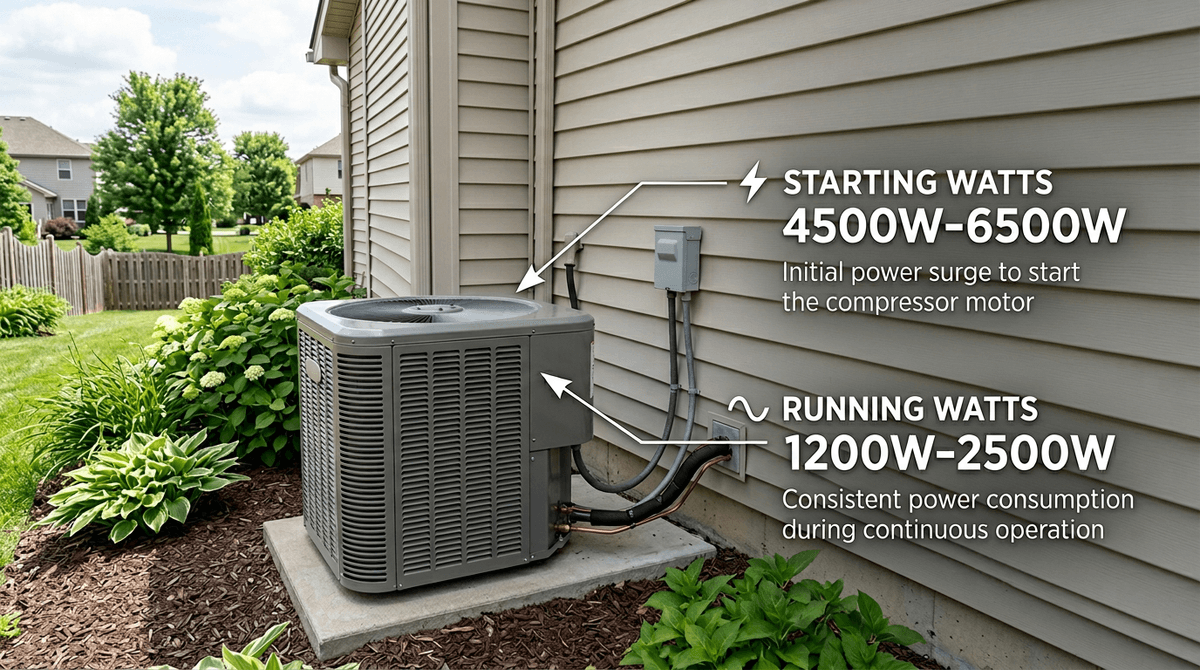
Most RVs use rooftop units, but some larger builds or bus conversions use central-style ducted cooling with similar electrical behavior.
For full system planning, use the WattSizing Calculator.
Quick Answer
A central-style RV AC setup usually draws around 2,000 to 4,000 W running, and many rigs see 10 to 26 kWh/day in warm weather.
Detailed Explanation
The key challenge is not only continuous power but also startup sequencing with chargers, microwaves, or water heaters. Shore power limits, generator derating, and cable voltage drop all matter in mobile systems.
For RV-specific sizing guidance, review What Size Generator for RV Air Conditioner and How to Read Generator Specs Running Vs Peak.
Watt Table
| RV Cooling Context | Typical Running Watts | Typical Daily Energy |
|---|---|---|
| Mild travel climate | 2,000 - 2,700 W | 10 - 15 kWh/day |
| Warm daytime operation | 2,500 - 3,300 W | 14 - 20 kWh/day |
| High-heat conditions | 3,200 - 4,000 W | 18 - 26 kWh/day |
Calculation Example
If central-style cooling averages 2,800 W for 6 hours/day:
kWh/day = (2,800 x 6) / 1000 = 16.8 kWh/day
Tips
- Stagger compressor starts with other heavy RV loads.
- Use reflective shades to reduce solar heat gain.
- Verify pedestal voltage before peak cooling periods.
- Service condenser coils before long summer trips.
FAQs
Can 30A shore power handle central-style RV AC?
Sometimes, but available headroom for other appliances becomes tight.
Do soft-start kits help?
Yes, they often reduce startup stress on inverters and generators.
Should I cool whole RV continuously?
Zoning and selective cooling usually lower daily kWh.
CTA
Size your RV cooling power accurately with the WattSizing Calculator before choosing inverter, battery, or generator upgrades.


