
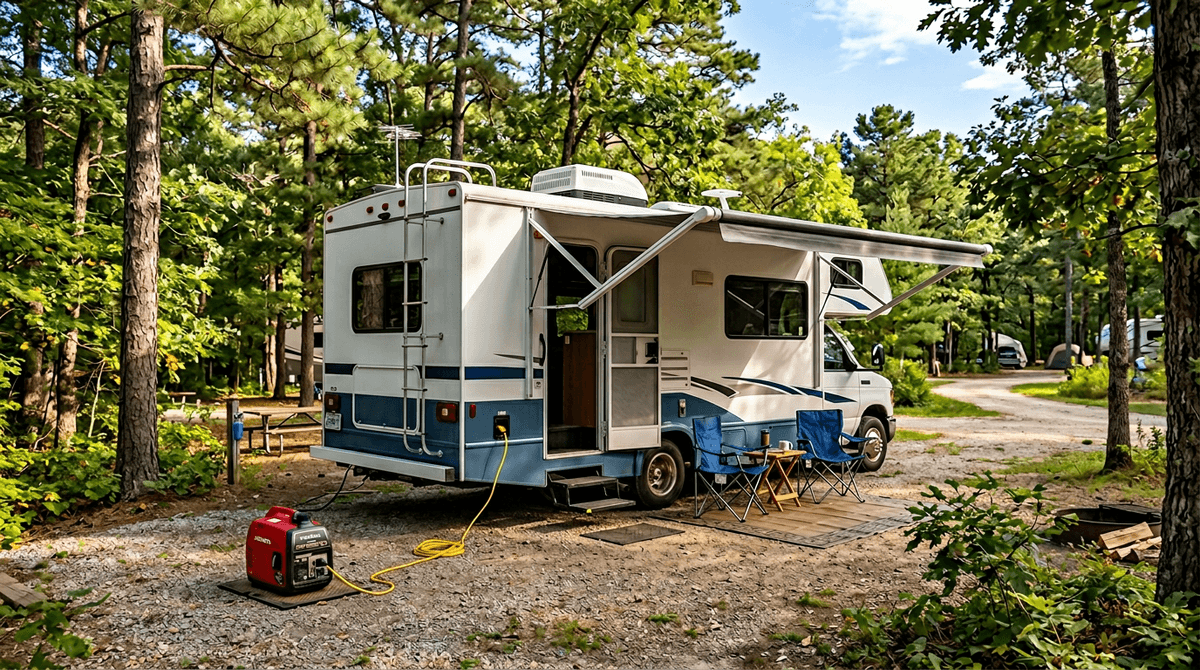
Answer-first: many single rooftop units in the 11k–15k BTU class pair with ~3,000–5,000 W portable generators once surge and RV parasitic loads are included; smaller 8k BTU class installs may work near ~2,500–3,500 W with careful staging; two ACs or high elevation often pushes ~5,500–7,500+ W.
BTU-to-watt bands follow How Many Watts Does a Window Air Conditioner Use and the RV-specific notes in How Many Watts Does a Window Air Conditioner Use in RV. Compare portable-AC behavior in How Many Watts Does a Portable Air Conditioner Use if you are weighing a floor unit. Stack loads in the WattSizing Calculator.
Why RV AC trips feel “random”
Rooftop units are branch-circuit limited: compressor start stacks with converter/chargers, fridge, and microwave on the same 30 A-style reality. Plan running, starting, and what else is on.
BTU bands (aligned with our window AC table)
| BTU class | Typical running watts | Typical starting watts |
|---|---|---|
| 8,000 BTU | 650–900 W | 1,500–2,200 W |
| 10,000 BTU | 900–1,200 W | 2,000–3,000 W |
| 12,000 BTU | 1,000–1,400 W | 2,200–3,300 W |
| 15,000 BTU | 1,300–1,700 W | 2,600–3,800 W |
13,500 BTU rooftops (common) usually fall between the 12k and 15k rows—illustrative until you read the nameplate.
Stacked RV loads (illustrative)
| Load | Illustrative running W | Surge / note |
|---|---|---|
| Rooftop AC (13.5k BTU class) | 1,100–1,600 | 2,400–3,500 start |
| Converter/chargers | 200–600 | varies with battery state |
| Fridge (AC mode) | 120–200 | 600–1,200 start |
| Microwave (when on) | 900–1,500 | resistive while heating |
Worked example (illustrative)
Assumed: 13.5k BTU class rooftop 1,400 W run / 3,000 W start; converter + misc. 400 W running.
- Running while cooling: 1,400 + 400 = 1,800 W.
- Start event (simplified): 3,000 + 400 = 3,400 W peak need before margin.
- Add 20% margin: 3,400 × 1.2 = 4,080 W—a ~4,500–5,500 W class inverter generator is a common real-world bracket before adding microwave overlap.
Soft-start kits can reduce start current—field-verify with your model.
Safety: shore cords, CO, bonding
- RV inlet ratings must match cord gauge and breaker; overheating cords cause low voltage and trips.
- CO: never run portable generators inside the coach or awning pocket—NFPA portable generator safety.
- Transfer/isolation: follow manufacturer guidance when bridging generator and shore paths.
U.S. Department of Energy: Room air conditioners.
FAQs
I have two rooftop ACs—do I need two generators?
Not always—some rigs stage loads or use management—but electrical math must cover worst-case starts you actually use. Recompute with both nameplates if you ever run both.
Why does my generator “lose” power in the mountains?
Altitude derating reduces engine output; plan extra headroom if you camp high elevations often.
Will a manufacturer-approved soft-start module shrink my generator class?
It can reduce compressor inrush, which helps marginal setups—but verify with measured starts; still plan for running watts and converter loads.
Sources
- U.S. Department of Energy: Portable Generators
- U.S. Energy Information Administration: Electricity Explained
- Generac: Generator Sizing Guide
CTA
Model AC starts plus RV parasitics in the WattSizing Calculator.


