
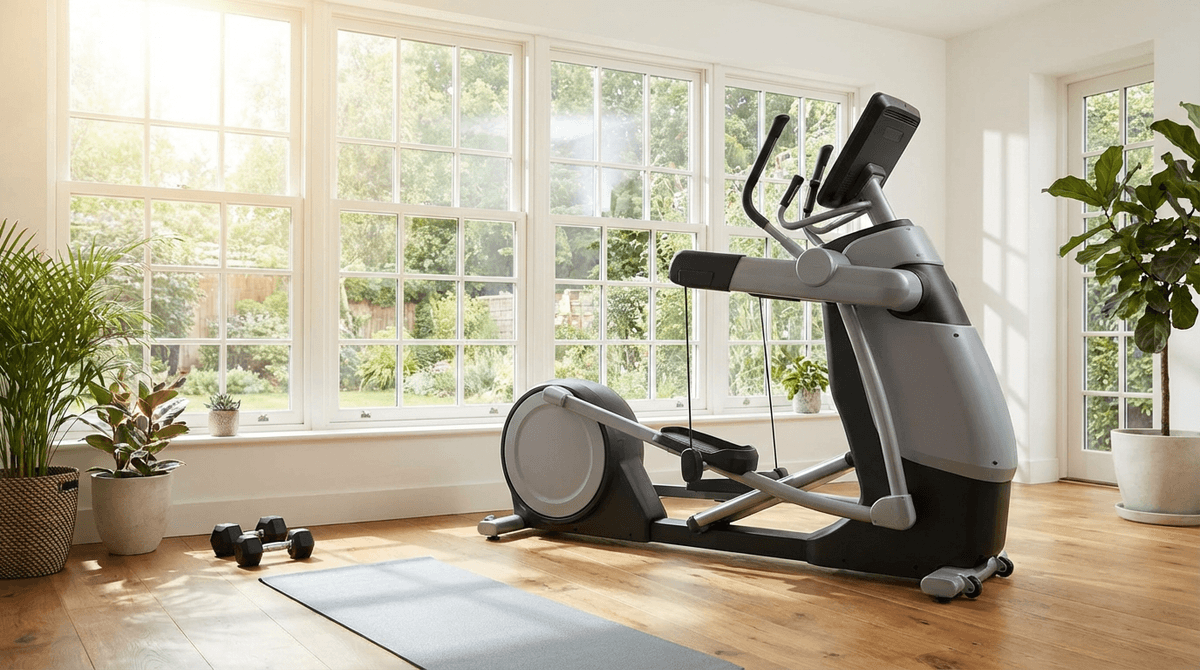
An elliptical is usually a lighter electrical load than a motorized treadmill: some units are mostly electronics and resistance controls, while self-powered designs can generate workout power and only sip outlet watts for the console. That means your planning row is often hundreds of watts, not a multi-kW motor line.
Use How to calculate kWh from watts and hours and Daily off-grid use in Wh to turn session time into energy. Generator running watts vs starting watts still matters if your gym shares outage power with a refrigerator or router. For small backup systems, check Inverter sizing for off-grid solar and Pure sine vs modified sine. Build your real list in the WattSizing calculator.
1) Typical wall watts by elliptical type (ballpark)
| Elliptical class | Typical active wall watts | What changes it |
|---|---|---|
| Self-powered (console only from outlet) | ~5-40 W | Console brightness, fans, charging ports |
| Basic plug-in magnetic resistance | ~80-250 W | Resistance level + electronics |
| Mid-range smart model | ~150-400 W | Program intensity, display hardware |
| Incline-capable or feature-heavy | ~250-600 W | Incline motors, larger displays, onboard fans |
The label and a plug meter win over any generic range.
2) Why elliptical watts move during a workout
Ellipticals are variable loads: resistance, cadence, incline adjustments, and console behavior change draw minute to minute. A workout interval block at high resistance can sit far above your easy warm-up row, even on the same machine.
Unlike a treadmill belt motor, many ellipticals avoid big repeated startup surges. But if incline motors or heavy electronics trigger at the same time as other home loads, the concurrent total can still matter.
3) Session kWh example (the number that hits the bill)
Example: your machine averages 280 W for a 35-minute session.
- Runtime: 35 / 60 = 0.58 h
- kWh = (280 x 0.58) / 1000 = ~0.16 kWh
At $0.16/kWh, that session is roughly $0.03. See EIA electricity explained for how $/kWh drives bill impact.
4) Elliptical vs treadmill rows in the same home gym
A plug-in elliptical often lands below a treadmill’s sustained motor draw, so the treadmill usually dominates the gym stack. Still, an elliptical plus TV, dehumidifier, and chargers can add up in backup mode.
If you keep both cardio machines, log separate rows and time overlap honestly.
5) Generator and inverter planning without over-sizing
For many setups, elliptical-only operation is easy for modest generators and inverters. The failure mode is usually not the elliptical by itself; it is overlapping with kitchen or HVAC peaks at the same moment. Use running vs starting math on the whole outage list.
For inverter systems, continuous watt ceiling still rules. A large battery does not fix an undersized inverter. Start with inverter sizing, then choose waveform quality based on your total AC mix (see pure sine vs modified).
6) Practical ways to reduce elliptical energy use
- Lower console brightness and disable idle fan/light extras.
- Use workout programs that match your training goal instead of constant max resistance.
- Turn the unit fully off after sessions instead of leaving standby electronics on.
- Keep moving parts maintained to avoid unnecessary drag.
FAQs
Do ellipticals have startup surge like treadmills?
Usually much smaller. Most elliptical draw changes are gradual resistance/electronics behavior, not belt-motor startup spikes.
Why does my elliptical show very low watts at the wall?
Many self-powered models generate workout power and only use outlet power for the display and accessory electronics.
Is elliptical watt draw fixed at one number?
No. It varies with resistance, cadence, incline activity, and console features.
Can I run an elliptical on a small inverter?
Often yes for basic models, if continuous inverter watts comfortably exceed the machine’s real active draw and other concurrent loads.
Elliptical vs treadmill for backup sizing?
Treadmills usually require a larger row because of sustained motor demand and potential surge behavior; ellipticals are commonly lighter.
Does an elliptical meaningfully increase my monthly bill?
It can, but session kWh is often modest unless workout time is long and frequent. Use your average watts and hours to estimate accurately.
Should I include TV, fans, and chargers in the gym row?
Yes. Backup sizing is about concurrent real use, not the cardio machine alone.
Recap: most ellipticals sit in the ~100-600 W active range when plug-in (and sometimes far less for self-powered console-only models). Use measured average watts and session hours for kWh, then size backup from the full concurrent list in the WattSizing calculator.


