
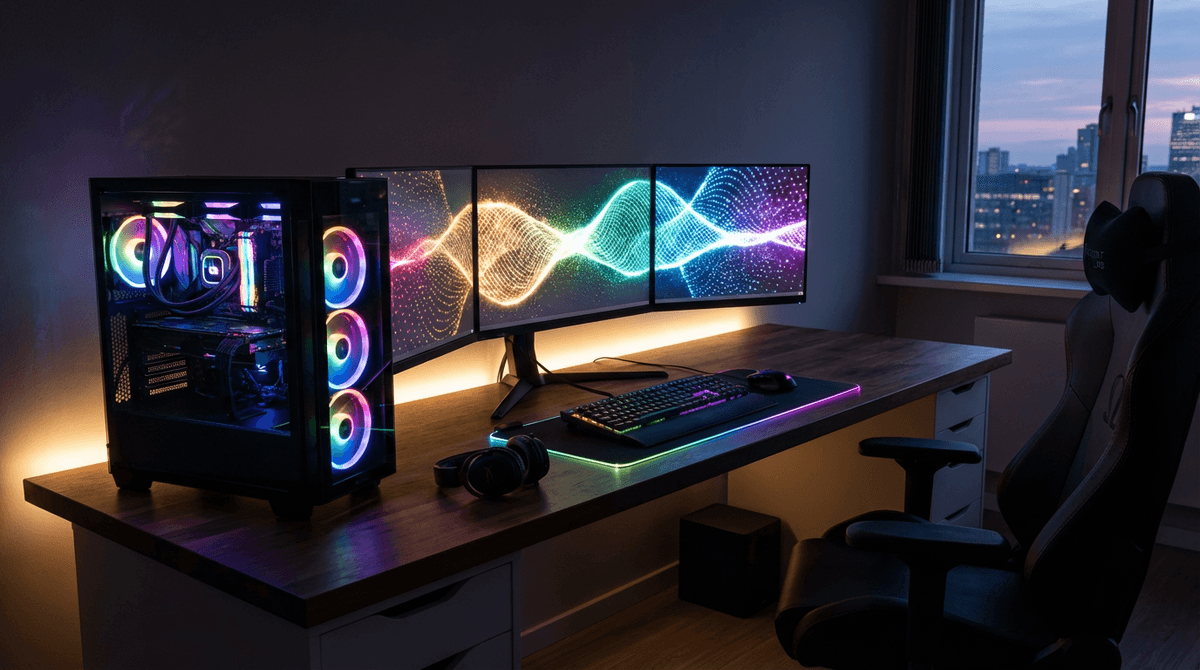
Most gaming pc setups use around 198 to 468 watts during peak hours, with typical startup demand around 216 to 540 watts.
For full system planning, use the WattSizing Calculator.
Quick Answer
For most homes, a gaming pc lands near 333 W on normal settings during peak hours. Actual draw depends on workload, speed profile, and how many hours you run it.
Detailed Explanation
Peak-hour operation is usually about reducing run time and shifting non-urgent loads when possible.
In practical terms, gaming pc power changes with three things:
- Operating level: low/medium/high speed for fans, or idle/productivity/heavy load for computers.
- Environment and schedule: during Peak Hours often changes total daily run time more than instant watts.
- System efficiency: newer motors and newer chipsets generally do more work per watt.
If you are comparing similar devices, see How Many Watts Does a Desktop Computer Use and How Many Watts Does a Laptop Use.
Watt Table
| Scenario | Typical Running Watts | Typical Starting Watts |
|---|---|---|
| Low-demand use | 139 - 188 W | 162 - 212 W |
| Typical daily use | 198 - 468 W | 216 - 540 W |
| Higher-demand sessions | 445 - 562 W | 513 - 648 W |
Calculation Example
Example: If your gaming pc averages 333 W for 4 hours/day during peak hours:
- kWh/day = (333 x 4) / 1000 = 1.33 kWh/day
- At $0.16/kWh, that is about $0.21 per day
Use this same method for your own schedule, then test multiple scenarios in the WattSizing Calculator.
Tips to Reduce Power Usage
- Start with the lowest setting that still feels comfortable or productive.
- Shift optional usage away from peak-cost periods when possible.
- Keep equipment clean and maintained so airflow and cooling stay efficient.
- On backup or battery systems, prioritize essential runtime over max-performance modes.
FAQs
Does this appliance have a large startup surge?
Usually the startup bump is modest, but it is still smart to leave inverter/generator headroom.
Why does watt draw change so much day to day?
Different workloads, speed settings, weather, and usage hours all change real-world averages.
Is the nameplate wattage always accurate in real use?
Nameplate values are useful for limits; measured day-to-day draw is often lower or variable.
CTA
Ready to size your setup with real numbers? Use the WattSizing Calculator to estimate wattage, daily energy, and backup runtime with confidence.


