
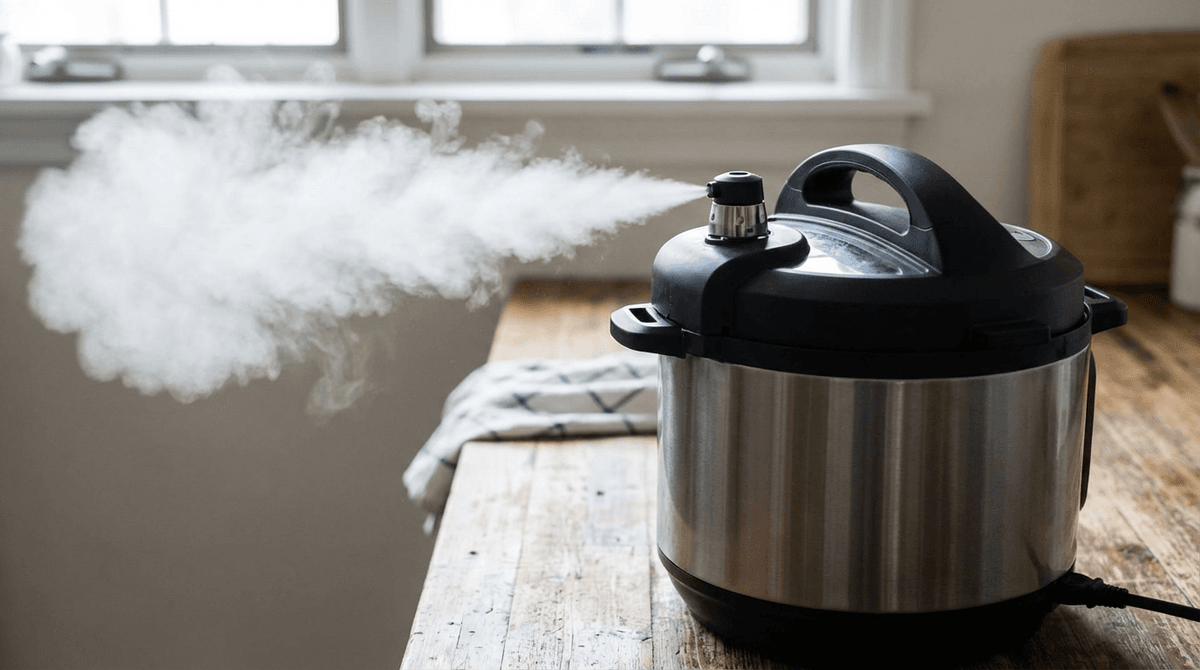
Most Instant Pot models are rated around 700 to 1,200 watts, but average draw during pressure cooking is often lower because the heater cycles after it reaches pressure. For inverter/generator planning, many setups should allow about 1,000 to 1,800 watts of headroom depending on size and what else is running.
For full system planning, use the WattSizing Calculator.
Quick Answer
Most Instant Pot models are rated around 700 to 1,200 watts, but average draw during pressure cooking is often lower because the heater cycles. For inverter/generator planning, allow about 1,000 to 1,800 watts of headroom depending on model size and simultaneous loads.
Detailed Explanation
An Instant Pot (and similar electric multi-cookers) uses a heating element controlled by a thermostat and pressure sensor. Power draw typically looks like this:
- Preheat/come-to-pressure: higher watts for a short period
- Pressure cook/maintain: cycling on/off, lower average watts
- Keep warm: low watts, but can run for hours if left on
For backup planning, the safest approach is sizing for the rated watts (plus margin). For energy planning, estimate kWh using an average over the recipe duration.
Watt Table
| Instant Pot Size / Mode | Typical Running Watts (Peak) | Typical Average Watts | Notes |
|---|---|---|---|
| 3 qt (pressure cook) | 600 - 800 W | 200 - 500 W | Lower peak, shorter heat-up |
| 6 qt (pressure cook) | 900 - 1200 W | 300 - 700 W | Common household size |
| 8 qt (pressure cook) | 1000 - 1400 W | 400 - 900 W | More mass to heat |
| Sauté / sear | 800 - 1400 W | 700 - 1200 W | Often near-continuous heat |
| Keep warm | 20 - 90 W | 20 - 90 W | Low watts, long duration |
Calculation Example
Example: A 6-qt Instant Pot averages 550 W across a recipe day (preheat + 25 minutes pressure + natural release), for a total active time of 55 minutes, then keep warm averages 50 W for 1 hour.
- Active time in hours: 55 / 60 = 0.92 h
- Active energy: ( (550 \times 0.92) / 1000 = 0.51 ) kWh
- Keep-warm energy: ( (50 \times 1) / 1000 = 0.05 ) kWh
- Total: 0.56 kWh
At $0.16/kWh, that’s about $0.09 per use, or roughly $2.69/month if used daily.
For complete home load planning, use How to Calculate Daily Energy Use and check inverter guidance in Inverter Sizing for Off-Grid Solar.
Tips to Reduce Power Usage
- Use keep-warm intentionally; turn it off if you won’t eat soon.
- For sauté-heavy recipes, consider reducing sauté time (it can be one of the higher-average-watt modes).
- Don’t stack high-watt kitchen loads at the same time on backup power.
- If you’re comparing appliances, note that shorter cook times don’t always mean less energy—high watts can offset the time savings.
FAQs
Does an Instant Pot have startup surge?
Not like a compressor motor. It can draw near its rated watts during warm-up, but it’s primarily a controlled heating load.
Is the rated wattage what it uses the whole time?
Usually no. During pressure cooking, the heater cycles, so average watts are often lower than the rating.
What’s a good internal comparison for kitchen planning?
See How Many Watts Does a Microwave Use and How Many Watts Does a Slow Cooker Use since they represent different “high-watt short time” vs “lower-watt long time” patterns.
CTA
Ready to size your setup accurately? Use the WattSizing Calculator to estimate panel, battery, and inverter requirements from your real appliance loads.


