
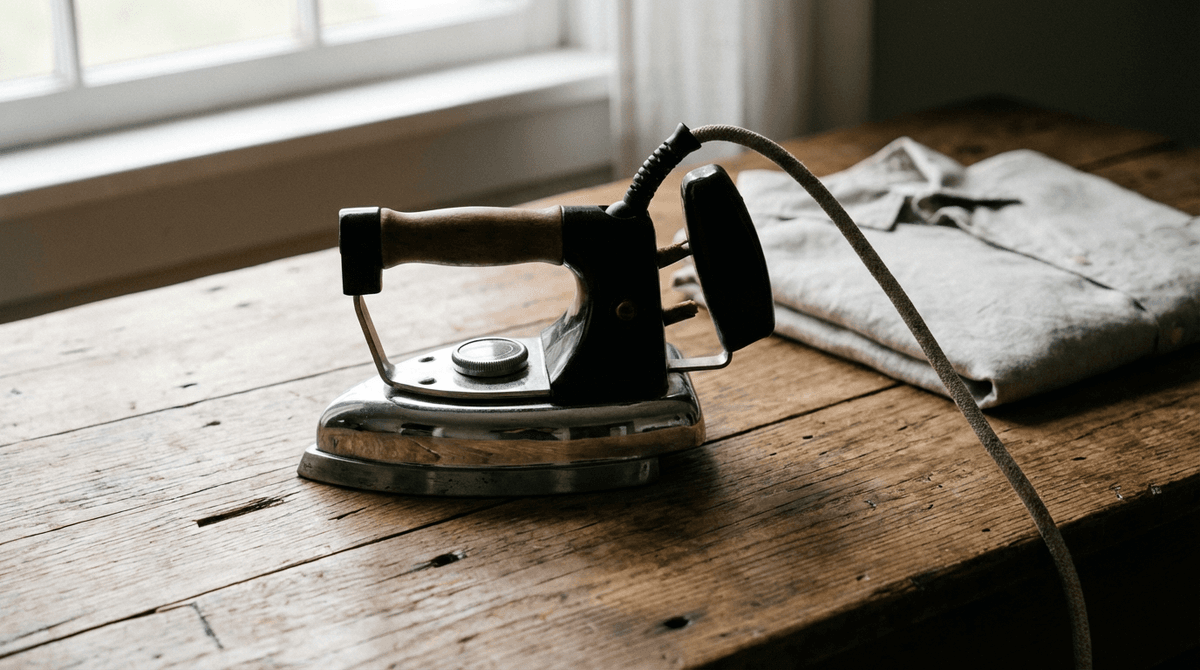
Most clothes irons pull high wattage for short periods. A typical household steam iron is usually around 1,200 to 1,800 watts when actively heating, while travel irons are often lower and steam-generator stations can be much higher.
If you searched for “how many watts does an iron use,” “steam iron wattage,” or “iron power consumption,” the short answer is:
- Typical iron running watts: 800 to 2,000 W
- Common steam iron range: 1,200 to 1,800 W
- Steam station systems: up to 2,800 W in some models
For full load planning, use the WattSizing Calculator.
Quick answer table: iron wattage by type
| Iron type / use case | Typical running watts | Typical starting watts | Best for |
|---|---|---|---|
| Travel iron | 600 - 1,000 W | 650 - 1,050 W | Portable use, small loads |
| Standard dry iron | 800 - 1,400 W | 850 - 1,500 W | Basic home ironing |
| Household steam iron | 1,200 - 1,800 W | 1,250 - 1,900 W | Everyday laundry |
| Heavy-duty / pro-style iron | 1,600 - 2,200 W | 1,700 - 2,300 W | Frequent, long sessions |
| Steam generator station (base + iron) | 1,800 - 2,800 W | 1,900 - 3,000 W | Fast throughput, high steam |
Use your nameplate as the final source of truth.
Why iron wattage changes in real use
An iron is mostly a resistive heating load controlled by a thermostat. That means it cycles:
- Higher draw while heating up
- Lower average draw once temperature is reached
- More frequent heating cycles when using heavy steam
If you’re comparing other “short time, high watt” appliances, see How Many Watts Does a Toaster Use and How Many Watts Does a Electric Kettle Use.
Running watts vs starting watts for an iron
Unlike motor loads, an iron usually has modest startup delta. In practice:
- Starting watts are often close to heating watts
- You generally do not see huge compressor-style inrush
- The bigger risk is overlap with other large loads (microwave, kettle, dryer)
For generator overlap logic, use Generator running watts vs starting watts.
Iron power consumption in kWh (session and daily examples)
Formula:
kWh = (average watts × hours) / 1000
Example 1: 30-minute steam session
A steam iron is rated 1,600 W, but cycles to an average of 900 W over a session:
- Session time: 0.5 hours
- kWh/session = (900 × 0.5) / 1000 = 0.45 kWh
- At $0.16/kWh, cost per session is about $0.07
Example 2: weekly laundry habit
If you iron for 4 sessions/week at 0.45 kWh/session:
- Weekly: 1.8 kWh
- Monthly (~4.3 weeks): ~7.7 kWh
- Cost at $0.16/kWh: ~$1.23/month
For full laundry-day planning, combine iron + washer + dryer in the WattSizing Calculator and compare How Many Watts Does a Washing Machine Use and How Many Watts Does a Clothes Dryer Use.
Iron wattage by voltage: 120 V vs 230 V
- 120 V regions: many home irons land around 1,200-1,800 W
- 230 V regions: many models can run higher nameplate watts
- Higher wattage often means faster heat-up, not automatically lower energy per garment
Always read your local model label and branch-circuit limits.
Can a generator or inverter run an iron?
Usually yes, if you size for real overlap.
Generator guidance
- A single iron load is straightforward for many generators
- Trouble starts when iron + microwave/kettle/fridge overlap
- Use Generator running watts vs starting watts to stack realistic concurrent loads
Inverter guidance
- Check continuous watts first, not just battery kWh
- A 1,000 W inverter cannot reliably run a 1,500 W iron
- See Inverter sizing for off-grid solar and Pure sine wave vs modified sine wave inverter
Practical ways to cut iron energy use
- Iron in batches so you only heat the iron once.
- Match temperature to fabric (avoid over-heating everything on max).
- Keep the soleplate clean for better heat transfer and shorter session time.
- Turn off “always-on” keep-warm modes when not needed.
FAQs
How many watts does a steam iron use?
Most household steam irons are around 1,200 to 1,800 W while actively heating.
How many watts does an iron use per hour?
At full heating, a 1,500 W iron uses about 1.5 kWh in one full hour. In real use, cycling lowers the average.
Is iron wattage the same as iron power consumption?
Not exactly. Wattage is instantaneous power; kWh is energy over time. Billing is based on kWh.
Does an iron have high starting watts?
Usually only slightly above running heating watts. It is not a large motor-inrush appliance.
Can a 1000W inverter run an iron?
Usually no for common household irons. Many irons are 1,200 W+ and need inverter continuous wattage above that.
Why does my watt meter jump up and down when ironing?
The thermostat cycles heating on/off to hold target temperature; steam use can increase duty cycle.
Is a higher-watt iron always better?
Not always. It heats faster, but total energy use depends on session length, thermostat cycling, and usage habits.
CTA
Want to know what your whole home setup needs (or what a portable power station can handle)? Use the WattSizing Calculator to estimate inverter size and daily energy from your real appliance loads.


