
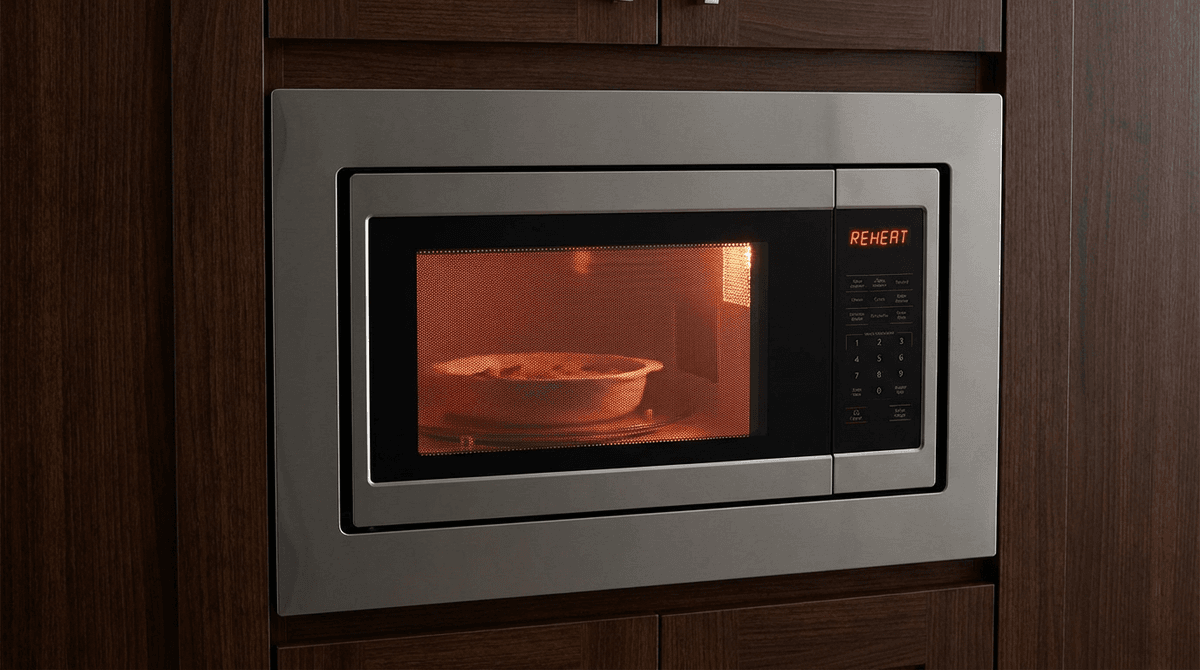
Most microwaves draw about 900 to 1,600 watts while heating, but because use time is short, many homes only use around 0.1 to 0.5 kWh/day.
For full system planning, use the WattSizing Calculator.
Quick Answer
Most microwaves draw about 900 to 1,600 watts while heating, but because use time is short, many homes only use around 0.1 to 0.5 kWh/day.
Detailed Explanation
Microwave labels can be confusing because they often show cooking output power (for example, 1,000 W), while wall draw is higher due to conversion losses. For battery and inverter planning, use input watts, not cooking output watts.
Unlike compressor loads, microwaves do not usually have a big motor-start surge, but they can be a high short-duration load. That matters if several kitchen devices run at the same time.
Watt Table
| Microwave Type / Size | Typical Running Watts (Input) | Typical Starting Watts | Typical Daily Energy |
|---|---|---|---|
| Compact (0.7-0.9 cu ft) | 900 - 1200 W | 900 - 1300 W | 0.08 - 0.25 kWh/day |
| Mid-size (1.0-1.3 cu ft) | 1100 - 1400 W | 1100 - 1500 W | 0.12 - 0.35 kWh/day |
| Large/family size | 1300 - 1700 W | 1300 - 1800 W | 0.18 - 0.50 kWh/day |
| Convection microwave combo | 1400 - 2000 W | 1400 - 2200 W | 0.20 - 0.80 kWh/day |
Calculation Example
Example: A microwave draws 1,350 W and is used 18 minutes/day total.
- Run time in hours: 18 / 60 = 0.30 h
- kWh/day = (1,350 x 0.30) / 1000 = 0.41 kWh/day
- At $0.16/kWh, monthly cost is about $1.97
For broader kitchen load planning, see How Many Watts Does a Refrigerator Use and How Many Watts Does a Chest Freezer Use.
Tips to Reduce Power Usage
- Heat food in shorter bursts and stir between cycles for better efficiency.
- Use the right container size so energy goes into food, not extra dish mass.
- For very small portions, compare microwave time versus toaster oven preheat overhead.
- Avoid long "standby clock" vampire loads by unplugging rarely used secondary units.
FAQs
Why is microwave kWh/day usually low even with high watts?
Because it runs for minutes, not hours. Short run time keeps daily energy relatively small.
Does a microwave need large inverter surge margin?
Usually less than motor appliances, but the inverter must handle full input watts plus other simultaneous kitchen loads.
Should I use output watts or input watts for energy math?
Use input watts from the appliance label or plug-in meter for accurate kWh/day calculations.
CTA
Ready to size your setup accurately? Use the WattSizing Calculator to estimate panel, battery, and inverter requirements from your real appliance loads.


