
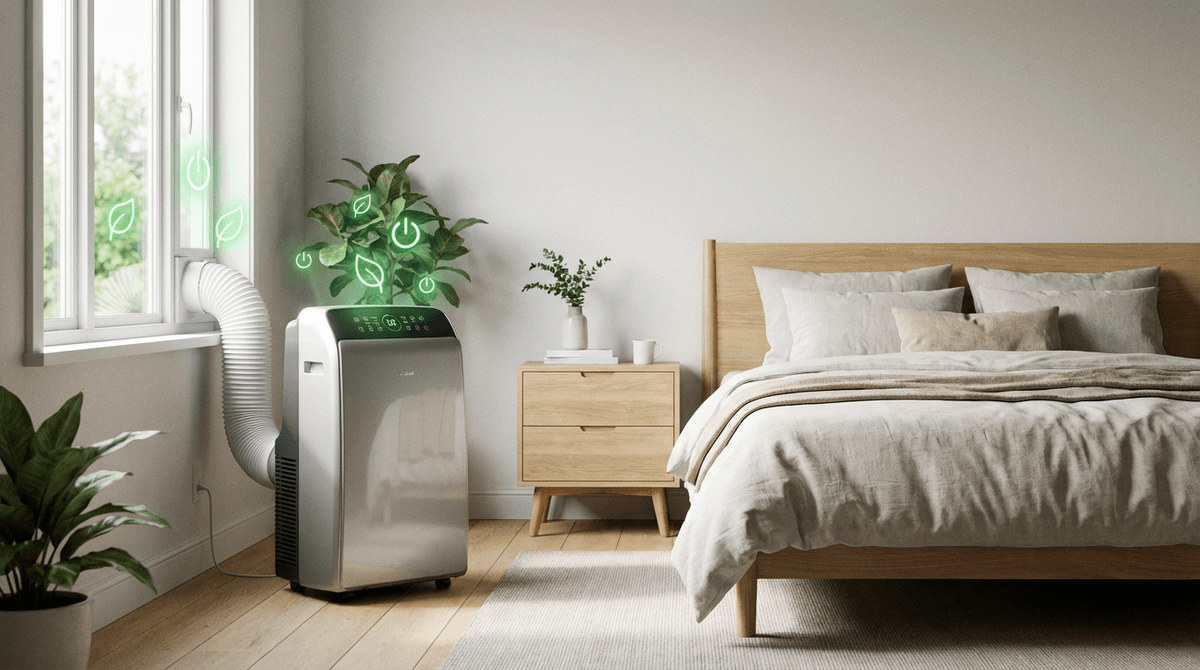
During rainy months, cooling load can shift from temperature control to moisture removal, especially in closed rooms.
For full system planning, use the WattSizing Calculator.
Quick Answer
In rainy season, portable AC units commonly run around 950 to 1,700 W and often consume 3 to 9 kWh/day depending on humidity.
Detailed Explanation
Even when temperatures are moderate, high indoor humidity can reduce comfort and keep compressor cycles active. Units with effective drainage and clean filters generally perform better in this context.
For moisture-related comparison, check How Many Watts Does a Dehumidifier Use Per Day and How Many Watts Does a Portable Air Conditioner Use.
Watt Table
| Rainy-Season Context | Typical Running Watts | Typical Daily Energy |
|---|---|---|
| Light humidity days | 950 - 1,200 W | 3 - 5 kWh/day |
| Typical humid conditions | 1,100 - 1,450 W | 4.5 - 7 kWh/day |
| Heavy humidity periods | 1,300 - 1,700 W | 6.5 - 9 kWh/day |
Calculation Example
If the unit averages 1,250 W for 4.5 hours/day:
kWh/day = (1,250 x 4.5) / 1000 = 5.6 kWh/day
Tips
- Keep drain lines clear to avoid efficiency loss.
- Use dry mode when humidity is the main discomfort source.
- Improve airflow around the intake and condenser areas.
- Seal window kit openings against moist outdoor air.
FAQs
Why can AC run often even when it feels cooler outside?
Humidity removal still requires compressor energy.
Is dry mode always lower power than cool mode?
Often, but behavior varies by model and control logic.
Should I pair with a standalone dehumidifier?
Sometimes helpful for targeted moisture control and better comfort.
CTA
Use the WattSizing Calculator to estimate rainy-season cooling and humidity energy impact before buying backup equipment.


