
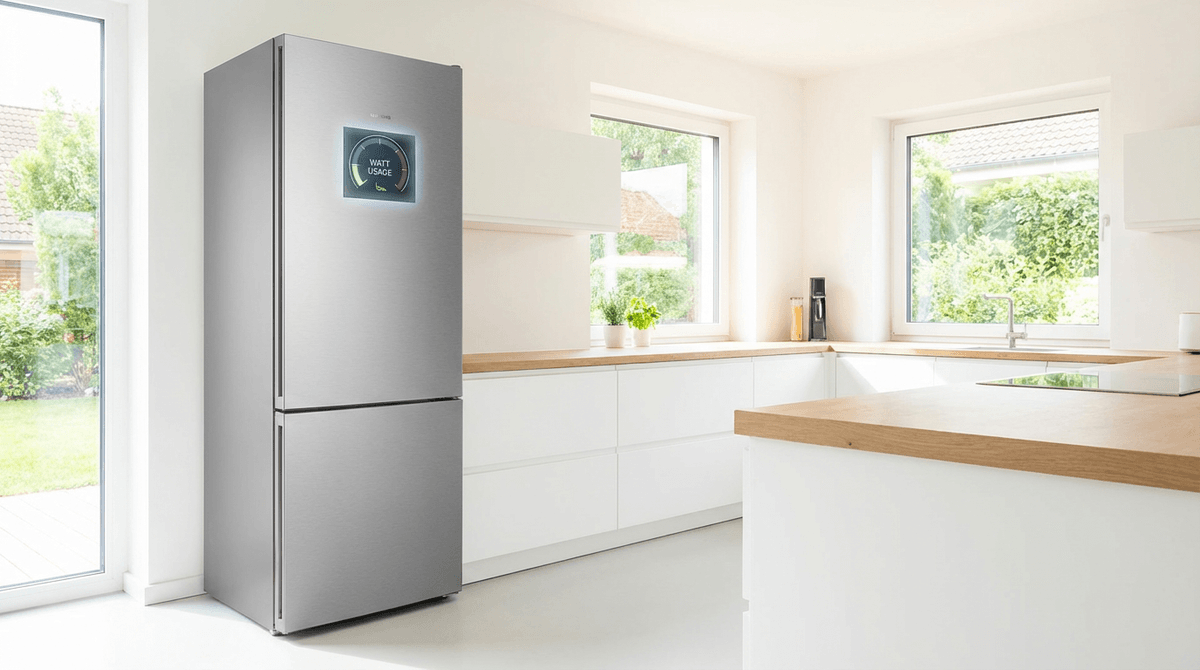
Refrigerators are usually priority loads during outages because food safety depends on maintaining stable internal temperatures.
For full system planning, use the WattSizing Calculator.
Quick Answer
On backup power, refrigerators typically run around 100 to 250 W with startup surges, and most use roughly 1 to 3 kWh/day.
Detailed Explanation
Backup design should handle compressor startup and allow for repeated cycling over long outages. Batteries, generators, or hybrid systems can all work, but each needs a realistic duty-cycle-based energy estimate.
For supporting methods, see What Size Generator for Refrigerator and How to Calculate Battery Runtime for Appliances.
Watt Table
| Backup Scenario | Typical Running Watts | Typical Daily Energy |
|---|---|---|
| Efficient newer unit | 100 - 150 W | 1.0 - 1.6 kWh/day |
| Standard family unit | 130 - 210 W | 1.4 - 2.2 kWh/day |
| Older/high-load unit | 180 - 250 W | 2.0 - 3.0 kWh/day |
Calculation Example
If average refrigerator draw is 145 W across 24 hours:
kWh/day = (145 x 24) / 1000 = 3.5 kWh/day (continuous equivalent)
Use measured duty-cycle data for a more realistic outage runtime estimate.
Tips
- Keep doors closed during outages to preserve cold mass.
- Pre-chill contents before forecasted severe weather.
- Use dedicated circuit and stable extension practices.
- Test backup startup behavior before emergency events.
FAQs
Can a small inverter power a refrigerator?
Often yes, if startup surge and continuous rating both have margin.
Is generator cycling better than continuous running?
Sometimes, depending on battery buffering and fuel strategy.
How long can food stay safe without power?
It depends on door opening and insulation; follow food safety guidance.
CTA
Use the WattSizing Calculator to estimate refrigerator outage runtime and choose a reliable backup strategy.


