
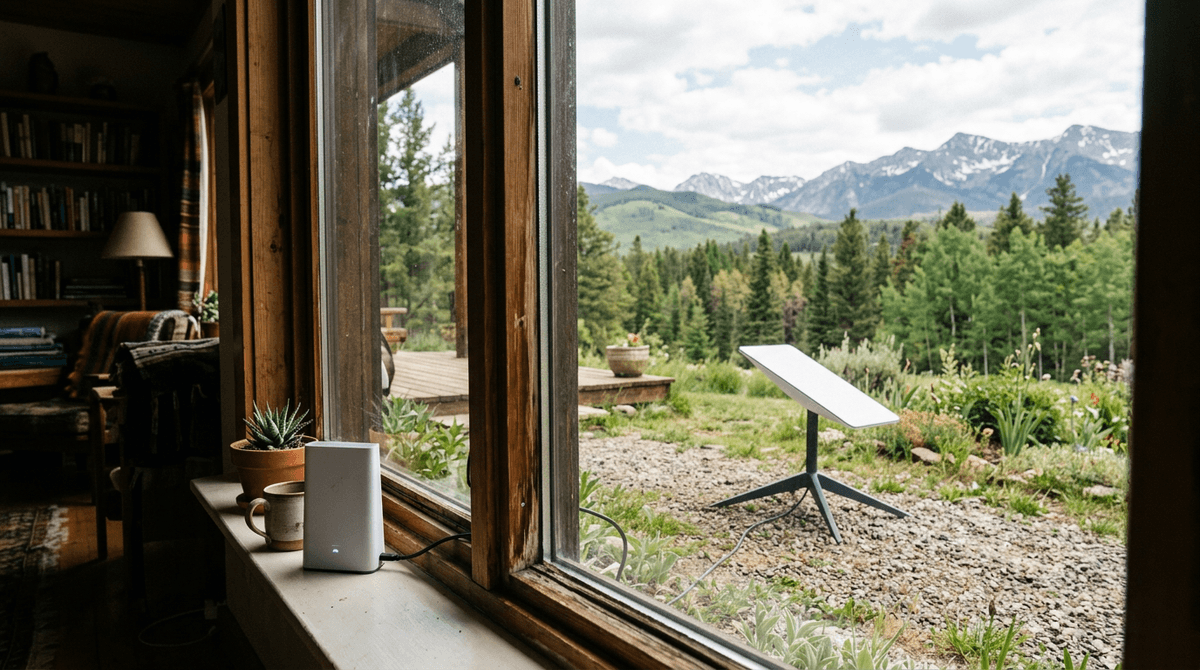
A Starlink setup often uses around 1.0 to 2.4 kWh/day in normal conditions, and can rise to 2.4 to 4.3 kWh/day during colder periods with higher heating demand.
For full system planning, use the WattSizing Calculator.
Quick Answer
If your Starlink system averages 70 W over 24 hours:
- kWh/day = (70 x 24) / 1000 = 1.68 kWh/day
At $0.16/kWh, that is about $0.27/day or $8.06/month.
Detailed Explanation
Starlink is a continuous load, so daily energy is mostly average watts multiplied by 24 hours. The challenge is that average watts can shift a lot with environment and usage patterns.
Common reasons kWh/day changes:
- Cold weather operation can raise average draw significantly
- Peak evening traffic and streaming-heavy homes can push averages up
- Extra networking gear (mesh, switches) adds constant watts
For a complete household energy picture, compare this with How Many Watts Does a Router Use Per Day and How Many Watts Does a Refrigerator Use Per Day.
Watt Table
| Starlink Daily Scenario | Typical Running Watts | Typical Starting Watts | Typical Daily Energy |
|---|---|---|---|
| Mild weather, light-to-mixed traffic | 40 - 65 W | 50 - 80 W | 0.96 - 1.56 kWh/day |
| Typical mixed daily usage | 50 - 90 W | 60 - 110 W | 1.20 - 2.16 kWh/day |
| Heavy daily internet activity | 70 - 110 W | 80 - 130 W | 1.68 - 2.64 kWh/day |
| Cold weather with frequent heating | 100 - 180 W | 120 - 220 W | 2.40 - 4.32 kWh/day |
| Starlink + extra mesh node | 60 - 120 W | 75 - 145 W | 1.44 - 2.88 kWh/day |
Calculation Example
Example day:
- Daytime mixed traffic (16 hours) at 65 W
- Evening streaming and uploads (8 hours) at 95 W
Compute kWh/day:
- (65 x 16 / 1000 = 1.04 kWh/day)
- (95 x 8 / 1000 = 0.76 kWh/day)
- Total = 1.80 kWh/day
Cost at $0.16/kWh:
- Daily cost: (1.80 x 0.16 = $0.29/day)
- Monthly cost (30 days): about $8.64
If you run additional home office loads nearby, compare with How Many Watts Does a Laptop Use Per Day and How Many Watts Does a Television Use Per Day.
Tips to Reduce Power Usage
- Monitor average watts by season so your estimates are realistic year-round.
- Reduce unnecessary add-on network gear if you are power-constrained.
- For off-grid systems, size around winter peaks, not mild-weather averages.
- Use quality cabling and proper placement to avoid avoidable retransmissions and extra load.
FAQs
Why is Starlink kWh/day higher than a cable router setup?
The dish system plus its networking hardware generally draws more continuous power than basic cable/DSL gear.
Can I use a single "average watts" number all year?
It is better to use seasonal averages, especially in climates where cold-weather operation is common.
Is startup wattage important for daily cost estimates?
Usually less important than long-run average watts. Daily kWh is dominated by sustained 24/7 operation.
CTA
Want a realistic daily and seasonal estimate for your internet setup? Use the WattSizing Calculator to model Starlink, networking gear, and the rest of your home loads together.


