
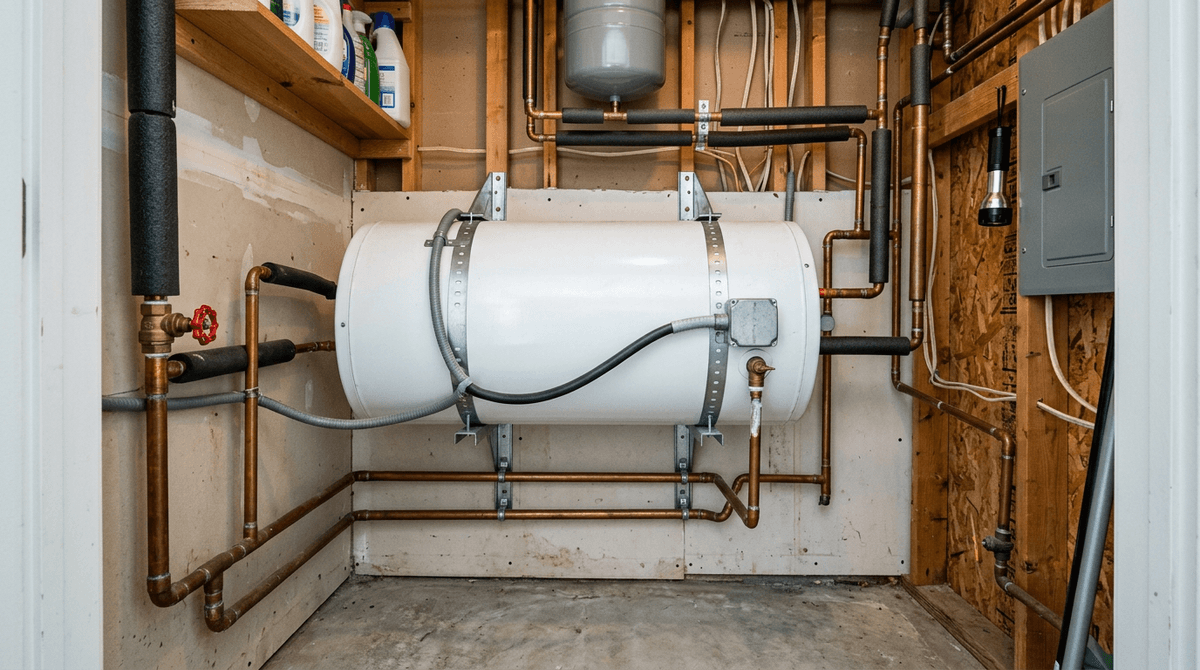
Electric water heaters commonly use about 3,000 to 5,500 watts per heating element, while whole-home electric tankless units can require 12,000 to 36,000+ watts.
For full system planning, use the WattSizing Calculator.
Quick Answer
Electric water heaters commonly use about 3,000 to 5,500 watts per heating element, while whole-home electric tankless units can require 12,000 to 36,000+ watts.
Detailed Explanation
Water heater power depends heavily on type. A storage-tank unit cycles on and off and often runs one element at a time, while a tankless unit can pull very high power instantly when hot water is demanded.
Because of these high loads, water heaters are usually one of the biggest electrical draws in a home. For off-grid or backup design, they often drive inverter and battery sizing decisions.
Watt Table
| Device Size / Type | Typical Running Watts | Typical Starting Watts |
|---|---|---|
| Small point-of-use tank (120V) | 1200 - 2000 W | 1200 - 2100 W |
| Standard tank (240V, 30-50 gal) | 3000 - 4500 W | 3000 - 4700 W |
| Large tank (240V, 60-80 gal) | 4500 - 5500 W | 4500 - 5800 W |
| Electric tankless (single point) | 3000 - 9000 W | 3000 - 9200 W |
| Whole-home electric tankless | 12000 - 36000+ W | 12000 - 36500+ W |
Calculation Example
Example: A 4,500 W tank water heater runs about 2.5 hours total per day.
- kWh/day = (4,500 x 2.5) / 1000 = 11.25 kWh/day
- At $0.16/kWh, monthly cost is about $54.00
For full load planning, pair this with How Many Watts Does a Central Air Conditioner Use and How Many Watts Does a Refrigerator Use.
Tips to Reduce Power Usage
- Lower tank setpoint slightly while keeping safe hot-water temperatures.
- Insulate exposed hot-water pipes to reduce standby losses.
- Use low-flow showerheads to reduce hot-water demand.
- Schedule heavy hot-water tasks outside peak utility pricing windows.
FAQs
Does an electric water heater have startup surge?
Usually not like a compressor motor. It is mostly a resistive load, so draw is high but predictable.
Can I run a water heater on an inverter?
Small point-of-use units may be possible, but full-size tank and tankless units often exceed practical inverter/battery limits.
What should I use for sizing: watts or kWh/day?
Use both. Watts size your inverter and wiring, while kWh/day sizes your battery and solar generation.
CTA
Ready to size your setup accurately? Use the WattSizing Calculator to estimate panel, battery, and inverter requirements from your real appliance loads.


