
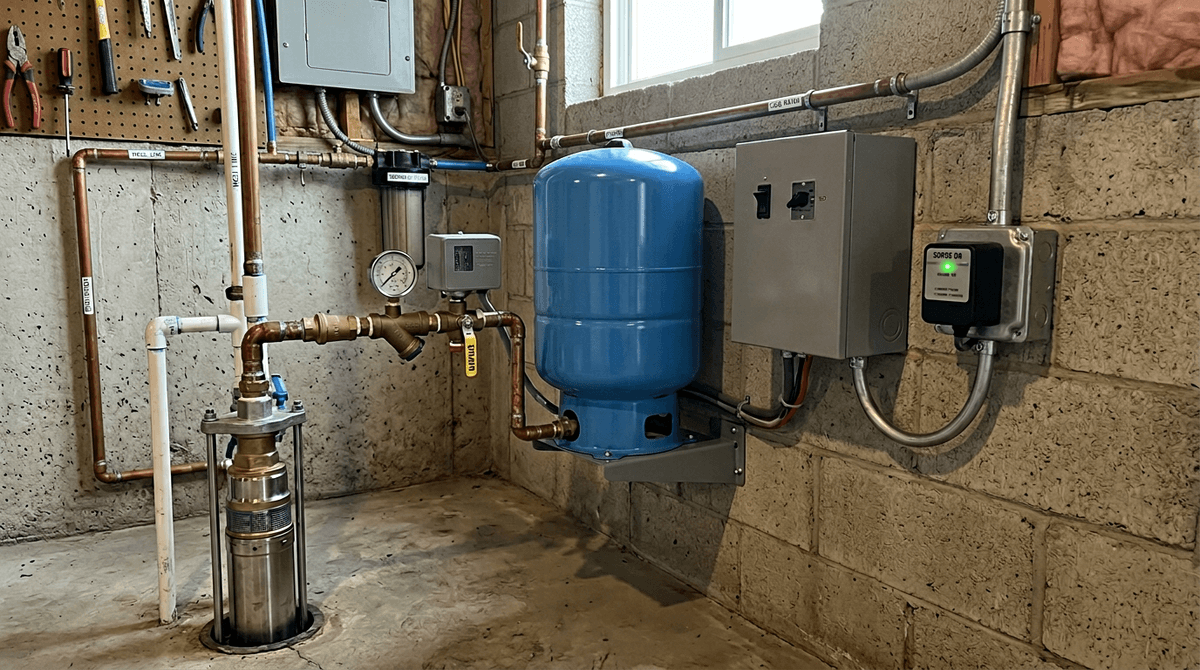
Off-grid well pumps are often one of the toughest loads because startup surge is high even when average daily energy looks manageable.
For full system planning, use the WattSizing Calculator.
Quick Answer
Most systems need 700 to 2,000 running watts and 1,400 to 4,200+ startup watts depending on horsepower, depth, and wiring conditions.
Off-Grid Design Notes
Battery kWh handles runtime. Inverter surge capability handles startup. If either side is undersized, pump reliability suffers during critical water needs.
Typical Off-Grid Ranges
| Pump Size | Running Watts | Starting Watts | Typical kWh/day |
|---|---|---|---|
| 1/2 HP | 700 - 1,100 W | 1,400 - 2,500 W | 1.4 - 3.5 |
| 3/4 HP | 900 - 1,500 W | 1,800 - 3,200 W | 2.0 - 4.6 |
| 1 HP | 1,200 - 2,000 W | 2,400 - 4,200 W | 2.7 - 5.8 |
Practical Example
If a pump uses 3.0 kWh/day and your inverter is 90% efficient, DC-side battery demand is higher than 3.0 kWh/day.
Related: How to Convert HP to Watts for Motors.
FAQs
Why does off-grid well pumping fail on small inverters?
Because motor startup current can exceed inverter surge capacity.
Can I run pump and other large loads together?
Usually better to stagger heavy loads.
Is a pressure tank important off-grid?
Yes, it reduces frequent short cycling and saves energy.
CTA
Ready to size your setup accurately? Use the WattSizing Calculator to estimate panel, battery, and inverter requirements from your real appliance loads.


