
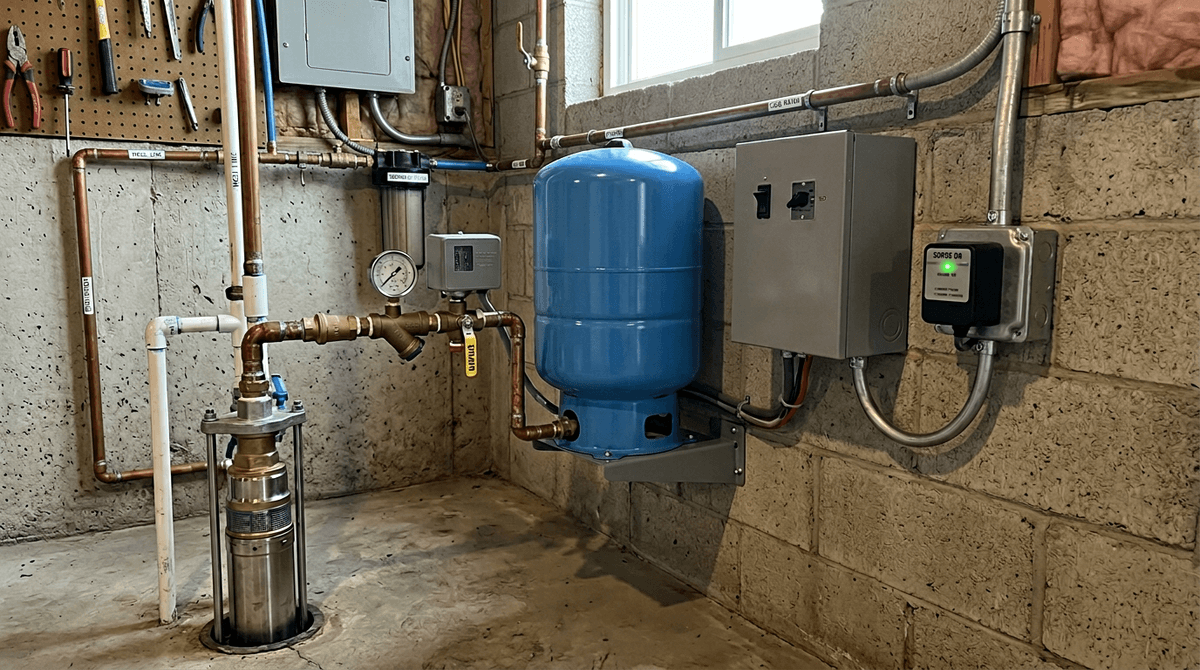
In tiny houses, well pumps are often among the largest surge loads, so inverter selection should be done carefully.
For full system planning, use the WattSizing Calculator.
Quick Answer
Plan around 700 to 2,000 running watts and 1,400 to 4,200+ startup watts depending on pump horsepower and installation.
Tiny-House Considerations
A compact system can support a well pump reliably, but only with enough surge headroom and realistic daily run-time assumptions.
Typical Ranges
| Pump Size | Running Watts | Starting Watts | Typical Tiny-House kWh/day |
|---|---|---|---|
| 1/2 HP | 700 - 1,100 W | 1,400 - 2,500 W | 1.0 - 2.8 |
| 3/4 HP | 900 - 1,500 W | 1,800 - 3,200 W | 1.4 - 3.5 |
| 1 HP | 1,200 - 2,000 W | 2,400 - 4,200 W | 1.8 - 4.3 |
Practical Example
At 1,100 W for 1.6 hours/day:
- Daily energy = 1.76 kWh/day
Related guide: How to Calculate Surge Watts for Motor Loads.
FAQs
Is a pressure tank helpful in tiny homes?
Yes, it reduces short cycling and pump starts.
Do I need a soft starter?
In some systems it can improve startup behavior.
Can battery-only setups run a 1 HP pump?
Possible with proper inverter surge capability and battery sizing.
CTA
Ready to size your setup accurately? Use the WattSizing Calculator to estimate panel, battery, and inverter requirements from your real appliance loads.


