
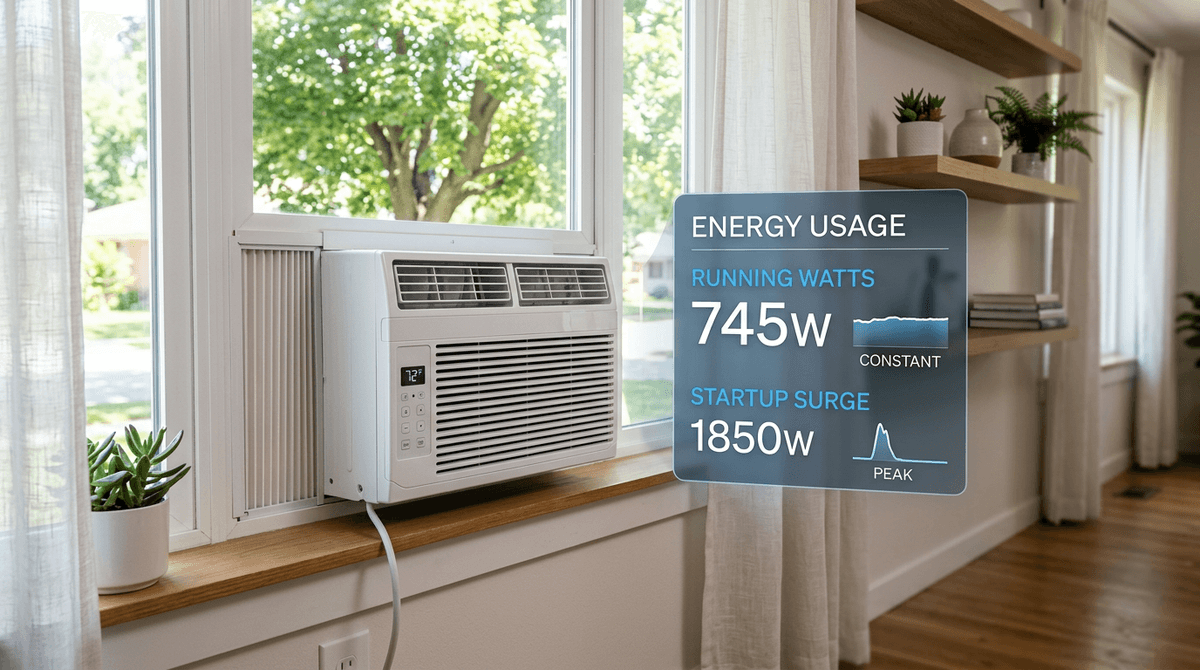
Peak-hour usage is often the most expensive part of cooling even when watts are unchanged.
For full system planning, use the WattSizing Calculator.
Quick Answer
Window AC peak-hour draw is usually 800-1,600 W, with high duty cycle and higher tariff rates making this the costliest period.
Detailed Explanation
In late afternoon, both outdoor temperature and utility rates may be high. Same appliance wattage can cost 1.5x-3x more under time-of-use plans.
Learn cost conversion in How to Calculate Electricity Bill from kWh and compare cooling options in Portable AC vs Window AC Energy Use.
Watt Table
| Peak Condition | Running Watts | Typical Peak kWh (4h window) |
|---|---|---|
| Moderate peak | 800 - 1,050 W | 2.5 - 3.8 |
| Hot peak | 1,000 - 1,350 W | 3.2 - 4.8 |
| Extreme heat peak | 1,300 - 1,600 W | 4.2 - 5.8 |
Calculation Example
1,200 W x 4 peak hours = 4.8 kWh. At $0.28/kWh peak rate, cost is $1.34 for that window.
Tips
- Pre-cool before peak tariff starts.
- Raise setpoint by 1C during peak window.
- Close blinds to reduce radiant heat.
- Shift non-cooling loads outside peak hours.
FAQs
Do peak hours change watt draw directly?
Usually no; they change cost per kWh.
Why does runtime rise during peak?
Outdoor heat and indoor gains are highest then.
Can battery arbitrage reduce AC cost?
Yes, if battery is charged off-peak or solar.
CTA
Plan TOU-friendly cooling with the WattSizing Calculator.


