
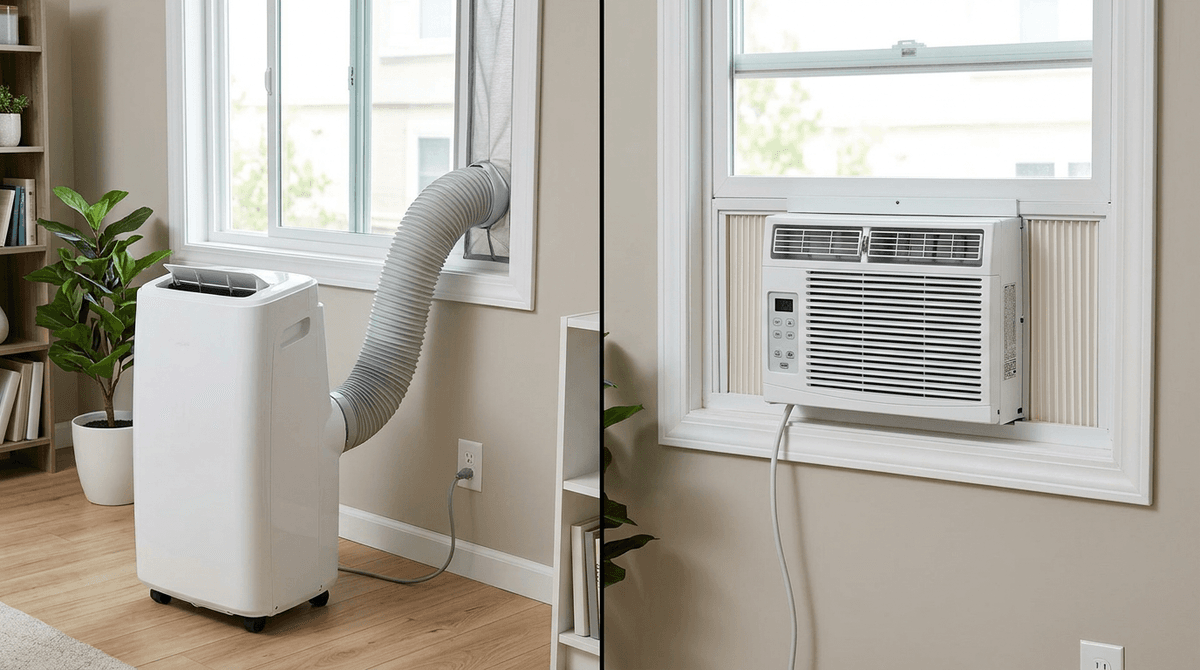
In the same bedroom, a window AC usually beats a single-hose portable on daily kWh—often 15% to 35% less at similar BTU—because heat leaves through the window opening instead of pulling conditioned air out via one hose. Dual-hose portables narrow the gap but rarely beat a sealed window unit on efficiency alone.
Match CEER at the same BTU, then meter kWh at the wall. Bands below are illustrative (May 2026); your install wins.
Use the WattSizing Calculator for rates and hours. Related: portable AC wattage, window AC wattage, window AC vs mini split power.
Scope: room AC only, matched BTU and runtime
120 V room units only—portable vs window—not central, mini-split, or ventless coolers. Match room, sealing, setpoint, and hours; mismatched BTU invalidates the comparison.
BTU class to running watts (and why CEER matters)
BTU is capacity; watts are what you pay for. CEER (Combined Energy Efficiency Ratio) and EER report BTU cooling per watt under lab tests—higher is better at the same BTU. New U.S. room AC labels often show CEER, which includes standby draw.
At similar CEER, window units usually sit lower in the running-watt band:
| BTU (approx. room) | Window AC running W | Portable AC running W |
|---|---|---|
| 8,000 (~250 sq ft) | 650–800 | 800–1,100 |
| 10,000 (~350 sq ft) | 850–1,100 | 900–1,300 |
| 12,000 (~450 sq ft) | 1,000–1,300 | 1,100–1,500 |
A 12 CEER model draws roughly half the wall power of a 6 CEER model at the same BTU—in theory. Leaky installs and oversizing erase label gaps. Portable CEER is often lower than window at equal BTU because of hose heat and infiltration (next section).
Single-hose vs dual-hose: the penalty guides underplay
Single-hose portables exhaust heat through one duct and pull a slight vacuum indoors, so warm outside air enters through gaps—the compressor runs longer for the same °F. Dual-hose units intake condenser air from outside and cut most of that “vacuum the room” effect; expect roughly 10% to 25% lower daily kWh than a single-hose unit in the same leaky room, not a universal rule.
Window units put the condenser outside the envelope. That is why they often win kWh per degree when the opening is legal and sealed.
Worked kWh: one 12,000 BTU bedroom, 8 summer hours
350 sq ft room, 85 °F outside, 72 °F setpoint, compressor “on” about 70–85% of 8 hours (varies by unit and infiltration):
| Type | Illustrative average W over 8 h | kWh that day |
|---|---|---|
| Window, CEER ~12 | ~805 W | 6.4 |
| Dual-hose portable, CEER ~9 | ~1,010 W | 8.1 |
| Single-hose portable, CEER ~8 | ~1,190 W | 9.5 |
kWh ≈ (average W × hours) ÷ 1000. At $0.16/kWh, that day costs about $1.02 vs $1.30 vs $1.52; ×30 days ≈ $31 vs $39 vs $46/month—illustrative only. Log a hot weekend on a plug-in meter for your home.
Generator sizing: surge on both, not just running watts
Both types spike ~1.5× to 2.5× running watts when the compressor starts. Outage stacks often pair AC with a fridge—surges can overlap.
Illustrative 12,000 BTU class + fridge + lights:
- Window: ~1,100 W run / ~2,800 W surge
- Portable: ~1,350 W run / ~3,000 W surge
- Fridge: ~180 W run / ~1,200 W surge; lights/router ~120 W
Worst-case peak ≈ 4,100–4,300 W before margin; add ~20% → ~5,000 W generator or inverter class is a common bracket. Portable does not mean smaller surge—see Generator Running Watts vs Starting Watts Explained.
When portable wins vs when window wins
Portable fits renters, no-drill rules, sliding doors, or moving cooling between rooms. Window fits owners who want lower seasonal kWh, can seal the sash, and run many hours daily—the gap compounds on the bill. Long-term owners comparing upgrades should also read window AC vs mini split power.
What most guides skip
- CEER without matching BTU is not a fair fight.
- Long, kinked hoses add heat; keep runs short per the manual.
- Ventless “AC” is not refrigerative cooling—do not compare its kWh to either type here.
- Oversized window units that short-cycle can waste kWh too; right-size the room.
Checklist
- Size BTU to the room; do not oversize without cause.
- At that BTU, pick higher CEER; if portable, prefer dual-hose.
- Seal panels and track infiltration on a windy day.
- Meter one hot day: kWh ÷ hours ≈ average watts.
- Size backup for AC + fridge surge, not running watts alone.
- Plug results into the WattSizing Calculator.
FAQs
Is window AC always cheaper to run than portable?
Usually yes at the same BTU and hours, especially vs single-hose portables. Dual-hose and a sloppy window install can narrow the gap—meter if it is close.
How much extra power does single-hose use?
Depends on leaks; 10% to 30%+ more kWh than dual-hose or window in the same room is common in many apartments. There is no single national percentage.
Does higher CEER shrink my generator?
Not for surge. CEER cuts average kWh; compressor start still needs headroom like lower-CEER units at the same BTU.
Same 10,000 BTU—same electricity?
Same cooling class, different draw. Portables often pull more average watts at equal BTU because of hoses and infiltration. Match labels, then meter.
Can renters still save with window units?
Only if the lease allows a proper install; many accept higher kWh on a portable to avoid permanent changes.
Mini split vs this comparison?
For heavy daily use in a home you control, a mini split may beat both on kWh with higher upfront cost—see .
Monthly cost formula?
Cost ≈ kWh/day × days × $/kWh. Example: 8.1 kWh/day × 30 × $0.16 ≈ $39/month (dual-hose row above).
Conclusion
Window AC usually wins kWh when installation is allowed; portable AC wins flexibility, with dual-hose clearly ahead of single-hose among portables. Either type needs surge-aware backup sizing.
Next step: meter one hot day, then enter kWh in the WattSizing Calculator before buying hardware.


