
When a massive summer heatwave knocks out the electrical grid, your 4-ton Central Air Conditioner becomes completely useless unless you own a $15,000 whole-home standby generator.
This is where the humble Window Air Conditioner shines. Because they are designed to cool a single room, window units require significantly less power than central AC systems. A small window AC can run effortlessly on a cheap, portable generator, providing a "cool room" for your family to sleep in during an extended blackout.
However, just like their larger cousins, window ACs use compressors. This means they have a hidden startup surge that can easily trip a generator if you aren't prepared.
In this comprehensive guide, we will break down exactly how many watts different sizes of window ACs use (by BTU), explain how to calculate their daily energy impact, and show you exactly what size generator you need to survive a summer power outage.
To model your specific window AC alongside your refrigerator, use our free WattSizing Off-Grid Calculator.
The Quick Answer: Window AC Power Draw
Window air conditioners plug into standard 120-Volt wall outlets (though massive 15,000+ BTU units sometimes require 240V).
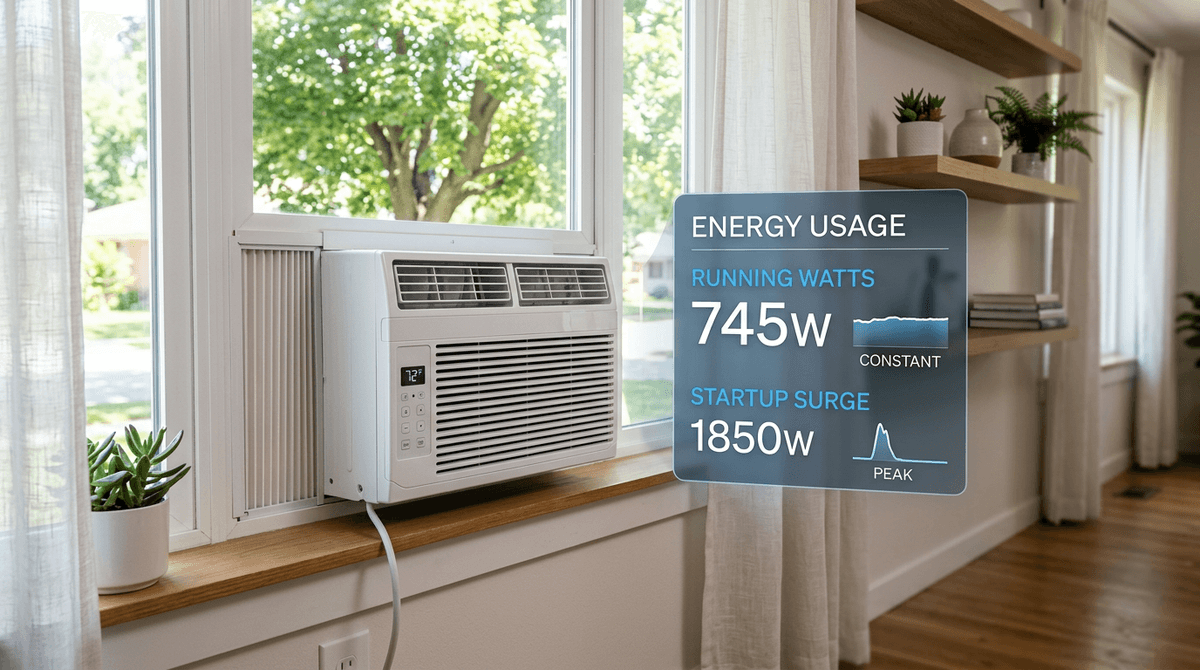
- Average Running Watts: A typical bedroom-sized window AC (5,000 to 8,000 BTUs) uses 450 to 750 running watts while the compressor is actively cooling.
- Starting (Surge) Watts: When the compressor first kicks on, it requires a massive spike of electricity to overcome inertia. This surge is usually 1,000 to 2,000 watts for a fraction of a second.
Why is the Startup Surge So Important?
If you plug a 500W window AC into a small 1,000W portable generator, you might assume it will work perfectly. But the moment the AC's compressor attempts its 1,500W startup surge, it will overload the generator's alternator and stall the engine. You must always size your generator for the surge, not the running watts.
Window AC Wattage by BTU Size
Air conditioners are sized by BTUs (British Thermal Units). The higher the BTU rating, the larger the room it can cool, and the more electricity it consumes.
Here is a realistic look at what different sizes of window ACs pull from your electrical panel or generator:
| AC Size (BTUs) | Room Size (Sq. Ft.) | Typical Running Watts | Typical Starting (Surge) Watts |
|---|---|---|---|
| 5,000 BTU | 100 - 150 sq ft | 400 - 500 W | 1,000 - 1,200 W |
| 8,000 BTU | 250 - 350 sq ft | 650 - 800 W | 1,500 - 2,000 W |
| 10,000 BTU | 350 - 450 sq ft | 850 - 1,100 W | 2,000 - 3,000 W |
| 12,000 BTU | 450 - 550 sq ft | 1,000 - 1,300 W | 2,500 - 3,500 W |
| 15,000 BTU | 550 - 700 sq ft | 1,300 - 1,800 W | 3,500 - 4,800 W |
Note: The exact wattage depends on the unit's CEER (Combined Energy Efficiency Ratio) rating. A brand new ENERGY STAR unit will pull 10% to 20% less power than a 15-year-old unit of the same BTU size.
What Size Generator Do I Need for a Window AC?
Window air conditioners are the perfect match for portable inverter generators. They allow you to create a localized "cooling bunker" in your master bedroom without burning through massive amounts of gasoline.
Generator Sizing Guidelines
- For a 5,000 BTU Unit: A small 2,000W Inverter Generator is the perfect size. It will handle the 1,200W compressor surge effortlessly and still have 800W left over to run a television and lights.
- For an 8,000 BTU Unit + Refrigerator: Aim for a 3,500W to 4,000W Generator. This provides enough headroom so that the AC compressor and the refrigerator compressor can both cycle on simultaneously without stalling the engine.
- For a 12,000 BTU Unit + Kitchen Essentials: You need a 4,500W to 5,500W Generator.
Worked Generator Example
You suffer a power outage in August. You want to run an 8,000 BTU window AC in your bedroom and keep your kitchen fridge cold.
- 8,000 BTU Window AC (Running: 700W / Surge: 1,800W)
- Refrigerator (Running: 200W / Surge: 1,200W)
The Math:
You must assume the worst-case scenario: The fridge compressor surges exactly when the AC compressor surges.
1,800W (AC Surge) + 1,200W (Fridge Surge) = 3,000W Peak Load.
Add a 20% safety margin so the generator engine doesn't bog down heavily: 3,000W × 1.2 = 3,600W.
Recommendation: A 3,500W to 4,000W portable generator will safely power your cooling and refrigeration needs.
Off-Grid Solar: Can You Run a Window AC on Batteries?
Yes, but it requires a significantly larger battery bank than you might expect.
Because window ACs use traditional "on/off" compressors (rather than the hyper-efficient variable-speed inverter compressors found in Mini Splits), they are not ideal for 24/7 off-grid living. However, they are often used in RVs and campervans for short bursts of cooling.
Calculating Daily Watt-Hours (Wh):
Formula: (Running Watts × Hours Run × Duty Cycle) ÷ 1,000 = Daily kWh
Let's assume you run a 5,000 BTU AC (450W) in your RV overnight for 8 hours. Because the AC cycles on and off as it reaches temperature, we will assume a 50% duty cycle (it is actively cooling for 4 hours total).
450W × 4 Hours = 1,800 Wh (1.8 kWh) per night.
Sizing the Battery Bank
To safely provide 1.8 kWh of energy overnight, you would need two 12V 100Ah Lithium LiFePO4 batteries (which hold roughly 2.5 kWh of total energy). If you try to do this on lead-acid marine batteries, the heavy discharge will drain them below 50% rapidly, destroying their lifespan.
Sizing the Solar Inverter
Even though the running wattage is only 450W, your inverter must handle the 1,200W compressor surge. You must install a 2,000W Pure Sine Wave Inverter.
4 Tips to Reduce Your AC's Power Consumption
- Use "Eco" or "Energy Saver" Mode: In standard cooling mode, the AC's internal fan runs 24/7, even when the compressor turns off. By switching to "Eco Mode," the fan turns completely off when the target temperature is reached, saving hundreds of watts of electricity over the course of a day.
- Clean the Filter Every Month: A window AC breathes through the front grill. If the thin mesh filter is clogged with dust and pet hair, the fan has to work twice as hard to pull air, reducing cooling capacity and increasing power draw. Rinse it in the sink every 30 days.
- Shade the Unit Outside: If the back of the window unit is baking in direct 2:00 PM sunlight, the condenser coils struggle to reject heat into the hot air. Providing shade (like a simple awning) over the outside of the unit can improve efficiency by up to 10%.
- Seal the Window Gaps: The accordion-style side panels that come with window ACs have virtually zero insulation value. Buy a roll of foam weatherstripping and seal every gap around the unit to prevent your expensive cold air from leaking back outside.
Frequently Asked Questions
Will a 2,000W generator run a 10,000 BTU Window AC?
Probably not. A 10,000 BTU unit typically requires a massive 2,500W to 3,000W surge to start the compressor. While a high-quality 2,000W inverter generator might barely start it on a cool day, it will likely trip the overload sensor on a hot day. Upgrade to a 3,000W+ generator.
Are newer "Inverter Window ACs" better for generators?
Yes! Brands like Midea and LG now make "Inverter Window ACs" (often shaped like a U). Instead of slamming on at 100% power and causing a massive surge, the compressor ramps up its speed slowly. These units have almost zero startup surge, making them the absolute best choice for small generators and solar systems.
Can I plug a window AC into an extension cord?
It is not recommended. If you absolutely must, use a heavy-duty, short "Appliance Extension Cord" (12-gauge or 14-gauge wire). Using a cheap, thin indoor extension cord will cause a voltage drop that can overheat the cord and burn out the AC's compressor.
Conclusion
A window air conditioner is the ultimate emergency cooling tool. By understanding the hidden startup surge of the compressor and sizing your portable generator accordingly, you can create a safe, cool sanctuary in your home during the most brutal summer blackouts.
Want to accurately size a generator for your emergency cooling? Use our free Off-Grid & Backup Load Calculator to enter your exact window AC BTU rating, add your refrigerator, and get a precise generator sizing recommendation instantly.


